Independent research · Austin
A table of 124,693 degree-24 fields, built on 18 August 2026. Each record separately reports the group-label evidence, polynomial reduction, discriminant calculation and maximal-order status.
For the complete downloads and board data, see the data page. Use the lookup below to inspect an individual cell.
124,693 degree-24 fields
Table built 18 August 2026, 10:08 UTC
124,693 rows over 20,882 of the 25,000 transitive groups of degree 24, covering 78,703 distinct cells, where a cell is a group together with a number of real roots. Every row is an irreducible degree-24 polynomial, and 124,242 of them are in canonical polredabs form, so they match against any other table without further work. Each row states on four separate axes how far it has been certified rather than asserting a single verdict.
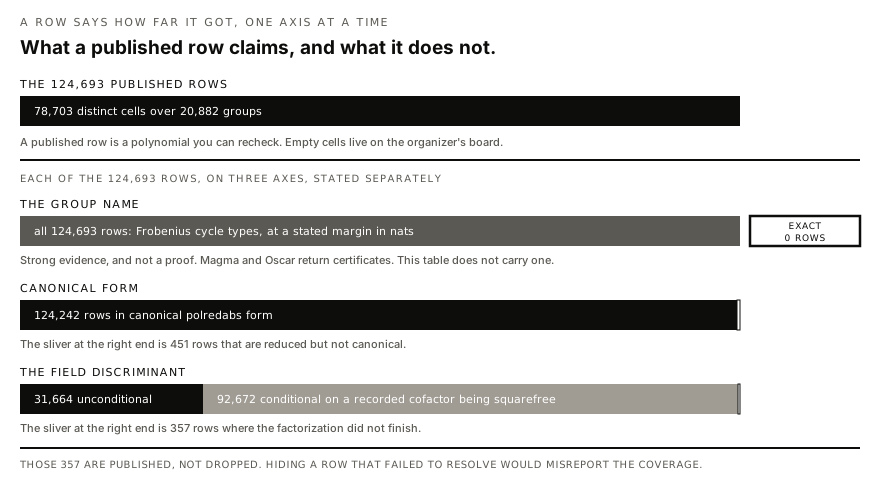
Drawn to scale, so the two slivers are as small as they are. A single verdict per row would have to report the weakest axis and would hide the other three.
We recomputed group labels from the polynomial coefficients before publication. Where the bank’s existing label disagreed with that reread, the published table uses the reread. The margin records the statistical evidence for the label; it is not an exact Galois-group certificate.
Download
fields.jsonl.gz is the whole table. The browsable copy is a hundred groups per file, one best-certified witness per cell, indexed by by-group/index.json. summary.json holds the counts, and MANIFEST.json the hash of each file. Those hashes are reproducible rather than merely published: the table and every shard are byte-identical across builds from the same source. The row format and the checker are at what to run.
shasum -a 256 fields.jsonl.gz # compare against MANIFEST.json
Look up a field
Enter a group number and real-root count to retrieve a polynomial and the checks recorded for its field. The lookup loads the relevant hundred-group shard and returns the table’s best-certified witness for that cell.
Group names
Open-cell counts come from the dated organizer board; this file records published fields. 78,703 cells here carry a published field. A cell name is written n_r, so 1_0 is 24T1 with no real roots and 1_24 is the same group totally real.
Pulled 16 August 2026, 11:54 UTC, hashed at 12:20. Independent timestamp 16 August 2026, 12:19:30 UTC, RFC 3161 from FreeTSA, and verification on that token returned OK.
cells.txt · HASH.txt · timestamp token · FreeTSA CA · FreeTSA TSA
shasum -a 256 cells.txt
openssl ts -verify -data cells.txt \
  -in OUR_CELLS.freetsa.tsr \
  -CAfile freetsa_cacert.pem \
  -untrusted freetsa_tsa.crt
What this is not
No group name anywhere here is a certified Galois group computation. A name on the list means a field existed for that cell at the pull.