Anomalies Explained. Twelve paradoxes of quantum mechanics come apart the same way.
Histories that leave no record add, and what is on the record is counted. Read that way, each paradox comes apart into what is proved from named premises and what is still owed, and eleven of the twelve wait on one question: what, in a laboratory, is an entry?
Choose one of the twelve experiments to open it and read its three lines.
01 · The question
Five rules that pass every test, and are taught as rules.
Open a textbook of quantum mechanics and its first chapters give five rules. A system has a state, and the state is a vector in a complex space. Left alone, the state turns by a unitary step that an energy operator generates. When something looks, one outcome appears out of a fixed list, with a probability equal to a squared length. Afterwards the state is the part of the old state that matches the outcome. Two systems taken together have states in the product of their two spaces.
The five rules have passed every test for a century. They were also found by working backwards from spectra and scattering, and the textbook says so: they are postulates. Why a complex number and not a real one? Why does energy drive the step? Why a square and not a fourth power? What counts as a measurement? Why the product? Each question has its own paradoxes. The dates below mark one landmark for each of the twelve best known: when it was posed, sharpened or put to a well-known test.
John Bell turns the question Einstein, Podolsky and Rosen asked in 1935 into an inequality; in 1969 Clauser, Horne, Shimony and Holt give it the form experiments test.
A network test tells complex values from real ones combined by the usual product, when two sources share nothing; experiments reported it in 2022.
02 · One sentence
Histories that leave no record add. What is on the record is counted.
Proved in the paper
a theorem, proved there from the premises in its statement
Premise
assumed, and named as assumed
Owed
one of the four statements still to be proved
Working statement
the record’s working reading of something, used and not proved
The paper reads the five rules as statements about one object: the record of events (Recognition Science also calls it the ledger). An event is a posting, an entry in the record: one unit written in one column of one account. A dot that has landed on a screen is one, and a posting is never erased. What one cell of the record holds between postings is its register. Space has three dimensions, and a cell has one on/off axis for each. Three on/off choices give 2 × 2 × 2 = 8 states, and visiting all eight one change at a time takes eight ticks (the count). The register has one real value at each of the cell’s eight positions, and one tick of the record’s clock moves every value on by one position. On the registers that four ticks reverse (the core), two positions two ticks apart together carry one complex value: the textbook’s amplitude.
A register is held while nothing is posted about what it holds. A read is the weight that a posting about some of its positions carries (the textbook’s probability, once the total is set to one). A contact reaches into a register from outside (the textbook’s measurement, or an interaction with an environment); a held register is written only at a contact, and which contacts write is owed (O1). The operator a contact applies, whole or in part, is a crossing.
The paper’s one sentence has two clauses. Between two postings there are histories that leave no record. The record cannot tell them apart, so it does not count them one by one; that their values add is the paper’s premise that the step is linear. What is posted is counted, and counts add. Each of the textbook’s five rules is one of these two clauses, read at one place: the clock, the step, the read, the contact, or two registers.
The five rules, on the record
Here is each rule as the textbook states it, what the paper puts in its place, and where that stands. Every theorem is proved in the paper from the hypotheses in its statement, and the paper names those hypotheses as premises.
The five postulates of quantum mechanics and where each stands on the record
The textbook’s rule
On the record
Where it stands
Rule 1A state is a vector in a complex space.
The clock makes a complex unit. One tick has no full set of real states that it only multiplies, and on the core two ticks square to −1.
Proved in the paper With no premise beyond the eight-tick clock of earlier work, the clock makes a unit: two ticks. Of the units on the core, two ticks and six (its opposite, the clock read the other way round) are the ones that are a whole number of ticks. Premise That states are complex rests on one about the clock, close to the conclusion: every state is a sum of states the tick only multiplies; it does not single out the complex numbers among larger number systems that contain them. Working statement A held register lies in the core. From the second rule on, the paper takes its spaces complex, as the textbook does.
Rule 2Left alone, a state turns by a unitary step that an energy operator generates.
The step between two records is exp(−icH), with H = −log T and T the law between the records. The energy operator is not a second thing to supply: a stationary state’s energy is its decay rate under that law.
Proved in the paper From the premises below, with one real number c, the unit of the tick, left free. Premise The step is linear, and four statements about it hold: it uses only the law, loses and gains nothing, regroups, and is continuous. The theorem holds for laws on finite-dimensional spaces with a floor under their factors (bounded rates); the textbook’s unbounded energy operators, such as an atom’s, are outside it.
Rule 3The probability of an outcome is a squared length.
A read taken position by position, with a total blind to a common turn of the register and three mild conditions, is a constant times the sum of squares.
Proved in the paper For reads of a register’s positions, from five premises. For reads along other splittings the square is a hypothesis. Owed · O2 The position read, the first principal premise. Premise The second: the total is blind to a common turn. Premise Three mild ones: reads add over positions, an empty position is silent, a larger value never reads less.
Rule 4A measurement gives one outcome and leaves the matching part.
Where a crossing takes a held state off where it stood, a contact divides it into two parts, one left exactly as it was and one with a crossing applied, with squared lengths cos²θ and sin²θ. Two acts (operations with two outcomes, each its own undoing) can be read together exactly when they commute, and reading one first moves the other’s weights by at most one half.
Proved in the paper The algebra. Premise For parts that are not sets of positions, weights are squared lengths, as in the textbook. Owed · O1 That one outcome occurs; deriving that the state afterwards is the matching part belongs to it too.
Rule 5Two systems together live in the product of their spaces.
Two blocks of one cube: their states are the product, acts on one block commute with acts on the other, and their correlations have three ceilings, 2 for acts that only read, 2√2 for acts that write, and 4 for tables that merely do not signal. One cube reaches 2√2 exactly.
Proved in the paper For two blocks of one cube. Owed · O3 For two laboratories, where published network experiments exclude real blocks whose two sources share nothing.
03 · Four questions
Four statements are owed, and the twelve wait on them.
The paper proves its theorems from premises it names, and it names four statements that it still owes. Each paradox waits on some of them. The marks in the table are the paper’s own, and the counts under it are taken from those marks. The four are not equally exact, and the paper says how exact each is.
O1 · Attachment · of
What a laboratory system, its apparatus and its outcome are on the record: which entry a click is, which event takes it, how often, what it does to the history, and that one outcome is entered. It is the measurement problem asked in the record’s words, and it is wide by design: every paradox that involves an apparatus contains it.
How exact: a question.
O2 · The position read · of
That a read is taken position by position: the weight a read gives one position depends on the value held there and on nothing else.
How exact: an exact proposition.
O3 · Composition · of
That two registers held by two recognizers, as in two laboratories, are two blocks of one cube: two parts of one larger set of on/off axes, each recognizer acting on its own part, their values composed over one complex unit.
How exact: exact once “held by two recognizers” is.
O4 · Exchange · of
That exchanging two identical records is one full turn of one about the other.
How exact: it uses a phrase, the turn of one record about another, that the record has yet to define.
The twelve against the four owed statements: the paper’s table
Number
The paradox (linked to its own page) and that page’s one sentence
O1
O2
O3
O4
1
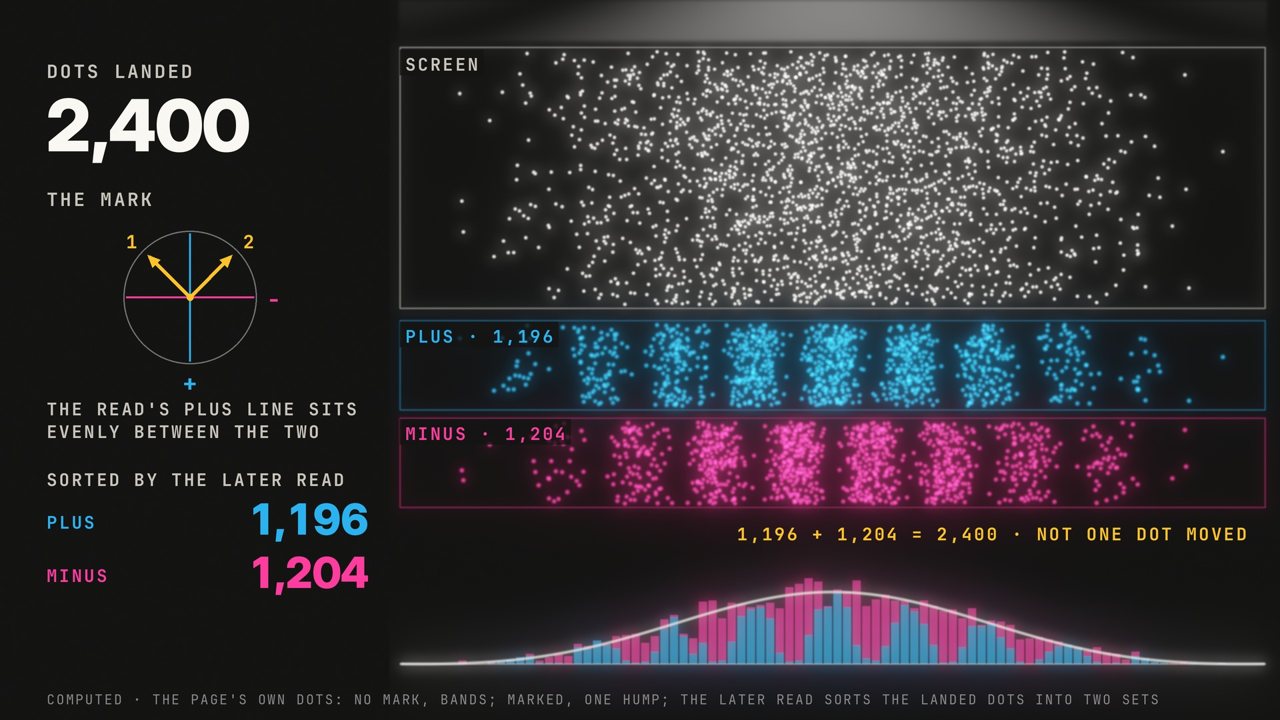
The double-slit experiment and the delayed-choice quantum eraserThe bands are there while nothing marks which slit each particle went through, and they vanish once something does. Choosing later what to do with that mark only sorts dots that have already landed.
no
2
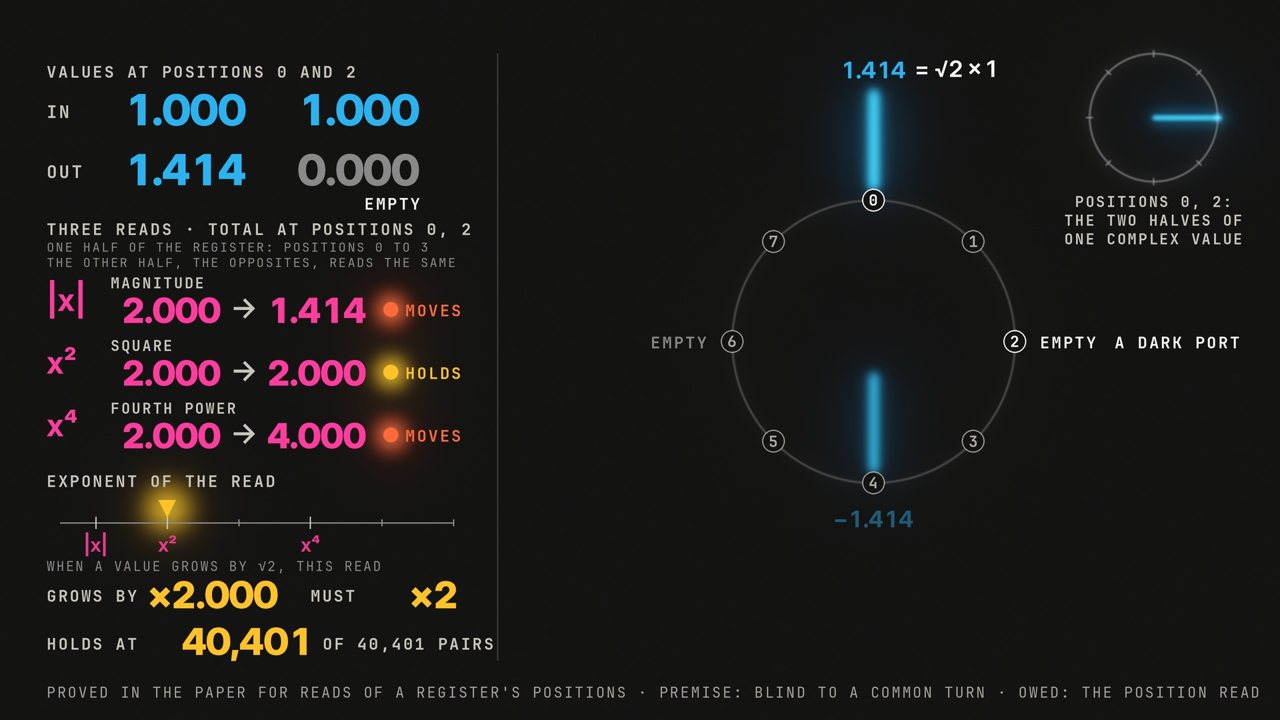
The Born rule: why probability is a squareA read taken position by position, whose total holds when the whole register is turned, is, with three mild conditions, a constant times the sum of squares: the clock’s one-eighth turn treats the two halves of one complex value as a beam splitter treats its two arms, and equal values leave one output empty, so the read must double when a value grows by √2.
no
no
3
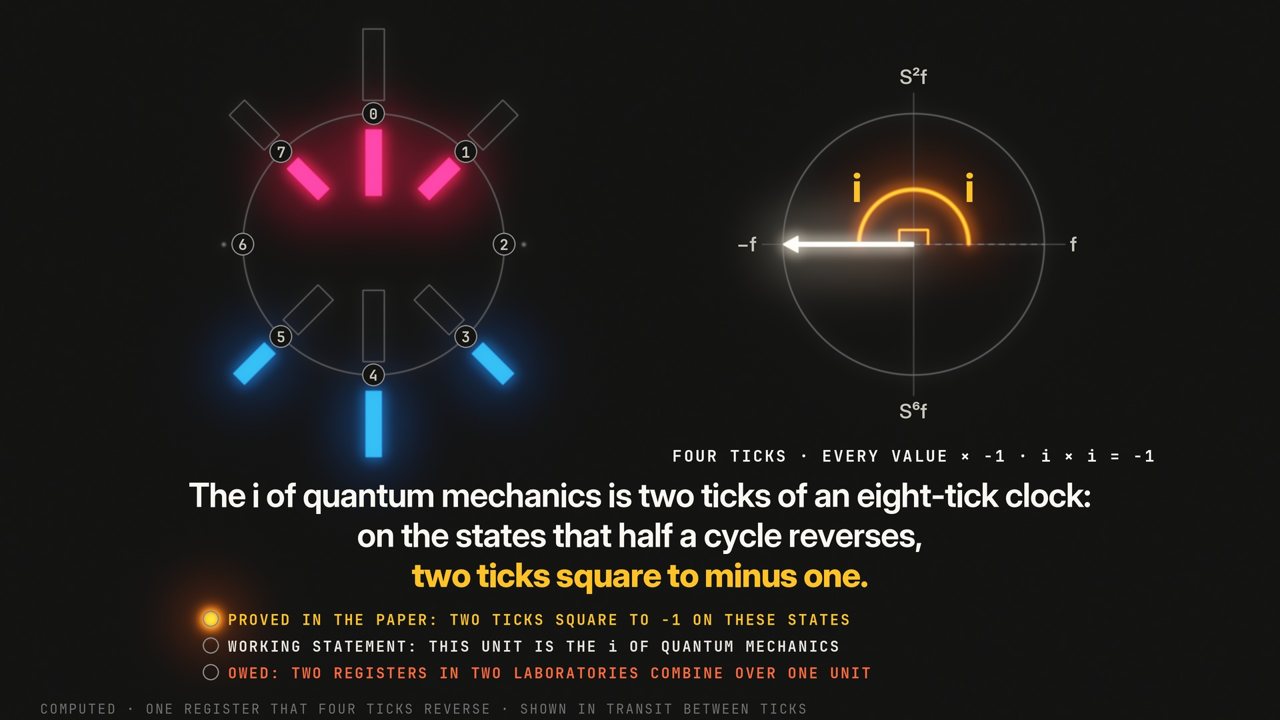
Why quantum mechanics needs complex numbersOn the record, the i of quantum mechanics is two ticks of an eight-tick clock: on the states that half a cycle reverses, two ticks square to minus one.
no
4
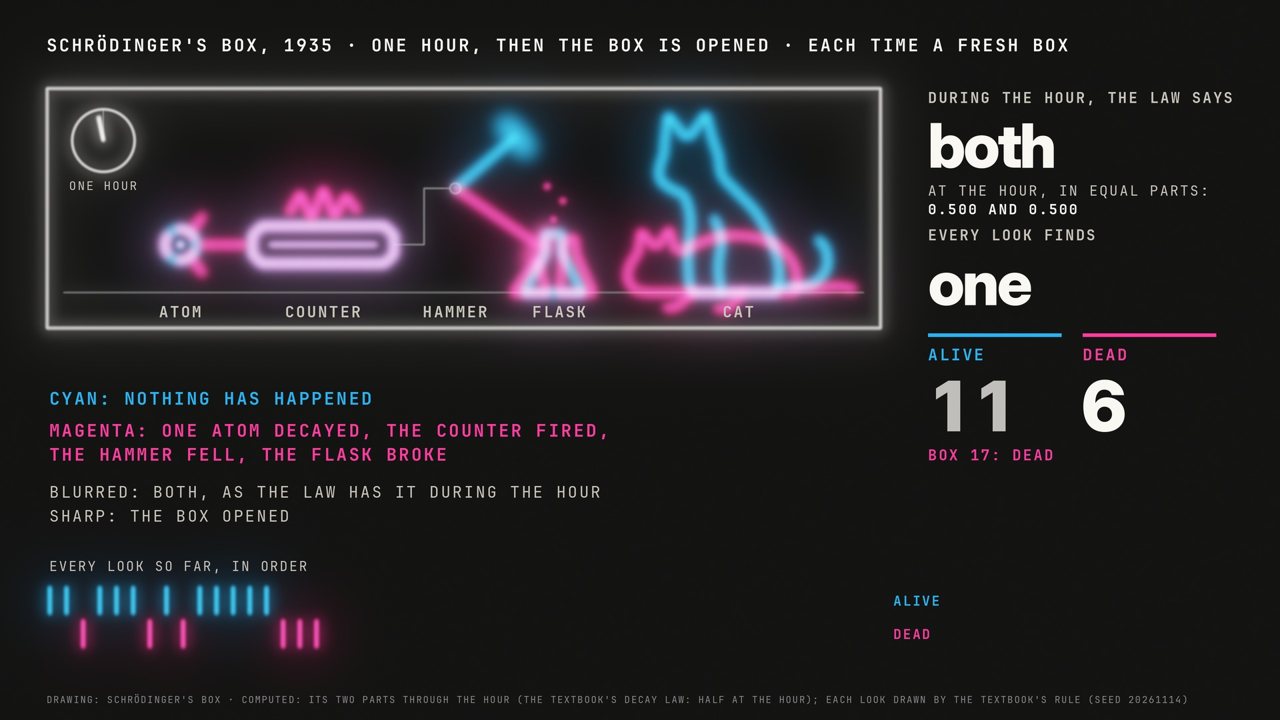
Schrödinger’s cat and the measurement problemNo entry ever shows the cat alive and dead at once. Possibilities add up only while nothing has been recorded about them, and a cat is touched by its surroundings all the time.
no
no
5
Where the quantum world endsMolecules of about two thousand atoms interfere; no dust grain has been seen to. The line is not a size. The bands go when something tells the two paths apart, and once that is written into the record they are gone for good.
no
no
6
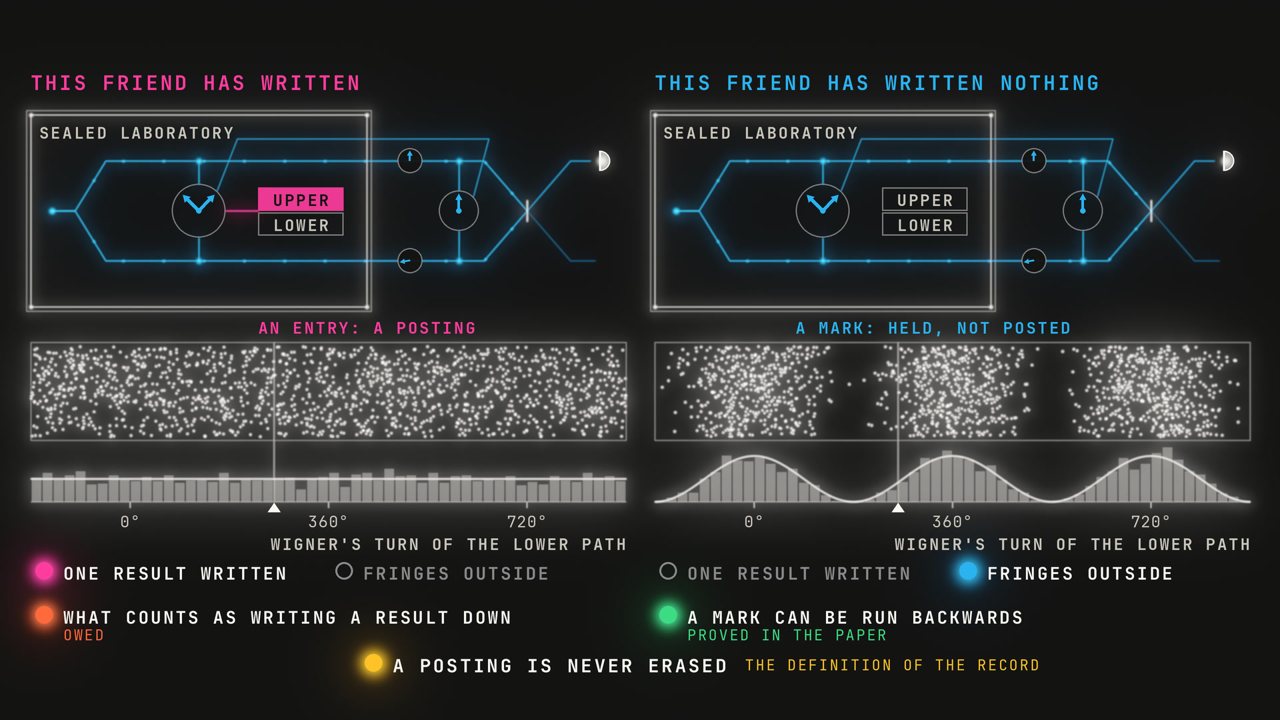
Wigner’s friendA friend who has written a result down can never be made to interfere, and one who can be made to interfere has not written it down. Nothing written is ever undone, so Wigner’s two descriptions never both fit one friend.
no
7
Bell’s inequalityMeasured far apart, with settings chosen at random, two particles give results correlated more strongly than any account can give in which each result depends only on what the pair carried and its own station’s setting. On the record no signal passes: the answers are made when measured, from one entangled state the two share.
no
8
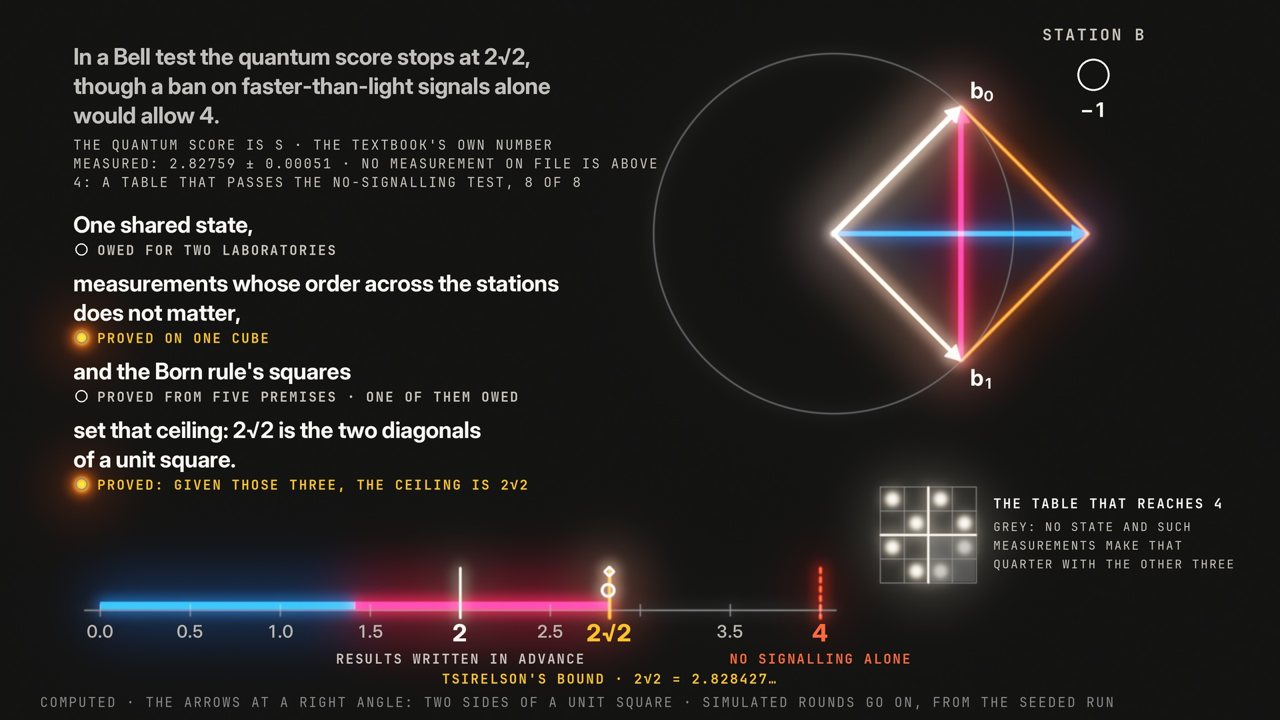
Tsirelson’s boundNot resolvedIn the CHSH form of a Bell test, the quantum score stops at 2√2, though a ban on faster-than-light signals alone would allow 4. One shared state, measurements whose order across the stations does not matter, and the Born rule’s squares set that ceiling.
no
9
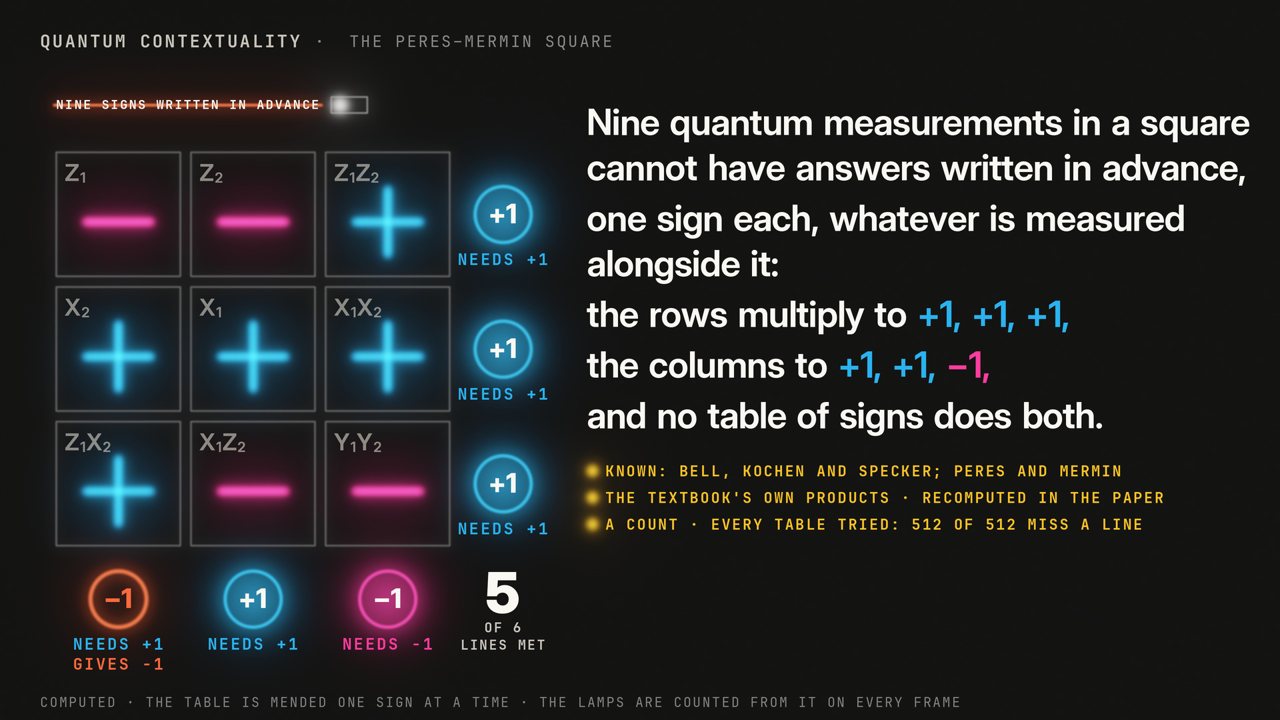
Quantum contextualityNine quantum measurements in a square cannot have answers written in advance, one sign each, whatever is measured alongside it: the rows multiply to +1, +1, +1, the columns to +1, +1, −1, and no table of signs does both.
no
10
The Leggett–Garg inequalityIs a large object in one definite state between looks? Not until something records it. A look writes an event into the record, and a yes-or-no look made first moves the next one’s chances by an exact amount, at most one half.
no
no
11
Tunnelling time: how long is a particle inside the barrier?There is no one time a particle spends inside the barrier. Time is a count of recorded events; none marks the held particle going in or out, so the record holds no time inside, not even zero, and each measured “tunnelling time” is what some clock’s touch reads.
no
no
no
12
Spin and statistics: why no two electrons share a stateNot resolvedElectrons never share a state; photons can crowd into one. Reality’s clock reverses the sign of some states in four ticks, as one full turn does an electron’s; that the two reversals are one is not proved. Whether a swap of two electrons carries that sign, which would keep them apart, is not proved on the record.
no
no
no
Count, from the marks above
04 · The twelve
Each paradox in three lines.
Each paradox gets the paper’s three lines, in the words of its own page: the puzzle; what the record says, with the result it uses; and what comes back, and what is owed. Each page runs its experiment in full.
All twelve pages are live. Nine films are finished, and each plays here, in its paradox’s place.
One particle at a time, sent at two slits, builds bands on a screen, as if each one took both paths. Mark which slit it took, and the bands vanish. In the eraser the mark rides on a twin particle; “erase” it later, even after the particle itself has landed, and the bands come back in sorted subsets of the dots (Kim and colleagues, Physical Review Letters, 2000).
On the record
Two paths that nothing tells apart are one history in two parts. What each path brings to a place on the screen, its value (the textbook’s amplitude), adds to the other’s, and values can cancel: where the two arrive out of step there are gaps between the bands. A full mark, a value held by something else, tells the two parts apart: they now sit at different positions of the screen and the marker taken together, so the screen counts each on its own. Counts never cancel, so the bands go, and nothing about the mark has to be written down for that. A landed dot is written down for good, as an entry in the record (a posting), so a later choice at the marker cannot touch it; the choice only sorts dots already there. This uses a premise of the paper, that values add while nothing is written down, and its proof, from five premises with the owed O2 (line 3) among them, that reads are squares; that a landing is such a read is O1.
What comes back, and what is owed
The textbook’s values: with a full mark, no bands among the unsorted dots, however long the delay, and, sorted by a read of the marker blind to the path, bands and their exact opposite in the two halves, adding back to the hump; for any mark, the bands’ strength V and how well the path can be told, D, obey V² + D² ≤ 1 (Englert, 1996), a textbook computation the paper recomputes and its theorems do not produce; measured with single photons, the exit each photon took, not a mark, telling the path: V² + D² = 0.97 ± 0.03 (Jacques et al., Physical Review Letters, 2008). Owed: O1, O2, and O3 for the two detectors.
Quantum mechanics gives each outcome a number, its amplitude, and the chance of the outcome is that number’s size squared. Why the square, and not the size itself or its fourth power?
On the record
A read taken position by position, whose total a common turn of all the register’s complex values cannot change, is a constant times the sum of squares, given three mild premises. With equal halves, the clock’s one-eighth turn leaves one half of a complex value empty, as a beam splitter with equal values in its arms leaves one output dark, so the read must double when a value grows by √2 (proved in the paper: “The read is the square”). On a system of three or more complex values whose squared sizes add to one, such as registers taken together, a read that totals one and meets four further conditions gives each position its squared size (“Unit total forces the weights”).
What comes back, and what is owed
Each probability is the squared size of its amplitude, and because the read is a square, three paths whose values add interfere only in pairs, so for ideal paths the third-order term is zero (Sorkin, 1994; measured below 1% of the pair terms by Sinha and colleagues, Science, 2010, where the textbook’s own looped paths also add a small term). Owed: O2, O1.
Quantum mechanics is written with the number i, the square root of minus one, and its textbooks take that as a starting rule. A version built from real numbers alone matches every experiment with one shared source, and whether it could do all the same work stayed open for decades; since 2022, published experiments on small quantum networks have excluded it whenever it combines two systems by the textbook’s usual product and its two sources share nothing.
On the record
A cell of the record holds eight real values, its register, and its clock moves them one place per tick. On the registers that four ticks reverse, every value turned into its opposite (the core), two ticks square to minus one: the record takes them as its i. Only two independent real registers keep their shape under the tick, so the premise that every register is a sum of registers that keep their shape calls for numbers beyond the real ones. Each cell’s own two ticks are its i on its core; on a pair of core registers taken together over the complex numbers, two ticks of the joint clock are just minus one, not an i.
What comes back, and what is owed
In the network test, real-number versions that combine two systems by the usual product, with sources that share nothing, reach a score of at most about 7.66 (a bound found numerically, not known to be tight), and complex quantum mechanics reaches 6√2 ≈ 8.49 (Renou et al., 2021); measured, 8.09 ± 0.01 on one chip (Chen et al., 2022) and 7.83 ± 0.03 with the sources and measurements kept apart (Wu et al., 2022). The record returns the complex value if two registers agree on their unit, which is O3; the measurements are evidence for that, and what they exclude is real blocks whose sources share nothing. Owed: O3, O2, O1.
The law that moves a quantum state is linear: a sum of possibilities stays a sum, and the law never picks one. Couple a cat to one atom that may or may not decay, and the law leaves the whole box as a sum: atom decayed and cat dead, plus atom whole and cat alive. Every look finds the cat alive or dead.
On the record
The order is the other way round. Records come first and are definite: an entry is one entry, never a sum of entries. Adding possibilities is what the law does between two entries (for laws with finitely many levels and bounded rates, the form of that step is the theorem “The step in real time”). A measurement is an entry. A contact of the paper’s form loses nothing and gains nothing (the theorem “A contact leaves the state or applies the crossing”): where its crossing moves a state wholly off where it stood, the state becomes a sum of a part left exactly as it was, weight cos²θ, and a part with one crossing, weight sin²θ; where the crossing keeps the state where it stood, no part leaves it: its two parts of definite sign turn in opposite senses, and neither changes length. A cat is in contact with its surroundings at every tick; that one part is posted is O1.
What comes back, and what is owed
The weights are squares, and no laboratory body yet gets a number of its own; the working candidate for massive bodies has an open unit. A held register is written only at a contact. Owed: O1, of which this paradox is the plainest statement, and O2.
Molecules of about two thousand atoms, sent through an interferometer, show bands, as if each took more than one path at once (Fein and colleagues, 2019). No dust grain has been seen to. Where is the line between the quantum world and ours, and what draws it?
On the record
The line is not a size. A body’s two paths keep all their bands for exactly as long as nothing tells them apart. Once something it touched holds a mark, a clue that tells the paths apart wholly, the bands are gone from every read of the body alone (for a register, the square and contact theorems, Theorems 16 and 25, with O2 among the square’s premises; for a laboratory body, O1 too, below); once that mark is posted, written into the record, they are gone for good, because a posting is never erased. A large warm body is told apart constantly: every gas molecule that bounces off it and every photon it gives off carries some of a mark away.
What comes back, and what is owed
The record gives no number of its own for any laboratory body, and the measured loss of contrast follows the count of collisions (Hornberger and colleagues, 2003). Owed: O1, with a working candidate for massive bodies whose unit is open, and O2.
A friend measures a photon inside a sealed laboratory and has a result. Wigner, outside, describes the whole laboratory as a sum of both results, and in principle he can make the two interfere. Which description is right?
On the record
A written result is a posting, one entry in the record, and a posting is never undone. Making the friend’s two results interfere needs them to be one history with no record. Both cannot be true of the same friend: a friend about whose result nothing has been posted is a held register, and Wigner can make the friend’s two possible results interfere; a friend who has written it is on the record, and he cannot. The answer follows from the definition of the record, that a posting is never erased, and from no theorem of the paper; two theorems serve it: “A contact leaves the state or applies the crossing”, which lets Wigner run a contact backward while nothing about its mark has been posted, and “Three ceilings”, which place the measured score.
What comes back, and what is owed
Every friend tested so far was one Wigner could reverse or make interfere; the record counts such a friend as having written nothing, and until O1 says what writing is, that cannot be checked apart from the reversal. For those, correlations of the textbook’s kind come back, above Brukner’s bound of 2, which holds if every result is a fact for everyone, settings are freely chosen and nothing passes between the sides: 2.416 ± 0.075 with photons as the friends (Proietti et al., 2019), and, with a photon’s path as the friend, further bounds broken (Bong et al., 2020). For a friend who has written the result down, the record’s answer is no bands, the number of the textbook’s rule for a measurement; the textbook’s step alone would allow them back, and no experiment has reached such a friend. Owed: O1 (which posting a friend’s result is), O3 and O2.
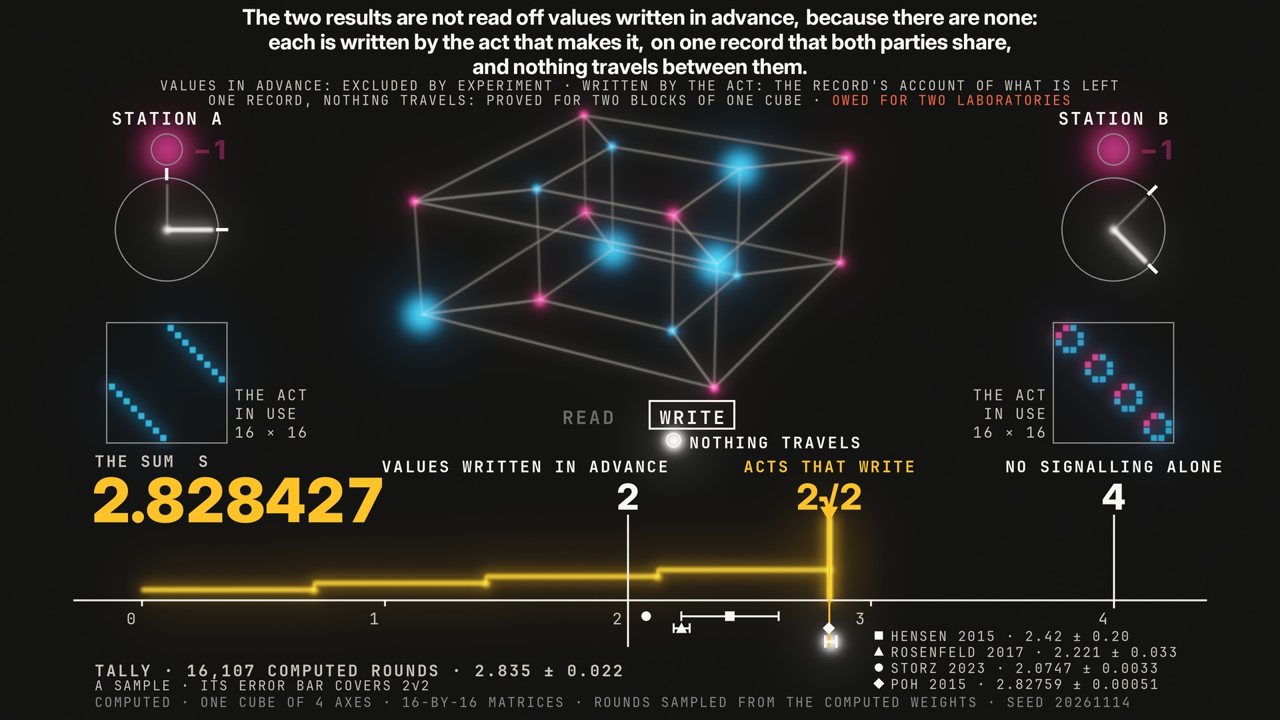
Two stations, far apart, each choose one of two settings at random and record a result, +1 or −1. If every result were written in advance, carried by the particles like answers on a card, one sum of the four correlations, S, could not pass 2 on average (a correlation is how often the two results agree minus how often they differ). Experiments pass 2.
On the record
An act is what a station does to get its +1 or −1. Acts that only read values already written cannot pass 2, so passing 2 rules out answers held in advance, each fixed by what the pair carried and its own setting. The record’s account of what is left: some act writes its result. There is one record, and in its account the two stations are two blocks of one cube, sharing one state. On the record no signal travels: each station’s acts touch only its own block, and acts whose order makes no difference do not move each other’s weights. The correlation lives in one shared state, which is not local in Bell’s sense; that two laboratories share one cube is O3.
What comes back, and what is owed
At most 2√2, with no signal from either station to the other. Measured in a loophole-free test (each setting chosen at random, too late for a signal at light speed to carry it to the other station, and every heralded pair counted): 2.42 ± 0.20 (Hensen et al. 2015). Owed: O3, O2, O1.
Two stations far apart, A and B, each choose one of two settings and get a result, +1 or −1. A correlation is how often the two results agree minus how often they differ: +1 if they always agree, −1 if they always differ. Add three of the four correlations and subtract the fourth. In quantum mechanics that score, S, stops at 2√2 ≈ 2.83. Yet the rule that seems to govern distant stations, that neither station’s choice can change the odds of the other’s results, allows S = 4. Why does it stop at 2√2?
On the record
On the record, the ceiling comes from three conditions: both stations act on one shared state; each act has two outcomes, +1 and −1, and is its own undoing: done twice, it gives back the state it started from, so asked twice it agrees with itself (the textbook’s observable with values +1 and −1), and every act at one station commutes with every act at the other, which for acts means that on every state they give the same odds in either order; and each read (the textbook’s probability, once the total is set to one) is a square: the squared length of the part of the state that matches that outcome. With these, S is at most 2√2, the combined length of a unit square’s two diagonals, and suitable acts on one cube of on/off switches reach it exactly; one table of probabilities that merely does not signal reaches 4. The ceiling, that one cube reaches it, and the table that reaches 4 are proved again in the paper’s Section 7, after Tsirelson (1980) and Popescu and Rohrlich (1994), in the theorems “Three ceilings” and “One cube reaches the middle ceiling”.
What comes back, and what is owed
The ceiling is 2√2 = 2.828427…, and the closest of the measurements the paper cites, 2.82759 ± 0.00051 (Poh et al. 2015), sits 0.00084 under the ceiling, 1.6 times its quoted uncertainty; no measurement has passed it. Within the textbook the bound is Tsirelson’s theorem; why nature stops there is the open question. Not resolved on the record until O3 is a theorem: this paradox is the composition law. Owed: O3, O2, O1.
Some quantum measurements can be made together: those whose order makes no difference, which physicists say commute. Nine measurements, each giving +1 or −1, can be set in a square so that the three in each row, and the three in each column, can be made together. If each carried its answer in advance, the same whichever row or column it is measured in, the three rows’ products would multiply to the same number as the three columns’, since both multiply all nine answers once. Quantum mechanics says the rows give +1, +1, +1 and the columns +1, +1, −1.
On the record
A measurement is a read of an act: it writes the act’s result as a new posting; it is not a look at an entry already there. Two acts can be read together exactly when they commute (proved in the paper). The square’s nine acts work on two of the three on/off axes of a register of the record, and each row’s and each column’s product is exact, on every state. If the answers were entries already on the record, one for each act whatever it is read with, they would form a table of nine signs, and no table has both the rows’ products and the columns’. It is a count.
What comes back, and what is owed
On the square’s test the nine acts score 6 and any table of nine signs written in advance at most 4, by the textbook’s computation, which the paper recomputes and its theorems do not produce. Two trapped ions measured 5.46 ± 0.04 on one state, with violations of like size on the other states they prepared (Kirchmair et al. 2009). Owed: O1, O2, and O3 where two ions carry the two axes.
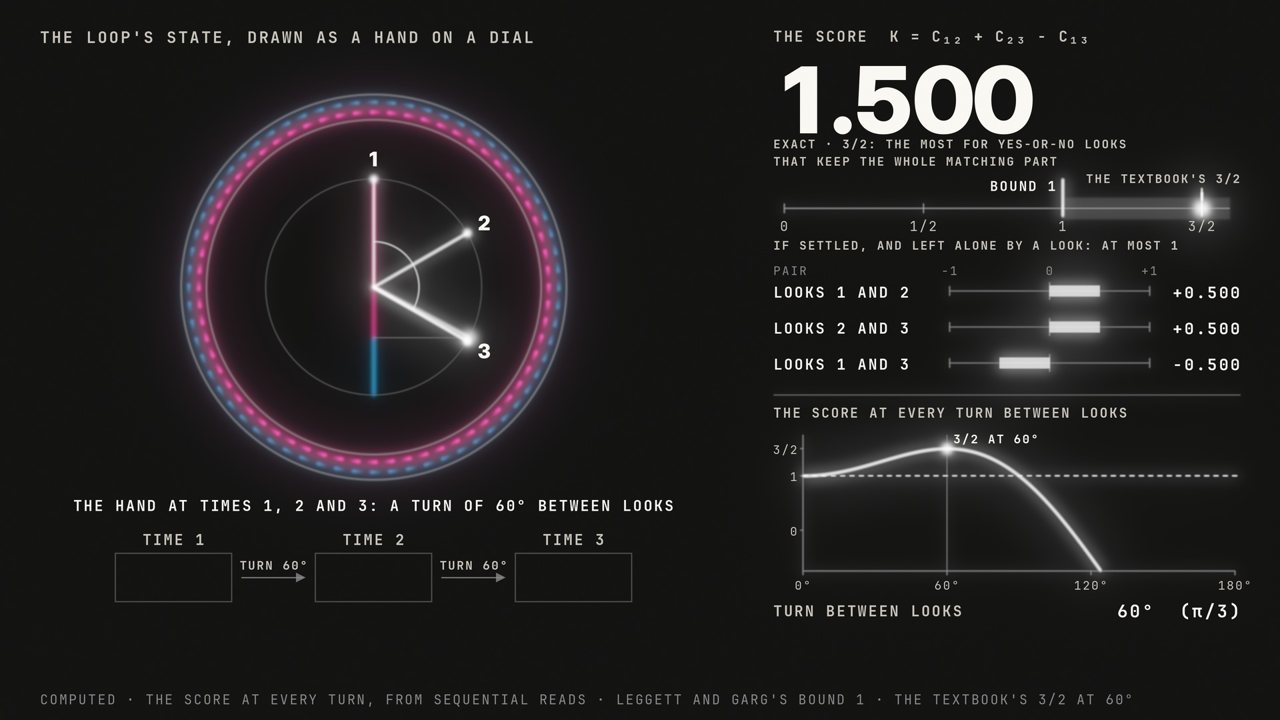
Look at one object at three times, each look giving +1 or −1: a current running one way round a loop, or the other. Give each pair of times its own runs and score the pair: how often its two looks agree, minus how often they differ. If the object is in one definite state between looks, and a careful look leaves it as it was, the scores for times 1 and 2 and for times 2 and 3, minus the score for times 1 and 3, K, cannot pass 1. Is a large object like that?
On the record
Not while nothing writes it. What is definite is what has been written. Between two looks, an object that writes nothing holds values that add, as waves add, not one settled state; and a look is itself a writing: a posting, an event written into the record. Reading one yes-or-no look first moves the chances of another by an exact amount: never more than one half, and zero whatever the state exactly when the order of the two looks makes no difference. Any turn other than none or a half turn makes the order matter, and a turn is what carries the score past 1; a register only shuffled between looks, and read, never passes 1.
What comes back, and what is owed
The 3/2 at a turn of π/3 is the textbook’s computation with squared weights; the paper recomputes it, and its theorems do not produce it. The bound 1 comes from counting over triples of values that careful looks leave undisturbed, the three-look form of Leggett and Garg’s inequality. Measured on a superconducting loop: a middle look whose result nobody inspected moved the last look’s average beyond what a definite, undisturbed current allows, by about 84 standard deviations (Knee et al. 2016). The test refutes definite values and undisturbing looks together and cannot say which fails; the record gives up both. Owed: O1, O2.
A particle meets a barrier it has too little energy to get over, and sometimes it turns up on the far side anyway: it tunnels. How long was it inside? The ways of defining that time give different answers, and some of them level off as the barrier gets wider (Thomas Hartman, Journal of Applied Physics, 1962).
On the record
Time is a count of postings, the entries written in reality’s record. While nothing is posted about a particle it is held, and a value held inside a barrier posts nothing: no entry marks it going in or coming out, so the crossing has no count of its own. That is not a time of zero: the record’s count runs on while the particle is held, but no entry divides that count, so no part of it is a time inside. Every measured “tunnelling time” is the reading of some apparatus making its own contact with the particle; what a contact of the paper’s form does to a held state, in the two cases the paper treats, is its contact theorem.
What comes back, and what is owed
The record gives no number of its own here. Two clocks, two answers: at most 1.8 attoseconds for electrons leaving hydrogen atoms, by an attoclock (Sainadh et al., Nature, 2019), and 0.61 ± 0.07 milliseconds for rubidium-87 atoms crossing a barrier 1.3 micrometres thick, by a spin clock (Ramos et al., Nature, 2020). Owed: O1.
Particles of half-integer spin, such as electrons, protons and neutrons, exclude one another: no two of the same kind share a state. Particles of whole-number spin, such as photons, can crowd together into one (Wolfgang Pauli, Physical Review, 1940). Spin is about how a particle behaves when it is turned. Why should it decide how two of them behave together?
On the record
The record’s clock has eight ticks (from earlier work). Its core is the set of states whose sign four ticks, half the cycle, reverse, and eight restore. One full turn reverses the sign of a half-integer spin’s state, and two restore it; that the two reversals are one is not proved. Given that a swap of two identical records (the textbook’s identical particles) reverses the sign of their joint state, exclusion follows at once: where the two would be in the same state, the joint state equals minus itself, so it is zero.
What comes back, and what is owed
Only signs come back, −1 and +1; given the odd sign, exclusion is exact, as in the textbook, with no violation, and none has been found. The puzzle is not resolved on the record; in relativistic field theory the link is a theorem (Pauli, 1940, for free fields), and what is missing is an elementary reason for it. Owed: O4, together with which turn of a body four ticks are.
Three results the paper names would break it, and each would break the textbook too.
Because the numbers are the textbook’s, the tests are shared. Each card below is one of them: try another result and see what would fall, and which of the twelve use it.
The third test is why the position read matters: a read that is not taken position by position lets one place steer another with no posting passing between them. That reason is about outcomes, whole complex values; inside one complex value the paper gives the position read no reason beyond its form.
Where the record says more than the five rules
The paper names three places where the record says more than the five rules, and each is a place to look.
The energy operator is not a second choice. It is minus the logarithm of the law between records, so, for laws on finite-dimensional spaces with a floor under their factors (bounded rates), a system’s energies are its decay rates under that law, and its spectrum is fixed once the law of motion is. The paper computes no spectrum. The test is to take that law for a known system and compare ratios of differences of its decay rates with ratios of measured lines; those ratios do not depend on the unit c.
A posting is never undone. A friend who keeps a record cannot be made to interfere, at any degree of isolation. Every friend tested so far keeps none, and what counts as keeping a record in a laboratory is O1, so this is not yet a test. It follows from the definition of the record and from no theorem of the paper, and it is where, among the twelve, the record says something the step between records alone does not.
Something counted takes the entry. The step between records never posts; what does is owed (O1). For massive bodies the paper’s working candidate Working statement has the form of a threshold in action, Penrose’s form (1996; see also Diósi, 1987): two histories of one body that are already apart stop being one history when the gravitational self-energy of the difference between them has built up one unit of action. Its unit is open. When it is fixed, it is a number the five rules do not contain.
06 · What it means
There is one record, and quantum mechanics is what it does between two entries.
Recognition Science starts from three facts every question already uses and proves that, under each result’s stated conditions, only one answer is possible (the Overview). Some things can be told apart, comparing two readings needs both, and reading an old record is a new event (the three facts). Reality keeps a permanent record: nothing that happens is ever erased, and the past still exists (why). Told as five bare rules, quantum mechanics seemed to argue with that record: a later choice that seems to reach back to dots already landed, a cat left as a sum of alive and dead, a friend whose written result one description keeps and another undoes. So Recognition Science needed the paradoxes worked on the record’s own terms, all twelve of them.
Several of the paper’s theorems are known results of the textbook’s own mathematics, and the paper says whose: Lüders’ theorem on reading two things together, the Jordan–Wigner construction that gives the cube its generators, Bell’s ceiling and Tsirelson’s, Popescu and Rohrlich’s table that reaches 4, Maxwell’s argument for a square; and the step’s form is the Wick rotation, which Osterwalder and Schrader made rigorous. It discovers none of them. What is new is what those results are about: the paper reads their objects as the record’s own (a register, its clock, a posting), and that reading is where the record enters. Read that way, the five rules’ algebra follows from premises the paper names, some of them parts of the rules themselves, and the twelve mysteries are traced to four owed statements and the premises beneath them.
01
Quantum mechanics is not a second set of laws for small things.
It is what the law of the record does between two of its entries, the one sentence of section 02 read at each rule. Nothing is outside the record, and the paper reads the premises beneath the owed statements as that one statement read at one place: at the clock, at the step, at the read.
Rests onThe theorems of the paper, from its named premises; the reading of a laboratory’s states, steps and outcomes as the register’s, and the working statements; O1, O2 and O3, owed. The premises themselves are still to be derived from the record’s starting fact; that work belongs to the foundations of Recognition Science, not to this paper.
02
What is written stays written.
A landed dot, a written result and a click that stays are postings, and a later act only writes after them. The two paradoxes that seemed to let a later act reach back, the eraser and Wigner’s friend (1 and 6), are where it is used. In the eraser the textbook agrees that a later act only sorts what is written; for a friend who has written, the record says more than the textbook’s step, and no experiment has reached one.
Rests onThe definition of the record, that a posting is never erased, taken from earlier work; that a dot or a result is a posting is O1, owed.
03
Where the paper proves them, the five rules share their parts.
Taught as postulates, the five read as a list. The one-eighth turn that gives the square is built from the clock’s i and from nothing else. The step of that proof in which equal halves leave one half empty (the form of a beam splitter’s dark output), and Tsirelson’s ceiling both use, in different roles, one law of squares: the two diagonals of a parallelogram, squared and added, equal its four sides squared and added; that law holds in any space with lengths and angles, and what the record adds is that the read’s premises lead to it. And on the record’s picture of two registers, the network tests tie the first rule to the fifth: real blocks whose sources share nothing contradict a measurement, and the record’s account is that two registers in two laboratories agree on their unit.
Rests onThe theorems of the paper’s sections on the five rules, proved from named premises, O2 (owed) among them; for two laboratories, O3, owed.
07 · Hard questions
What an expert asks first.
Is any of this different from ordinary quantum mechanics?
Not in any number these twelve return (the line under the twelve at the top of the page). What differs is the starting point, and the three claims of section 05 that the five rules do not make, the plainest that a friend who has written a result down can never be made to interfere. The textbook takes the five rules as given; the paper takes a record and its clock, proves the rules’ algebra from premises it names, and names what it still owes.
Isn’t this known?
The whole finite-dimensional formalism has been derived before, from axioms about what an experimenter can do (Lucien Hardy, 2001; Giulio Chiribella, Giacomo Mauro D’Ariano and Paolo Perinotti, 2011), and the square, in dimension three and above, from additivity over every orthogonal split (Andrew Gleason, 1957). The paper derives less than they do, from premises about a record and its clock, the same record from which earlier work derives the cost of a comparison, the scale between levels and the three dimensions of space: it leaves the square on other splittings as a hypothesis and the product for two laboratories owed, and three of its five results need no axiom about composite systems at all. The one sentence is close to Feynman’s rule (values add for alternatives nothing tells apart, chances add for those something does), and the way bands vanish once something tells the paths apart is decoherence, studied since Zeh (1970) and Zurek; the one sentence reads both on the record.
Then what has been explained?
Where each paradox comes from, not that it is closed: each is traced to the results it uses and the owed statements it waits on, and eleven of the twelve share the first, a question drawn wide by design. For three (the cat, Tsirelson’s bound, spin and statistics) one owed statement, O1, O3 or O4, is the paradox itself, said in the record’s words.
What is not proved?
The four owed statements, attachment, the position read, composition and exchange (section 03), and the premises beneath them, named with each rule in section 02; the paper also uses working statements, among them that a held register lies in the core, which operator a crossing is, and the threshold for massive bodies. Two paradoxes are not resolved in the paper’s own words: Tsirelson’s bound, until composition (O3) is a theorem, and spin and statistics, which waits on exchange (O4) and on which turn of a body four ticks are.
Could an experiment ever tell?
Not one of these twelve. Section 05 names the three places where the record says more than the five rules; none is a test yet.
A proof of the four owed statements, or of the premises beneath them.
That states are complex as a theorem: the clock makes a unit with no premise, and that states are complex rests on a premise (section 02).
That a laboratory’s states, steps and outcomes are the register and its operators: the theorems are about the register, its clock and operators on them, and the step to a laboratory is an identification.
A spectrum, the value of the action constant ħ, or the length of one tick in seconds.
Which outcome occurs: the paper gives the parts, with the textbook’s weights; that one of them is posted is O1.
Quantum mechanics has been called the theory nobody understands. Much of the difficulty was not in the five rules but in their being rules. Read as what one record does between two of its entries, their algebra is a set of short theorems with named premises, and what is left is on a list.
The widest item on that list, the one eleven of the twelve paradoxes wait on, is a single question: what, in a laboratory, is an entry?
09 · Read it
The paper, and the twelve pages.
The Five Postulates of Quantum Mechanics on the Record: Theorems, Premises, and What Is Owed
Jonathan Washburn · Recognition Physics Research Institute · Preprint, posted 14 November 2026 · Not peer reviewed. The twelve paradoxes are its last section before the close.
J. C. Maxwell, Illustrations of the dynamical theory of gases. Part I, Philosophical Magazine 19, 19–32 (1860).
M. Born, Zur Quantenmechanik der Stoßvorgänge, Zeitschrift für Physik 37, 863–867 (1926).
P. Jordan and E. Wigner, Über das Paulische Äquivalenzverbot, Zeitschrift für Physik 47, 631–651 (1928).
A. Einstein, B. Podolsky and N. Rosen, Can quantum-mechanical description of physical reality be considered complete?, Physical Review 47, 777–780 (1935).
E. Schrödinger, Die gegenwärtige Situation in der Quantenmechanik, Die Naturwissenschaften 23, 807–812, 823–828, 844–849 (1935).
W. Pauli, The connection between spin and statistics, Physical Review 58, 716–722 (1940).
G. Lüders, Über die Zustandsänderung durch den Meßprozeß, Annalen der Physik 443, 322–328 (1951).
A. M. Gleason, Measures on the closed subspaces of a Hilbert space, Journal of Mathematics and Mechanics 6, 885–893 (1957).
E. P. Wigner, Remarks on the mind-body question, in I. J. Good (ed.), The Scientist Speculates (Heinemann, London, 1961), 284–302.
T. E. Hartman, Tunneling of a wave packet, Journal of Applied Physics 33, 3427–3433 (1962).
J. S. Bell, On the Einstein Podolsky Rosen paradox, Physics 1, 195–200 (1964).
R. P. Feynman, R. B. Leighton and M. Sands, The Feynman Lectures on Physics, vol. III (Addison-Wesley, Reading, 1965), chapter 3.
S. Kochen and E. P. Specker, The problem of hidden variables in quantum mechanics, Journal of Mathematics and Mechanics 17, 59–87 (1967).
J. F. Clauser, M. A. Horne, A. Shimony and R. A. Holt, Proposed experiment to test local hidden-variable theories, Physical Review Letters 23, 880–884 (1969).
H. D. Zeh, On the interpretation of measurement in quantum theory, Foundations of Physics 1, 69–76 (1970).
K. Osterwalder and R. Schrader, Axioms for Euclidean Green’s functions, Communications in Mathematical Physics 31, 83–112 (1973); II, 42, 281–305 (1975).
B. S. Cirel’son (Tsirelson), Quantum generalizations of Bell’s inequality, Letters in Mathematical Physics 4, 93–100 (1980).
A. J. Leggett and A. Garg, Quantum mechanics versus macroscopic realism: is the flux there when nobody looks?, Physical Review Letters 54, 857–860 (1985).
L. Diósi, A universal master equation for the gravitational violation of quantum mechanics, Physics Letters A 120, 377–381 (1987).
S. Popescu and D. Rohrlich, Quantum nonlocality as an axiom, Foundations of Physics 24, 379–385 (1994).
R. D. Sorkin, Quantum mechanics as quantum measure theory, Modern Physics Letters A 9, 3119–3127 (1994).
B.-G. Englert, Fringe visibility and which-way information: an inequality, Physical Review Letters 77, 2154–2157 (1996).
R. Penrose, On gravity’s role in quantum state reduction, General Relativity and Gravitation 28, 581–600 (1996).
Y.-H. Kim, R. Yu, S. P. Kulik, Y. Shih and M. O. Scully, Delayed “choice” quantum eraser, Physical Review Letters 84, 1–5 (2000).
L. Hardy, Quantum theory from five reasonable axioms, arXiv:quant-ph/0101012 (2001).
W. H. Zurek, Decoherence, einselection, and the quantum origins of the classical, Reviews of Modern Physics 75, 715–775 (2003).
K. Hornberger et al., Collisional decoherence observed in matter wave interferometry, Physical Review Letters 90, 160401 (2003).
V. Jacques et al., Delayed-choice test of quantum complementarity with interfering single photons, Physical Review Letters 100, 220402 (2008).
G. Kirchmair et al., State-independent experimental test of quantum contextuality, Nature 460, 494–497 (2009).
U. Sinha, C. Couteau, T. Jennewein, R. Laflamme and G. Weihs, Ruling out multi-order interference in quantum mechanics, Science 329, 418–421 (2010).
G. Chiribella, G. M. D’Ariano and P. Perinotti, Informational derivation of quantum theory, Physical Review A 84, 012311 (2011).
R. Sawant, J. Samuel, A. Sinha, S. Sinha and U. Sinha, Nonclassical paths in quantum interference experiments, Physical Review Letters 113, 120406 (2014).
B. Hensen et al., Loophole-free Bell inequality violation using electron spins separated by 1.3 kilometres, Nature 526, 682–686 (2015).
H. S. Poh, S. K. Joshi, A. Cerè, A. Cabello and C. Kurtsiefer, Approaching Tsirelson’s bound in a photon pair experiment, Physical Review Letters 115, 180408 (2015).
G. C. Knee et al., A strict experimental test of macroscopic realism in a superconducting flux qubit, Nature Communications 7, 13253 (2016).
Č. Brukner, A no-go theorem for observer-independent facts, Entropy 20, 350 (2018).
Y. Y. Fein et al., Quantum superposition of molecules beyond 25 kDa, Nature Physics 15, 1242–1245 (2019).
M. Proietti et al., Experimental test of local observer independence, Science Advances 5, eaaw9832 (2019).
U. S. Sainadh et al., Attosecond angular streaking and tunnelling time in atomic hydrogen, Nature 568, 75–77 (2019).
K.-W. Bong et al., A strong no-go theorem on the Wigner’s friend paradox, Nature Physics 16, 1199–1205 (2020).
R. Ramos, D. Spierings, I. Racicot and A. M. Steinberg, Measurement of the time spent by a tunnelling atom within the barrier region, Nature 583, 529–532 (2020).
M.-O. Renou et al., Quantum theory based on real numbers can be experimentally falsified, Nature 600, 625–629 (2021).
M.-C. Chen et al., Ruling out real-valued standard formalism of quantum theory, Physical Review Letters 128, 040403 (2022).
D. Wu et al., Experimental refutation of real-valued quantum mechanics under strict locality conditions, Physical Review Letters 129, 140401 (2022).