Protein folding & medicine
A protein’s shape determines much of what it can do. We study the physics of folding and binding to understand disease at the molecular level and guide the design of treatments.
 RECOGNITION
Science from first principles
Abundant energy, a world free of disease and a new kind of intelligence.
Understanding nature should change what we can build. We develop the mathematics, experiments and engineering behind that ambition, with a long-term goal: to make matter designable, down to the atom.
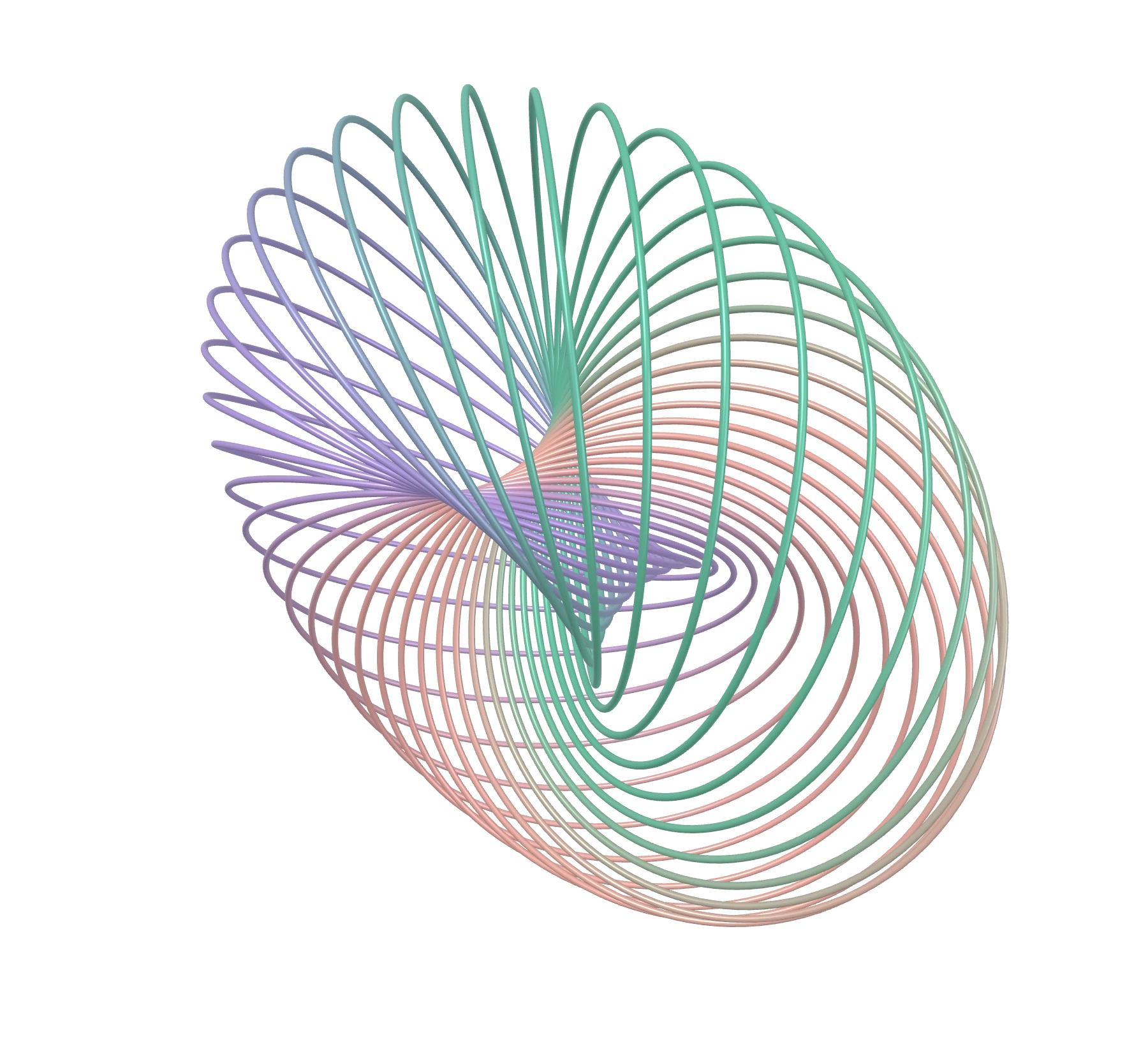
Each circle is linked to all the others. Choose a pair to see how the connection holds.
Why these circles?
Every circle links every other. You can bend or stretch the loops without breaking those connections; separating them would require cutting one or passing it through another. These lasting relationships illustrate the loop record in Recognition Science’s account of why space has three dimensions.
The curves are exact Hopf fibres, with an artistic choice of arrangement, color and lighting.
Read the paper: Three dimensions from a recognition requirement
Read the paper: From one generator to loop order on the three-cube
Live simulation
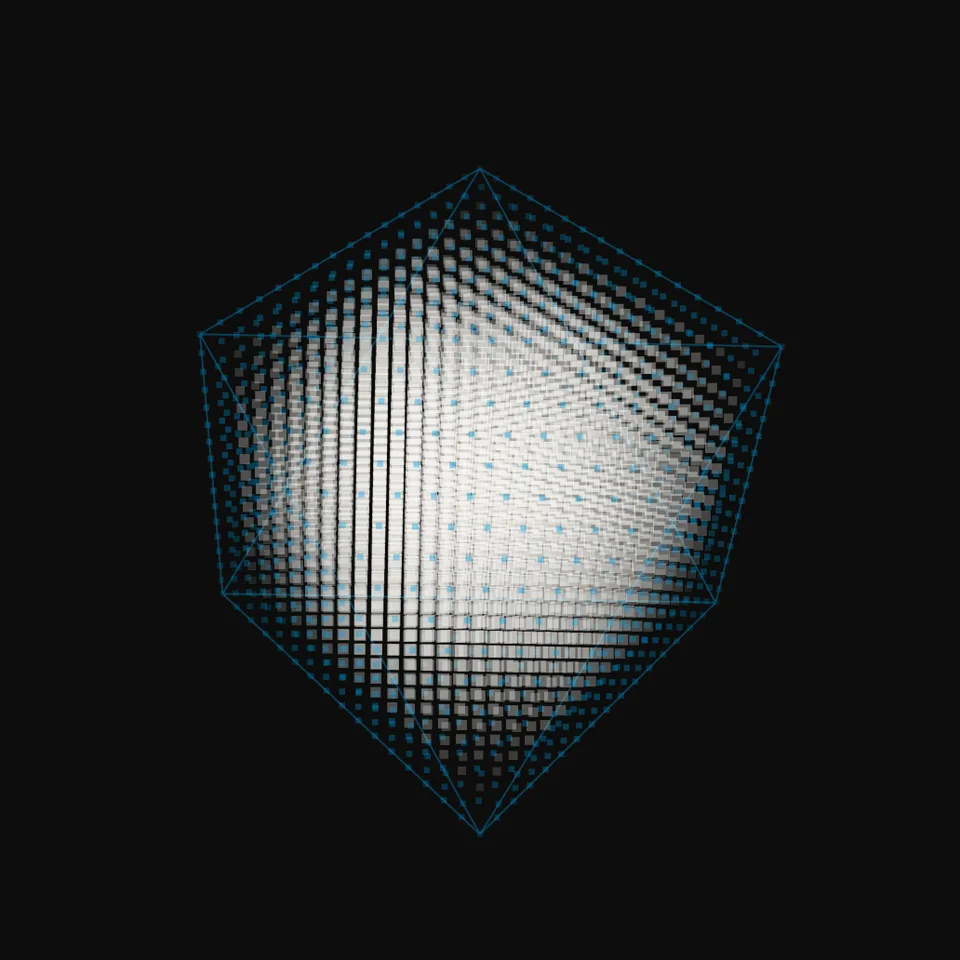
The picture: every place one recognizer’s record can reach after 16 ticks, brighter where more lawful histories arrive.
We are simulating reality from the first recognition event, in exact arithmetic. Each step is a definition in our Lean library, every history the law allows is kept, and your browser recomputes the early stages as you watch.
The page shows how far the simulation reaches today, what is proved at each stage, and the open problem at its frontier. It changes as the work does.
Open the simulationOur scientific foundation
Recognition Science is the discovered architecture of reality. It begins with distinction and the requirements of consistent recognition, and derives a fixed mathematical foundation for physics.
A forcing result explains why a structure has to take the form it does: the requirements leave no alternative within their stated scope. We follow those consequences into matter and energy, connecting the proofs to physical processes and testing what they predict.
Explore Recognition ScienceApplied research
A protein’s shape determines much of what it can do. We study the physics of folding and binding to understand disease at the molecular level and guide the design of treatments.
Fusion power depends on controlling a hot, moving plasma. We study its behavior and develop the physics and engineering needed to turn fusion into a practical source of abundant energy.
We use Recognition Science to develop quantum algorithms and study how quantum states maintain the relationships that make computation possible, including in processors that work with light.
Our people
Our work connects mathematical foundations with molecules, plasmas, light and computation. The team brings the expertise needed to move between a formal result and a physical experiment.










Selected research
A theorem tells us what follows from its premises. An experiment tells us what happened. These three projects show how we use both, with AI helping to discover and verify new mathematics.
Mathematics · Published
If one length is twice another, the second is half the first. Our formula treats those two views equally. The paper proves that this formula is uniquely selected by its rules: a nonnegative measure, zero at a match, a law for combining comparisons and a fixed scale.
The result supplies a common measure of difference for the framework.
Experiment · Preprint
In eight sequential passes on Quandela’s photonic processor, our team measured correlations in selected photon detections. The counts, analysis and code let other researchers inspect and reproduce the calculation.
The chart shows recorded scores and their sensitivity to readout imbalance. This work establishes a measurement reference; it does not certify entanglement.
Recorded Readout sensitivity
Bars show counting uncertainty.
AI discovery · Proof checked
Physics calculations often divide space into a grid. Cambrian, our AI research system, produced a machine-checked proof of a bound on a cube that holds however fine the grid becomes.
Researchers can add detail to this calculation without weakening the bound, which depends on the cube’s size rather than the number of grid points.
Recognition Science / 90 seconds
When a detector absorbs light or a clock advances, something changes. Recognition Science begins with these physical events and asks how their differences can be compared and carried forward.
A light detector changes when it absorbs a photon, leaving a difference between its earlier and later states. In Recognition Science, “recognition” means a physical process that makes such a difference available for comparison, without requiring a conscious observer.
If one length is twice another, reversing the comparison gives one half. The formula assigns both the same score, called the comparison cost. Move the slider to see how the score changes as the lengths move closer together or farther apart.
To compare a new event with an earlier one, some information about the earlier event must remain. Recognition Science derives the rules these records must follow. The arithmetic of faithful records is fixed by those requirements; changing how the records are written cannot change their arithmetic.
The same difference, either way
Ratio A / B2
Comparison cost0.25
Twice as much and half as much both have a cost of 0.25. At a perfect match, the cost is zero.
J(x) = ½(x + 1/x) − 1
The published proof explains why the rules for combining comparisons and setting their scale select this formula. Here we compare lengths; applying it elsewhere means identifying the quantities being compared and how they are measured.
See how these ideas develop into the wider theory.
Explore the full introductionThe scientific foundation
Recognition Science derives the structure required for events to be distinguished, compared and recorded consistently. Its forcing results establish the foundation we use to explain physical processes and develop their applications.
Explore the scienceMathematical discovery
Cambrian helps researchers discover new mathematics. Its AI agents develop results and proofs, which are checked by Lean, software designed to verify each logical step.
See the discoveriesResearch
How do we compare quantities? What follows for gravity, matter and quantum behavior? These papers develop the answers. Follow an entry to its publication details, or browse the publications by subject.
Shows why the paper’s rules for combining comparisons and setting their scale select a unique formula. It treats twice as much and half as much as the same degree of difference.
Derives arithmetic from records of repeated distinction. Under the stated rules, every faithful counting system carries the same arithmetic; the choice of marks cannot change it.
Compares several quantities at once and derives the resulting geometry. The measure of difference depends on one underlying direction in the space of comparisons.
Derives Newton’s law of gravity, with a small correction, from a model built from discrete information. It compares the result with galaxy rotation without adjusting a separate parameter for each galaxy.
Uses the golden ratio to organize the timescales and vibrations of water’s hydrogen bonds. A measured timescale sets the scale, and a second measured relationship connects the model to the liquid.
Reports photon correlations measured in eight sequential passes on a commercial processor. The archived counts and code provide an inspectable measurement reference, with an analysis of readout imbalance and the limits of the experiment.
Collaborate with us
We welcome researchers and partners with a problem our science could help address, or an experiment that could put it to the test.
hello@recognitionphysics.orgBring a question, a mathematical idea or an experiment that could advance the work.
Discuss a research ideaFind where our work in energy, medicine, intelligence or quantum computing could connect with yours.
Start a conversation