RECOGNITION
PHYSICS INSTITUTE

Our Science / Recognition Boundary Theory

Reality’s record draws its own perspectives.

One world holds many points of view. A perspective here means a participant inside a boundary, together with its record; no observer draws the boundaries and no outside environment is averaged away.

Exact walls, one cell’s four motions, settling records: provedNative step, genesis state, contact timing (main premises): suppliedThat a perspective experiences (main identification): identified, not derived

One cell, 64 basic states

40of 64 free of neutral weight

Before any posting

16of 64 free of neutral weight

Through every record of one

8of 64 free of neutral weight

Through records of up to two

4of 64 free of neutral weight

Through three, and forever

  • Free of neutral weight so far
  • Holds or can take neutral weight
  • The four motions: never take neutral weight
Of the cell’s 64 basic states, 40 are free of neutral weight before any posting, 16 through every record of one posting, 8 through every record of up to two, and 4 through three and forever. The four cyan states, two persistent loop currents and the two states of one oscillation, never leak, and neither does any blend of them.

The words, in plain terms Ledger · Posting · Cell · Pole states · Mixed, balanced · Loop edge · Neutral weight · Participant · Lineage · Native event · Boundary · Perspective

The question

What draws the edge of a point of view?

Philosophers asked how one world holds many points of view, and where the walls between minds lie. Physics needed a line between the observed system and the observer, and no equation placed it. It did find walls between groups of states (superselection). Some are exact, drawn by a symmetry, and no measurement crosses them; others are approximate, and emerge when a surrounding environment keeps recording one preferred set of states. This page shows walls drawn by the ledger’s own events. They separate the beginnings a history can have, not observer from observed, nor two minds side by side.

  1. 1714

    The same town, seen from many sides.

    “And as the same town, looked at from various sides, appears quite different and becomes as it were numerous in aspects [perspectivement]; even so, as a result of the infinite number of simple substances, it is as if there were so many different universes, which, nevertheless are nothing but aspects [perspectives] of a single universe, according to the special point of view of each Monad.”

    Each monad is “a perpetual living mirror of the universe” (§56), and “The Monads have no windows, through which anything could come in or go out” (§7). Leibniz had the many views of one universe, each limited and differentiated by the degrees of its distinct perceptions (§60).

    G. W. Leibniz, The Monadology (1714), §57 (p. 248), §56, §7 and §60; tr. R. Latta, Oxford: Clarendon Press, 1898

    Picture: Acta Eruditorum, Supplementa VII (Leipzig, 1721), p. 508. Scan: Wellcome Library; Public Domain Mark.

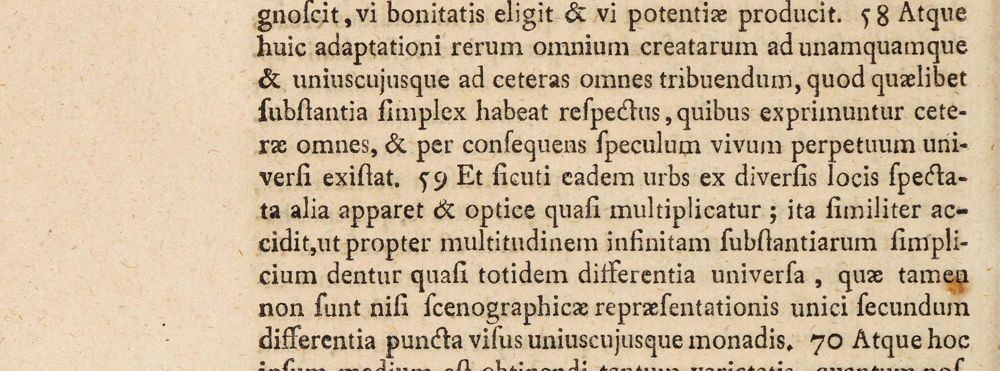
    A page of Latin in eighteenth-century type: the Monadology’s sections on the living mirror of the universe and the town seen from different places.Enlarge

    The Monadology’s first Latin printing (a German translation had appeared in 1720): Acta Eruditorum, Supplementa VII (Leipzig, 1721), p. 508. This printing numbers the modern §§56-57 as 58-59: “speculum vivum perpetuum universi” and the town seen from different places. Scan: Wellcome Library; Public Domain Mark.

  2. 1886

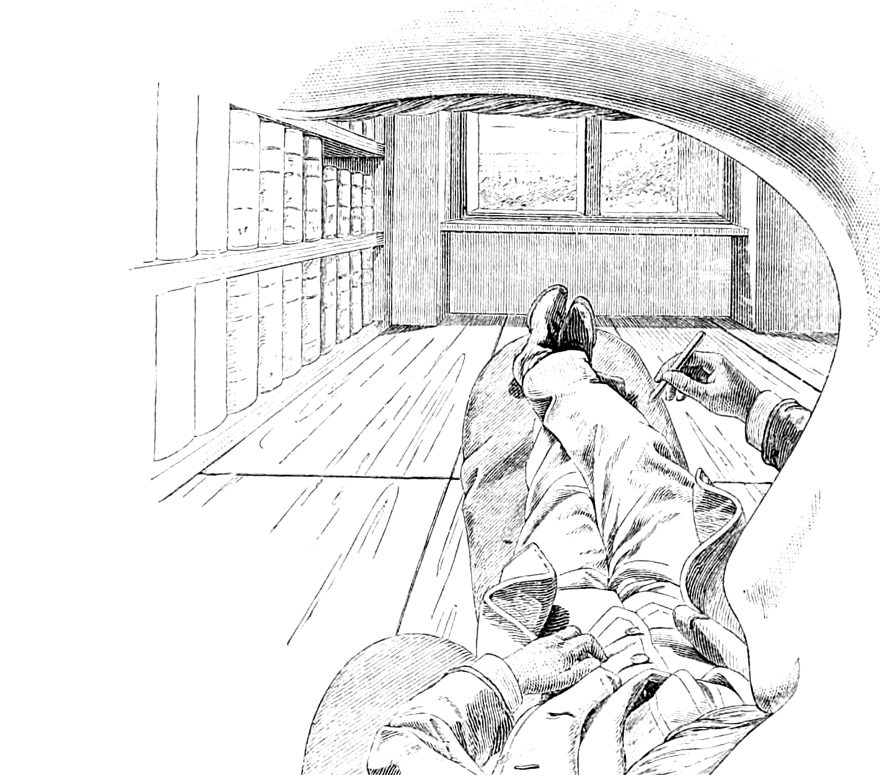
    A point of view, drawn.

    “Thus, I lie upon my sofa. If I close my right eye, the picture represented in the accompanying cut is presented to my left eye.”

    Mach draws the world from inside one eye, framed by brow, nose and moustache, and doubts the self has a sharp edge: “the boundaries of bodies and of the ego do not admit of being established in a manner definite and sufficient for all cases”.

    Ernst Mach, Beiträge zur Analyse der Empfindungen, Jena: Gustav Fischer, 1886, Fig. 1, p. 14; The Analysis of Sensations, Open Court, 1914, pp. 18-19 and 23

    Picture: Mach’s Figure 1, p. 14. Scan: Royal College of Surgeons of England; Public Domain Mark.

    An engraving of a room seen from inside one eye: the brow and nose frame the view, a man’s legs stretch out on a sofa toward a window, and his hand holds a pencil.Enlarge

    Mach’s Figure 1: the room seen from inside his left eye. Beiträge zur Analyse der Empfindungen (Jena, 1886), p. 14. Scan: Royal College of Surgeons of England; Public Domain Mark. Toned to grey to remove show-through from the back of the page.

  3. 1890 · 1909

    Insulated minds, and a sentence split among twelve men.

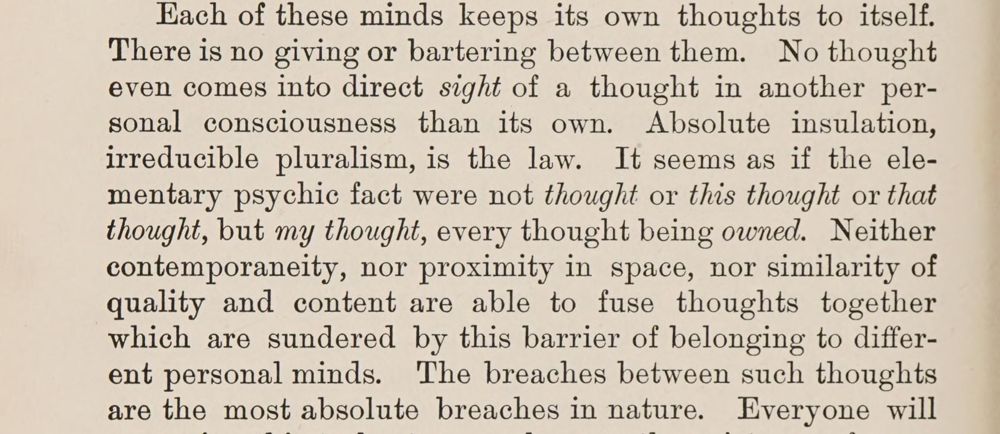
    “Absolute insulation, irreducible pluralism, is the law.” “The breaches between such thoughts are the most absolute breaches in nature.”

    Each mind keeps its thoughts to itself, James says. Give twelve men one word each of a sentence, however arranged, and “nowhere will there be a consciousness of the whole sentence.” His twelve men pose the composition question: do separate views add up to one?

    William James, The Principles of Psychology, New York: Holt, 1890, vol. 1, ch. IX, p. 226; ch. VI, p. 160

    Picture: The Principles of Psychology, vol. 1, p. 226. Scan: Wellcome Library; Public Domain Mark.

    1909 James gives up the view behind his twelve men.

    “For many years I held rigorously to this view”

    Nineteen years later, James writes of that view in Lecture V and gives it up in Lecture VII. Whether parts make one point of view stays open.

    William James, A Pluralistic Universe, London: Longmans, Green, 1909, Lecture V (“The Compounding of Consciousness”) and Lecture VII

    A printed paragraph from page 226 of The Principles of Psychology, beginning “Each of these minds keeps its own thoughts to itself.”Enlarge

    The Principles of Psychology (New York, 1890), vol. 1, p. 226. Scan: Wellcome Library; Public Domain Mark.

  4. 1932

    The cut no equation places.

    “wir müssen die Welt immer in zwei Teile teilen, der eine ist das beobachtete System, der andere der Beobachter … Die Grenze zwischen beiden ist weitgehend willkürlich”

    Our translation: we must always divide the world into two parts, the observed system and the observer; the boundary between them is arbitrary to a very large extent. Quantum mechanics needs the line and gives no rule for where it falls.

    John von Neumann, Mathematische Grundlagen der Quantenmechanik, Berlin: Springer, 1932, ch. VI, pp. 223-224

  5. 1940

    The binding problem: how do many parts make one experience?

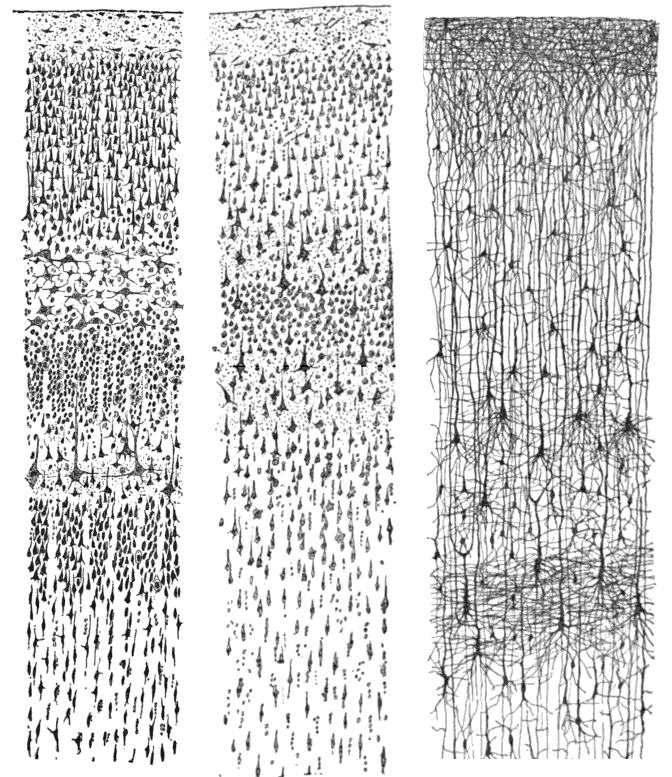
    “Swiftly the head-mass becomes an enchanted loom where millions of flashing shuttles weave a dissolving pattern, always a meaningful pattern though never an abiding one”

    Sherrington’s millions of shuttles weave a pattern; later, Treisman and Gelade write that “focal attention provides the ‘glue’ which integrates the initially separable features into unitary objects.” Step 5 answers a narrower question: with contacts posting in round order, composition creates no kept weight; whether a whole made of participants is one subject is open.

    Charles Sherrington, Man on His Nature (Gifford Lectures 1937-38), Cambridge University Press, 1940, p. 225; Anne Treisman and Garry Gelade, Cognitive Psychology 12 (1980) 97-136, p. 98

    Picture: Santiago Ramón y Cajal (1899), pp. 314, 361, 363. Public domain (Wikimedia Commons).

    Three microscope drawings of stained brain cortex by Cajal, left to right: adult visual cortex, adult motor cortex, infant cortex.Enlarge

    Santiago Ramón y Cajal, “Comparative study of the sensory areas of the human cortex” (1899), pp. 314, 361, 363. Left, adult visual cortex; middle, adult motor cortex (both Nissl-stained); right, infant cortex (Golgi-stained). Public domain (Wikimedia Commons).

  6. 1952

    Superselection: limits on what any measurement can reach.

    Wick, Wightman and Wigner introduce superselection rules. Their walls divide states into sectors, and a symmetry draws them.

    G. C. Wick, A. S. Wightman and E. P. Wigner, “The Intrinsic Parity of Elementary Particles,” Physical Review 88 (1952) 101-105

  7. 1974

    Can an outside description capture a point of view?

    Nagel argues that what it is like to be a bat is tied to the bat’s point of view, which an objective physical description leaves out, and that we do not yet understand how identifying experience with a physical process could be true.

    Thomas Nagel, “What Is It Like to Be a Bat?”, The Philosophical Review 83 (1974) 435-450

  8. 1981-1982

    Walls that emerge when an environment keeps recording.

    Wojciech Zurek shows approximate superselection emerging when an environment keeps recording a preferred basis. Here the line between sectors comes from what surrounds a system.

    W. H. Zurek, “Pointer basis of quantum apparatus: Into what mixture does the wave packet collapse?”, Physical Review D 24 (1981) 1516; Physical Review D 26 (1982) 1862

  9. 2026

    Recognition Boundary Theory: walls from the ledger’s own events.

    It gives exact walls between the beginnings a history can have, drawn by the ledger’s own events, and, in one cell, four motions and every blend of them that the postings keep. It does not answer Nagel’s question: its identification is the kind of claim Nagel says we do not yet know how to understand.

    J. Washburn, Recognition Boundary Theory: How One Ledger Holds Many Perspectives, preliminary manuscript, not peer reviewed, 28 October 2026 (below)

The ledger’s own events draw exact walls between beginnings.

How it works

One explicit step, with stated choices, gives boundaries, participants and records.

Recognition Science starts from three facts: occurrences can be told apart; comparing them needs information about both; and examining a record is itself a further occurrence. Followed through, they give one ledger, reality’s permanent record: every recognition event (an occurrence told apart from another and recorded) is a posting, and every posting leaves a record. Everything below is worked out for one explicit operation, the native recognition step. It is the ledger’s basic operation, taken here as given, not derived: it acts on one cell and writes a label, a current on three edges, to the cell’s record. A cell is two sites, each occupied or empty and each with a four-state clock: 64 basic states. Which physical interactions carry it out is open; step 1 states exactly what it does. Three layers come out of it: boundaries, participants and records. The ledger’s own events divide its histories into lineages, starting tracks fixed when a history begins. Its own steps keep exactly the participants: in one cell, the states built from the four motions, each writing on the loop edge at every step and never falling silent; every state with some weight off the four motions can fall silent.

1 · Cell and step

Each step acts on the cell and writes a current label.

Take one cell: two sites, each occupied or empty, each with a four-state internal clock. Four occupations (00, 10, 01, 11) times four pole states for each clock (p, a, P, A; see “Pole states” in The words, in plain terms, below) make 64 basic states; each site with its clock has 8 basic states, as many as the 2 × 2 × 2 configurations of three binary coordinates. One step is one posting: the sites trade occupations, then each clock advances, reads the occupation bit that arrived and writes its site’s new bit, keeping or flipping it, so a posting can fill or empty a site; the step writes a current on three edges arranged in a ring. The middle edge, the loop edge, carries current exactly when the step starts from a mixed occupation (one site occupied, one empty: 10 or 01), and that current moves a counter, the loop flux. The labels the steps write are the cell’s record.

Manuscript, Chapter 2; Theorem 2.4; Propositions 2.1, 2.7 and 2.8; Example 2.18

More

Each nonzero part of the current is booked as one debit or credit. A single debit or credit is the cheapest nontrivial monotone change to a ledger under the canonical recognition cost of Recognition Science, J(x) = ½(x + 1/x) − 1. The step and the routing of its current through the loop edge are taken as given from recognition dynamics, not derived here.

2 · Boundaries

Boundaries are exact walls, fixed when a history begins.

Begin a history (a run of postings) with weight on two lineages, each a starting occupation and loop flux: occupation 00 at loop flux 0, and occupation 10 at loop flux 3. Its boundary is exactly those two lineages, at every later stage. Change how much weight each has, or post a thousand times: the boundary stays the same. Remove one lineage’s weight and that lineage leaves the boundary.

These walls separate the different beginnings a history can have; they are not walls between two participants side by side. A larger family of reads (operations that read the history, among them the retained read of recognition dynamics) crosses some of these walls, though never one between lineages with different starting loop fluxes, and which family acts inside the ledger is open.

Manuscript, Chapters 4 to 6; Example 5.2; Theorems 5.4, 6.5 and 6.13

More

A boundary is a closed subspace of histories that no native event carries a state out of (a native event is the question whether a history sits at one point: stage, loop flux, occupations and clock positions, and record so far). Every boundary is made of indivisible atoms; the atoms a history can occupy are lineages, one for each starting occupation and loop flux. They are exact superselection sectors for the ledger’s own events: no native event connects two lineages, no outside environment is traced out, no limit is taken, and the record is kept. Which lineages a history holds is fixed at its beginning, and neither a symmetric rule nor any single operation of the native event algebra picks one out: the genesis state is an initial condition, a supplied premise. The record cannot tell a blend of lineages from a mixture of them, or which loop flux a history started at, though its first label shows whether it started at 10 or at 01.

Figure 1 · Sealed at the start

Live · computed in your browser

With JavaScript on, you set a beginning over lineages (a starting occupation together with a starting loop flux, wherever the two clocks start), post the whole history with every record kept, and see every lineage keep exactly its starting weight, summed over all its records. A phase panel checks every record of three postings: the phase between two lineages changes no record’s probability, while inside one lineage it can; and a rule test shows that a rule respecting the posting’s symmetries picks none, all balanced, all mixed or all lineages, never a single one.

How to read it

A history begins as a blend of one or more lineages. A lineage is a starting occupation of the two sites together with a starting loop flux, wherever the two clocks start. No native event of the ledger connects two lineages: however posting spreads the history over records, every lineage keeps exactly its starting weight. No symmetric rule picks one lineage.

Each square of the grid is a lineage: a starting occupation (● occupied, ○ empty) and a starting loop flux. Set the weights of a beginning and post. The figure posts the whole history, keeping every record, and reads each part of it back to the beginning it came from: from its occupation and loop flux after the last posting, back through its record. The weight it finds on each lineage, summed over all its records, is the starting weight at every stage, and all the weight reads back to a beginning. Each lineage starts its two clocks at the same position here; any clock start gives the same weights. The grid draws three loop values; there are lineages at every loop value.

The phase panel blends two starts, half each, with a phase between them. When the two are in different lineages, every record of three postings has the same probability as in the half-and-half mixture, at every phase: the record cannot tell the blend from the mixture, and cannot tell which loop flux a history started at. It can tell ●○ from ○●: the first posting from ●○ writes a current of +1 on the loop edge into the record, and the first from ○● writes −1. When both parts sit inside one lineage, the phase can show in the records: here, with two clock positions at ●○ and loop 0, it changes the record probabilities. It need not: a blend of the persistent loop current + and the oscillation at ●○ also sits inside one lineage, and its records ignore the phase.

The rule test: a rule that respects the posting’s symmetries (shifting the loop flux; filling the empty sites and emptying the occupied ones, or swapping the two sites with their clocks, each with the loop flux reflected) and picks any lineage must also pick every lineage those symmetries reach: every balanced lineage (○○, ●●) or every mixed one (●○, ○●), at every loop value. Such a rule picks none, all balanced, all mixed or all lineages, never a single lineage. The walls between lineages are drawn by the ledger’s own events: no outside environment is traced out, and the record is kept. A larger family of reads, which includes a read that recognition dynamics supplies (its retained read), crosses some of these walls, though never one between lineages with different starting loop fluxes; taking the native family as the operations inside the ledger is an identification, and which family describes them is open.

What is live, and what is drawn

The weights on the lineages, the record probabilities and the rule test are computed live, and so are the other counts, weights and differences the figure reports; the number of postings, the units of weight and the phase are what you set, and the loop values and the 72 phases are fixed text. It posts the whole history from the chosen beginning with the cell’s own step, up to five postings, every record kept, and reads each part back to its beginning to find the weight on each lineage. The phase panel computes the probability of every record of three postings for a half-and-half blend at the chosen phase and for the mixture. The rule test computes the closure of the picked lineages under the posting’s symmetries. The grid’s three loop columns are a window: there are lineages at every loop value.

Computed in your browser from the cell’s posting rule: the history is posted in full, with no sampling, every record kept, up to five postings, and weights are read back part by part; changes below one part in 10¹² show as 0. Record probabilities are computed for every record of three postings.

3 · Participants

In one cell, posting alone keeps four motions and every blend of them.

Four motions: the occupation stays at 10 while the loop flux climbs by one at every posting; it stays at 01 while the flux falls by one; or it hops across the loop edge, 10, 01, 10 and on, starting at either side (the oscillation, which counts as two). One site is always occupied and one empty, so every posting writes the loop edge: these motions never fall silent.

The four motions and every blend of them never take neutral weight, under any record. Every state with some weight off the four motions can start leaking within three postings (for some record of at most three postings that can actually occur, the state given that record has some neutral weight), and three is the least. A blend of the four motions never leaks, and its first posting already shows which motion is present; from then on that motion continues. These states are exactly the ones that pass the eight-tick window every time: Recognition Science’s criterion of eight ticks with none silent, read here as eight postings in a row, each writing the loop edge (that reading is supplied). The work calls them participants. The class is defined by posting alone, with no test assumed, and the eight-tick criterion names the same class. On a network, the participants are the states its round order keeps (step 5).

Manuscript, Chapter 2 (Table 2.1); Theorems 7.11 and 7.16; Corollaries 7.15 and 7.17; Section 8.6

More

Neutral weight is weight where the sites are mixed (one occupied, one empty) but at least one clock sits on an undressed pole, p or a; “neutral” refers to the clocks, not electric charge. Before any posting, 24 of the 64 basic states carry it. After one, two and three postings, a cell wholly on neutral weight has written the loop edge at every posting with chance 1, 1/2, 1/4. The ready vector (both sites empty, clocks on p and a) stays free of neutral weight through every record of one or two postings and first leaks at the third, with probability 1/2. Through every record of one posting, 16 basic states stay free; through records of up to two, 8; through three, 4, and those 4 stay free forever.

Figure 2 · Postings keep four motions and every blend of them

Live · computed in your browser

With JavaScript on, this figure runs live. Pick a start for one cell, or blend two, and post: every row shows each record the start can write, with its probability, and how much of the cell each record leaves on the four motions and in neutral weight. Its grids count the basic states still free of neutral weight: 40, 16, 8, then 4, and 4 forever.

How to read it

One cell of the ledger has 64 basic states, and every other state is built from them: two sites, each occupied or empty, and a clock at each site in one of four pole states. Every posting writes one label onto the record and steps the cell. Step through the postings: every one of the 64 except four holds neutral weight from the start or can, within three postings, write a record after which the state given that record has some neutral weight. The four that never leak, at any length, are four motions: two persistent loop currents of opposite direction, and the two states of one oscillation of occupation across the loop edge (at ●○ and at ○●, one posting apart). Every blend of them never leaks either; the work calls the four motions and every blend of them the cell’s participants.

The grid shows the 64 basic states of one cell, a basis from which every other state is built: four blocks for the four occupations of its two sites (● occupied, ○ empty), and in each block the four pole states p, a, P, A of the first site’s clock by row and of the second site’s clock by column. A basic state can start leaking at posting n when, for some record of n postings with positive probability, the state given that record has some neutral weight; the number in its square is the first such n, and 0 means it holds neutral weight from the start. Of the 64, 24 hold neutral weight from the start, 24 more can start leaking at the first posting, 8 at the second and 4 at the third. The other 4 never leak, the four motions: the persistent loop currents + and −, whose loop flux climbs or falls by one at every posting, and the oscillation at ●○ and at ○●, one posting apart, whose occupation hops across the loop edge, from one site to the other, at every posting, keeping the loop flux within one unit of its start. From three postings to four the set of states still free of neutral weight stays the same, and once one more posting changes nothing, no longer record can; so these four never leak, at any length. Neutral weight sits only on the occupations ●○ and ○●, on states where at least one clock is in p or a; the word refers to the clocks, not to electric charge.

The rows follow the chosen start. Each row lists every record it can write in that many postings; a record’s width is its probability, and its colours split the state given that record: cyan on the four motions, grey hatched neutral, plain grey elsewhere. Never falling silent, which the colours do not draw, means writing the loop edge (a nonzero middle current in its label) at every posting. The four motions do it at every posting, with certainty. A cell wholly on neutral weight writes it at each of its first two postings with probability one half, and at each of its first three with one quarter; the Neutral column shows something else, the neutral weight itself. The ready vector is the basic state ○○ p, a. Each of the four motions writes one record of each length and stays wholly on the four motions; every state with some weight off the four motions can, within three postings, write a record after which the state given that record has some neutral weight. Blend two basic states with the Blend button to see that a blend of motions never leaks and a blend with anything else can start leaking. When one of the four motions is chosen, a Motion line steps it through the postings, and each record’s tag gives its occupied sites and how far it has moved the loop flux: the sum of the middle currents of its labels. The number at the end of each row, in the Neutral column, is the neutral weight of the state given each record, averaged over the row’s records by probability.

What is live, and what is drawn

Every record and grid in the figure is live, and so are the counts on the posting buttons and the two large readouts. The grids are computed in your browser from the cell’s posting rule when the figure loads; the records, their probabilities, the split of the state given each record and the weight on the four motions are computed from that rule each time you choose, blend or disturb a start. Nothing is a picture or a recording. The grids’ counts come from an exact rank computation; random, blended and disturbed starts use double precision. Each record’s tag is computed from that record too. The grey hatching marks neutral weight in the rows and, in the grid, the basic states that hold it, or can start leaking, within the postings shown.

Computed in your browser from the cell’s posting rule: 64 basic states, 15 record labels. The grid and the rows for basic states use exact arithmetic; random, blended and disturbed starts use double precision.

4 · The record decides

A state’s own record decides whether its present tends to the four motions.

In general, follow a state’s weight on the four motions, given its record so far. Along every infinite record it goes to 1 or to 0, and it goes to 1 with probability equal to the state’s starting weight on them. Here probability is the record law, the Born weight of each record; that records occur with these probabilities as frequencies in repeated trials is a separate statement about apparatus, not derived here. Averaged over records, the part still undecided after n postings (n ≥ 2) is at most 2−(n−1) times the state’s neutral weight. A single record can stay undecided for a long time, and no fixed finite stretch of record decides for every state. This has the structure of repeated nondemolition measurement (Bauer and Bernard, 2011); the bound 2−(n−1) at every n ≥ 2 is this work’s. Here the work reads the cell’s state given its record as the present. That is an identification, a reading and not a theorem; read that way, the record settles the state’s own status.

Take a participant in one of the four motions. It writes its motion at every posting, so any one posting tells which motion it is. Read the third posting or the seventh: the two readings agree with certainty. Every posting is a witness.

Manuscript, Theorems 8.4 to 8.6 and 8.11

Figure 3 · The record decides

Live · computed in your browser

With JavaScript on, you pick a case or set the weight and the rest, then post one at a time or replay 16 postings over 100 sampled records. Take weight 1/2 on the four motions (the case Decides slowly), carried by the persistent loop current, which writes (1, 1, −1) at every posting, and the rest on ●○ a, P. The record that writes (1, 1, −1) at each of its first four postings has chance 17/32 and leaves weight 16/17; as it keeps writing (1, 1, −1), that weight tends to 1, reaching it at no finite length. Any other record leaves weight 0. With weight 9/25 and the rest ●○ A, P, one posting decides.

How to read it

Each posting writes a label to the cell’s record, and given the record so far the cell’s weight on the four motions can change. Each square is one sampled record.

Weight on the four motions means weight on the four motions and every blend of them (the space they span). Here the four motions’ part of the state is the persistent loop current +, which writes the label (1, 1, −1) at every posting (a label is the current on the cell’s three edges; its middle entry is the current on the loop edge). A record is the list of labels the postings write. The state given the record is the cell’s state given that list, and the weight on the four motions is read from it. Its average over the next posting’s label, each label weighted by its probability given the record so far, equals its value given the record so far (it is a martingale). Writing never mixes the four motions’ part of the state with the rest, so the record law is the sum of the laws of the two parts, with no cross term. The loop current’s part writes (1, 1, −1) at every posting, so a record that writes any other label has weight 0 on the four motions from then on. So along every infinite record the weight tends to 0 or to 1. It can tend to 1 only along the one record that writes (1, 1, −1) forever, and it does so when the starting weight w on the four motions is above 0; that record has probability exactly w.

How fast is limited by the state’s neutral weight: weight where the sites are mixed (one occupied, one empty) but a clock sits on an undressed pole (p or a). Averaged over records, the part still undecided after n postings (n ≥ 2), the average of v(1 − v) where v is the weight given the record, is at most 2⁻⁽ⁿ⁻¹⁾ times the starting neutral weight, so at most (1/128)ʳ after 8r postings. A state with no neutral weight is decided by its first posting: with w = 9/25 and the rest ●○ A, P, the first label is (1, 1, −1) with probability 9/25, leaving weight 1, or (0, 1, −1) with probability 16/25, leaving weight 0. No fixed finite stretch of record decides for every state: ●○ a, P has no weight on the four motions, yet it writes (1, 1, −1) at each of its first n postings with chance 2⁻ⁿ (and the loop edge at each of them with chance 2⁻⁽ⁿ⁻¹⁾), which the loop current + does surely. The infinite record decides: a state’s chance of writing, forever, the list of labels one of the four motions writes is exactly its weight on the four motions.

Reading the state given the record as the cell’s present is an identification; read that way, the record settles whether the present tends to the four motions.

What is live, and what is drawn

Everything is live. Your browser computes every number from the cell’s posting rule. Each sampled record draws its labels with the probabilities set by the state given the record so far, so the counts out of 100 can change each time you press New records; the chance at each posting stays fixed until you change w or the rest (exact fractions for the two named rests, computed in double precision for a random rest). The sampling is the browser’s way to show the record law; the work does not claim that single occurrences sample it. The starting weight, the rest and the persistent loop current as the four motions’ part are chosen here, not derived. The squares and lines are drawings of computed values.

Computed in your browser from the cell’s posting rule: each sampled record draws its labels with the probabilities the state given the record assigns; the exact numbers apply the posting rule to the loop current’s labels, (1, 1, −1) at every posting, and are shown as fractions for the two named rests and computed in double precision for a random rest.

5 · Networks

Contacts take turns; two even-or-odd checks decide which clock patterns can be kept.

In general, on a network whose contacts (pairs of sites that post together) post in a fixed round order, and with every touched clock on a dressed pole (P or A; a touched clock on p or a is never kept), two parity checks decide which patterns of clocks can be kept: one across every contact and one around every closed loop of contacts. For a given configuration the test is per contact and per position in the order. With contacts posting in their round order, composition creates no kept weight: a whole holds none its beginning lacked, and on a connected network each contact’s own test keeps exactly what the whole network keeps. A posting out of turn can create a participant, so the round order is part of the statement. The order, the orientation of contacts, the gate and the independence of attempts are supplied. On the ledger’s torus (its grid of sites, wrapped around in each direction, where one post moves one unit one step), with the network’s sites taken as its sites, three premises place contacts on every nearest-neighbour pair: locality, a contact rule with the torus’s symmetries, and one existing contact.

A centre site is joined by contacts to three partners, every clock on the dressed pole A, with occupations 0 at the centre and 1, 0, 1 at the partners in the order their contacts post; with these choices, as the A clocks flip occupations through the round, every posting meets a mixed pair (Example 12.20). Replace each partner by an exact copy (same clock, same occupation), one at a time. At every stage every posting meets a mixed pair, so the configuration never falls silent. Whether the centre is the same participant throughout is open.

Manuscript, Propositions 12.4, 12.19 and 13.21; Example 12.20; Theorems 12.16, 12.17, 13.5, 13.9, 13.13, 13.14, 16.4 and 16.6; Lemma 16.2

More

What separates two participants side by side? Not a lineage wall: lineage walls separate the different beginnings a history can have. Within one connected network, with contacts posting in their round order, participation is joint, and one contact’s own test keeps exactly what the whole network keeps; the work reads this as: nothing in the postings separates them, and only a network that is not connected separates its participants. What stays apart is narrower: every record on every network reads each site through only 12 of the 64 independent quantities measurable at a site, so no record compares the turning directions of two clocks, although a participant does read a neighbour’s site through a shared site, within those 12. Whether two participants are one subject is open.

Figure 4 · The parity law on a network

Live · computed in your browser

With JavaScript on, you build a small network, set each clock and bit, and run its postings in round order; the figure checks the two parity conditions beside the actual postings. The triangle keeps 8 states in 4 clock patterns; with every clock A, four fully joined sites keep the joint oscillation in 192 of the 720 orders of their contacts.

How to read it

Contacts can share sites. The parity law is about configurations in which every clock on a site with contacts is one of the two dressed pole states, P or A; a configuration with a clock on p or a at a site with contacts is never kept. Here every clock is P or A. The Star network is the example of step 5: a centre with three partners, every clock A, bits 0 at the centre and 1, 0, 1 at the partners in the order their contacts post.

Each site has an occupation bit, 1 when occupied (●) and 0 when empty (○), and a clock; the small numbers name the sites. The clocks here are the two dressed pole states: P, which keeps its site’s bit when a posting meets a mixed pair, and A, which flips it. A contact posts on its two sites with the cell’s own step, contact after contact in the round order shown. A posting that meets a balanced pair (both sites occupied or both empty) branches: with these clocks it can write any of four labels, and the configuration is not kept.

The parity law: with these clocks, every posting meets a mixed pair, in every round, exactly when (i) at every contact u–v, f(u)·deg(u) = f(v)·deg(v) mod 2, where f is 1 for A and 0 for P and deg counts a site’s contacts; and (ii) at every position i of the order, the two starting bits (as set, before the run) add to γ = 1 + f(u)·ν(u) + f(v)·ν(v) mod 2, where ν (the Greek letter nu) counts the contacts through that site that come before position i. The parity-law box checks both conditions; the strip runs the actual postings. In its round order, the states the postings keep on a network are spanned by these configurations; a site with no contact is free to carry any bit and any of its four pole states. With every clock P, a configuration is kept exactly when its bits alternate across every contact (each contact of a kept configuration carries a persistent current); some bits do this exactly on networks with no odd cycle, and the triangle frustrates them. With every clock A, the six contacts of four fully joined sites keep the joint oscillation in some orders and nothing in others: 192 of the 720 orders keep it.

What is live, and what is drawn

The postings and the counts are live. Each posting is the cell’s own native step applied to the contact’s two sites, and the counts are computed in your browser. The contacts, their orientation and their round order are chosen here; none is derived for these networks, and no posting order is forced.

Computed in your browser from the cell’s posting rule: every posting applies it to the contact’s two sites, and the counts run every choice of P or A clocks and bits on the sites with contacts through three rounds and compare the result with the law. The contacts, their orientation and their round order are chosen here; none is derived for these networks, and no posting order is forced.

6 · The present

Away from the four motions, the chain of definite states carries a steady one-way current with no outside driver.

Along almost every record, the present comes as close as you like to a definite state in the long run, and away from the four motions it keeps moving among such states, carrying a steady one-way current with no outside driver.

Purity is 1 for one definite state and below 1 for a mixture, which combines possibilities with probabilities. The record leaves no part of the cell where the present (step 4) can stay a mixture. It never reads which way a clock turns. Yet along almost every record purity tends to 1: in the long run the present comes as close as you like to being one definite state. No collapse is assumed. Maassen and Kümmerer’s purification of quantum trajectories is the same kind of result.

In the long run, along almost every record, the present comes close to one of 256 pointer lines (figure 5). Each line fixes which sites are occupied and sets each clock to a pole or standing wave (a blend of two poles: p+a, p−a, P+A, P−A). Each clock has 8 options, not 4, giving 256 lines, not 64. Moving among them as a classical chain, with probability 1 it enters one of five closed classes (sets of lines it never leaves) and leaves the other 144 lines for good.

In the three classes holding the four motions, its steady state runs the same backward as forward. In the other two, the present’s chain of lines carries a steady one-way current: around one closed walk of lines (a loop back to its start) it adds up to 1/24 in one class and 3/112 in the other. Nothing outside drives it. The orientation of the native step (the one basic operation everything is worked out for) sets the current’s direction. Reading the current as an arrow of time is an identification; the work does not claim it is the direction of time we feel.

Manuscript, Theorems 10.5, 10.14, 10.17, 11.1 and 11.4; Corollary 10.12

More

Take the cell’s state given its record, read as the present in step 4. The record leaves no part of the cell where this state can stay mixed, though it never reads a turning direction, so along almost every record its purity tends to 1 (in the long run it comes as close as you like to being pure), as in Maassen and Kümmerer’s purification of quantum trajectories; this is not a collapse rule.

In the long run, along almost every record, it comes close to one of the cell’s 256 pointer lines (figure 5), each a definite state, and moves among them as a classical chain, ending in one of five closed classes of lines it never leaves; the other 144 lines are left for good. On the three that hold the four motions it runs, in its steady state, the same backward as forward. On the other two it keeps moving, carrying a steady one-way current that no potential explains (Kolmogorov’s criterion fails around two explicit closed walks), with no heat bath or imposed boundary condition; the native step’s orientation sets its direction. Around one closed walk of lines it totals 1/24 in one class and 3/112 in the other. Reading it as an arrow of time is an identification, and the work does not claim it is the direction of time we feel.

A clock turning one way and the same clock turning the other way write the same record law. Recording erases a clock’s turning direction: no sequence of postings reads it, it is not kept in the present, and it survives only as phases between alternative records. The ledger still keeps every entry.

Figure 5 · The present as a chain

Live · computed in your browser

With JavaScript on, the figure colours each of the cell’s 256 pointer lines by where it lies, computed from the cell’s step: in the three classes of the four motions, the 64-line class, the 44-line class, or among the 144 lines outside the closed classes. Put the present on any line and post: it moves at the chain’s probabilities. Two closed walks of lines, one in the 64-line class and one in the 44-line class, show the one-way current: in exact fractions, the current on their steps adds to 1/24 and 3/112.

How to read it

A pointer line is an occupation of the two sites and, for each clock, a pole (p, a, P, A) or a standing wave (p+a, p−a, P+A, P−A). Once on a line, the present moves at each posting to a next line, with probabilities that depend only on the line it is on: a classical chain.

The chain is computed from the cell’s own step: one posting carries each pointer line to one line for each label it can write, with that label’s probability (1/4, 1/2 or 1). The figure reads the cell’s state given its record as the present; that reading is an identification. From every start, on almost every record, this state comes as close as you like to the 256 pointer lines in the long run; averaged over records it does so at a proved but far-from-sharp rate, and no collapse is assumed.

Five closed classes, sets of lines the chain never leaves, inside which every line can reach every other: the three that hold the four motions (the persistent loop current +, the persistent loop current −, and the two states of the oscillation); a class of 64 lines, in each of which exactly one clock sits on its zero plane; and a class of 44 lines, in each of which both clocks sit on their zero planes or neither does. (A clock’s zero plane is P, A and their standing waves when the two sites agree, and p, a and theirs when they differ; lines outside the classes can share either property.) The other 144 lines are left for good with probability 1: after 2m postings at most 2⁻ᵐ of the weight remains on them. Each class has a conserved weight, the present’s weight on the space spanned by the class’s lines (lines outside the classes can carry part of it): averaged over records by probability, it is the same after every posting. On the three classes of the four motions the chain, in its steady state, runs the same backward as forward: its stationary current is zero. On the 64-line and 44-line classes the stationary current is not zero; it is divergence-free (as much flows into each line as out of it), and around the two closed walks shown it adds to 1/24 and 3/112, so no potential explains it: a current made of differences of a potential adds to zero around every closed walk. Every reverse step on those walks has probability 0.

What is live, and what is drawn

Every computed number in the figure is live; the class sizes and line counts in the key and header are fixed labels that match the computation. It applies the cell’s step to each of the 256 lines, finds the closed classes, solves each class’s long-run law in exact fractions, and computes the current on every step and its sum around each of the two closed walks, which are the manuscript’s (Theorem 11.4), chosen rather than searched for. The present’s moves are sampled at the chain’s probabilities. The walk drawings are drawings of the computed walks; the moving stroke shows the current’s direction only.

Computed in your browser from the cell’s posting rule: the 256-line chain, its closed classes, their stationary laws and currents in exact fractions, and the weight not yet in a closed class; the present’s moves are sampled at the chain’s probabilities.

7 · Perspective

A perspective is a participant, its boundary and its record.

With participants, boundaries and records in hand, the work defines a perspective: a participant inside a boundary, together with its record. A participant is one part of a perspective, not the whole of it. The definition is the work’s proposal for what the word should name, and the theorems characterize what it names. Each part is fixed by the native step, its records and the stated choices: the algebra of native events that defines boundaries, and on networks where contacts sit and when they post. The eight-tick window names the same participants (step 3).

Manuscript, Theorem 11.6; Definition 22.1

More

Far from the start, the odds of each new posting, averaged over the record so far, depend on the starting state through six numbers, five of them free: its weight on each of the five classes (they sum to one), and one oscillation phase (how the oscillation’s weight divides between the two sides of the loop edge at even postings). Everything else about the start fades at least by half every eight postings. The ledger keeps every entry; what fades is the start’s influence on new postings.

The words, in plain terms

Ledger
Reality’s one permanent record. Every recognition event, an occurrence told apart from another, is written into it, and nothing written is ever erased.
Posting
Here, one native step: it acts on a cell and writes a current label (a current on three edges) to the cell’s record.
Label
The current a posting writes on the cell’s three edges, given as three numbers such as (1, 1, −1). Its middle entry is the current on the loop edge. A record is the list of labels a cell’s postings write.
Cell
The unit one native step acts on: two sites, each occupied or empty, each with a four-state clock. Counted in the clocks’ pole states, it has 64 basic states.
Pole states
Each clock’s four special states. Undressed poles: p (unchanged as the clock advances), a (reversed). Dressed poles: P and A (p and a with a fixed sign pattern).
Mixed, balanced
Mixed means one site occupied, one empty (10 or 01; ●○, ○● in the figures); balanced means both empty or both occupied (00 or 11).
Loop edge
The middle of a posting’s three edges. A posting that starts mixed puts current on it, moving a counter, the loop flux; otherwise it is silent.
Weight
How much of a state lies in a part (a set of basic states, a lineage or the four motions): the squared size of the state’s component there, averaged by probability when the state is a mixture. Weights on parts that together cover everything without overlap add to 1.
Neutral weight
Weight where the sites are mixed but a clock sits on an undressed pole (p or a). Wholly on it, a cell’s chance of having written the loop edge at every posting so far is 1, 1/2, 1/4 over one, two, three postings.
Participant
A state the postings keep, never silent. In one cell: one of four motions (two loop currents, an oscillation counted twice) or any blend; on a network, the states its round order keeps. One part of a perspective.
Blend
One state that is a superposition of other states, with a phase between its parts. A mixture combines states with probabilities and no phase between them; it is not a superposition.
Lineage
A starting occupation and loop flux; a history can start with weight on several. The genesis state, where a history (a run of postings) begins, decides which lineages it holds.
Native event
The yes-or-no question whether a history is at one point (stage, loop flux, occupations and the two clocks’ positions, record so far). Boundaries are made from these events.
Boundary
A closed subspace of histories that no native event carries a state out of. The smallest boundary holding a history is exactly the lineages it holds, at every stage.
Perspective
A participant inside a boundary, together with its record, the labels its postings write. The participant is one part of it.
Pointer line
One of the cell’s 256 definite states: both sites’ occupations and, per clock, a pole (p, a, P, A) or standing wave (p+a, p−a, P+A, P−A). Along almost every record, the state given the record comes close to one of them in the long run, and it can keep moving from one to another.

The numbers

What one cell gives.

  • Basic states of one cell

    64

    The cell one native step acts on: 4 occupation pairs × 4 × 4 clock states. Every state of the cell is built from these 64.

    Manuscript, Chapter 2

  • Motions that never leak

    4

    In one cell: two persistent loop currents and the two states of one oscillation. They and every blend of them never take neutral weight, under any record.

    Manuscript, Theorem 7.11

  • Postings that cut them out

    3

    The fewest postings that cut the four motions out: through every record of up to two postings, 8 of the 64 stay free of neutral weight; through three, only 4.

    Manuscript, Corollary 7.15

  • Undecided after n postings, at most

    2−(n−1)

    Averaged over records, the part of a state still undecided after n postings (n ≥ 2) is at most this fraction of its neutral weight. One record can stay undecided longer.

    Manuscript, Theorem 8.4

  • Classes no posting mixes

    5

    Three classes hold the four motions; the other two carry the rest of the cell’s weight. No posting moves weight from one class to another; averaged over records, each class keeps its weight.

    Manuscript, Theorem 11.1

  • Numbers late odds depend on

    6

    Far from the start, the odds of new postings, averaged over the record so far, depend on the start through five class weights and one oscillation phase, five of the six free. The rest of its influence fades at least by half every eight postings.

    Manuscript, Theorem 11.6

What it means

One ledger holds many perspectives as exact structure of its own events.

For the native recognition step, taking the algebra of its native events as the operations inside the ledger (an identification), the results settle where a perspective’s boundary lies, that only a history’s beginning decides which lineages it holds, which states are kept, what a record keeps, and which way the long-run motion runs off the participants.

  1. 01

    The ledger’s own events draw each perspective’s boundary exactly.

    A perspective’s boundary is exact structure of the ledger’s own events (step 2). No observer draws it, no outside environment is traced out, and no limit is taken. A larger family of reads crosses some of these walls, and which family acts inside the ledger is open.

    From the manuscript: Chapter 4; Section 22.6

  2. 02

    Only a history’s beginning decides which lineages it holds.

    A history’s genesis state, the state it begins in, alone decides which lineages it holds, and no later posting changes them (step 2). The genesis state is a supplied initial condition. No symmetric rule picks one lineage out, and no single operation of the native event algebra does.

    From the manuscript: Chapter 5

  3. 03

    In one cell, posting alone selects which states are kept.

    In one cell, posting alone separates the participants, the four motions and every blend of them, from every state with some weight off the four motions, with no observer and no further rule (step 3). On a network the supplied round order decides too; with contacts posting in that order, a whole holds no kept weight its beginning lacked (step 5). Whether a connected network of participants is itself one subject is open.

    From the manuscript: Theorem 7.11; Proposition 12.19; Theorems 13.9 and 13.13; Section 23.3

  4. 04

    In the long run, with probability 1, the present tends toward being definite; nothing written is erased.

    With probability 1, the present gets as close as you want to being definite in the long run: one definite state, not a mixture of possibilities with probabilities (step 6). The present is the cell’s state given its record; that is the work’s reading of the results, not a theorem. Each posting of a participant in one of the four motions shows which motion it is in; readings of any two of its postings agree with certainty (step 4). Nothing written is ever erased (step 6).

    From the manuscript: Theorems 2.14, 8.11, 10.5, 10.17 and 11.6; Corollary 10.12

  5. 05

    In two of five groups, the chain of definite states carries a one-way current nothing outside drives.

    Along almost every record, the present comes as close as you like to a definite state in the long run and moves among such states as a chain, ending in one of five groups it never leaves (step 6). In the three groups that hold the four motions, its steady state runs the same backward as forward. In the other two, its chain of definite states carries a steady one-way current that nothing outside drives; the native step’s orientation sets which way the current flows. Reading this current as an arrow of time is an identification.

    From the manuscript: Chapters 10 and 11; Theorem 11.4

The experiential identification

Where experience enters: as an identification.

Recognition Science reads every recognition event as having an experiential inside, and holds that a complete experience spans eight ticks with none silent; this work reads those ticks as eight postings in a row, each writing the loop edge. It reads a participant, inside its boundary and with its record, as a perspective that experiences: a conscious point of view. In one cell, the states that pass the eight-tick test every time are exactly the states the ledger’s own postings keep. That agreement is proved, though its force as evidence is limited: neutral weight is itself a loop-edge quantity, and reading the ticks as loop-edge postings is this work’s choice. The criterion could still have picked out nothing, or a set the step mixes with the rest; it picks out exactly the kept class. The substance of the match is that the kept class never leaks and three postings expose the rest: a test of two or more postings in a row, each writing the loop edge, passed with certainty, picks out the same class.

That keeping a state in this class is felt from the inside is the identification itself: the work states that step exactly and does not derive it. It judges this the most economical reading of the results, an inference from the theorems and not one of them; the theorems are neutral on whether anything is felt. Two questions stay separate from it: whether a whole made of participants is one subject, and how a participant’s report carries what it feels. On this reading a participant in a single cell, inside its boundary and with its record, would already be a conscious point of view; the work does not say which physical systems realize such cells, and it does not address how the insides of eight postings make one experience. Whether a person corresponds to one participant, a network of them, or neither is open.

From the manuscript: Chapter 22; Theorems 7.16, 13.9 and 13.13. The essay What reality is, and why its shape is conscious sets out what the mathematics proves, where the proof stops, and the premise it adopts about experience.

Where it stands

Proved, supplied, identified and open.

The main items; Chapter 23 of the manuscript lists every premise and open problem.

Proved

  • For the ledger’s own events, boundaries are exact walls fixed at a history’s beginning.
  • In one cell, posting alone keeps four motions and every blend of them; every state with some weight off the four motions can start leaking within three postings.
  • A state’s own record decides: every infinite record takes its weight on the four motions to 1 or 0.
  • Given its record, the cell’s state comes as close as you like to being pure in the long run, along almost every record.
  • Far from the start, averaged odds of new postings depend on the start through six numbers; the rest fades at least by half every eight postings.
  • Off the participants, the long-run motion of the cell’s state given its record carries a one-way current, with no heat bath.
  • With contacts posting in round order, composition adds no kept weight; on connected networks participation is joint.

Supplied as premises

  • The native step, and the routing of its current through the loop edge.
  • The eight-tick criterion (eight ticks, none silent), read as eight postings in a row, each writing the loop edge.
  • For the identification only: every recognition event has an experiential inside.
  • The genesis state, which sets the lineages a history holds.
  • Contact placement on the ledger’s torus: locality, a contact rule with the torus’s symmetries, one existing contact, one contact per pair.
  • The retained read and the placed reads of recognition dynamics.
  • Contact orientation, posting order, the gate and the independence of attempts.
  • Least-cost booking, which decides whether a padding post (an entry with no current) is a physical write.

Identifications

  • The cell’s state given its record, read as the present.
  • The photon dictionary: the three-edge ring each posting writes on (step 1), read as one plaquette (lattice square) of the photon field.
  • The algebra of native events, read as the operations available inside the ledger.
  • The genesis lineages, read as the physical initial conditions.
  • Each nonzero part of a posting’s current, read as one physical write (a debit or credit).
  • The one-way current, read as an arrow of time.
  • A participant, inside its boundary and with its record, read as a perspective that experiences.

Open

  • Which family of reads acts inside the ledger; a larger one crosses some of the walls.
  • Whether a connected network of participants is itself one subject.
  • Whether the whole ledger is one experiencing subject.
  • Whether a centre stays the same participant when exact copies replace all its partners.
  • Deriving a participant’s report channel, with the content it reports, from the native dynamics.
  • Which physical interactions enact the exchange and the clock.
  • Which structure beyond the native postings supplies the posting order (the native data cannot fix it); deriving the gate and the independence of attempts.
  • Whether padding posts are physical writes without the least-cost premise.

Standard results the proofs use: Kolmogorov’s reversibility criterion (1936), Schnakenberg’s cycle currents (1976) and Hall’s marriage theorem (1935). Standard counterparts the manuscript names: superselection rules (Wick, Wightman and Wigner, 1952), noiseless subspaces (Knill, Laflamme and Viola, 2000), repeated nondemolition measurement (Bauer and Bernard, 2011) and purification of quantum trajectories (Maassen and Kümmerer, 2006).

Go deeper

Five essays on lineages, participants, records and time.

  • Lineages

    Why Am I Me?

    The essay explains that lineages never mix, that which ones a history holds comes from its start, and that no rule respecting the step’s symmetries picks one out.

  • Participants

    The Universe Writes in Pen, Part 1: What You Are

    The essay counts the 64 ways a cell can start, finds the four that never fall silent, and explains the eight-tick test.

  • Recording

    Does Looking at Something Change It?

    The essay explains that looking never changes the past, and that repeated recording makes a cell definite and erases its clocks’ turning direction.

  • Nothing erased

    The Universe Has No Delete Key

    The essay explains that erasing moves information into heat, and that the ledger keeps every entry.

  • The one-way current

    The Universe Writes in Pen, Part 2: Time

    The essay places time’s arrow in the record’s busy activity, not in consciousness; this page reads that arrow, an identification, as the one-way current off the participants.

The manuscript

The proofs, premises and open problems.

The full manuscript, 402 pages

Recognition Boundary Theory: How One Ledger Holds Many Perspectives

Jonathan Washburn · Preliminary manuscript, not peer reviewed · 28 October 2026

The full manuscript holds the proofs and tables, places each premise where it enters, and states the open problems. A few results are proved in outline, and one statement, on what two members sharing one clock can tell apart (Chapter 15), is recorded without proof; each is marked where it appears.

The short preprint, 41 pages

Recognition Boundary Theory: How One Ledger Holds Many Perspectives

Jonathan Washburn · Preliminary manuscript, not peer reviewed · 27 October 2026

The short version of the main results, most proved there; a few network results have proof outlines or are stated without proof.

One ledger holds many perspectives as exact structure of its own events.