Independent research · Austin
Choose a cell that was empty on the organizer’s 20 August 2026 board and inspect the base fields its group permits. A permitted base identifies a construction route; it does not establish that the needed field exists.
loading
What is left
On 20 August 2026, the organizer's board had 1,926 cells on 879 groups.
Six more cells sit on primitive groups, which have no subfield at all, so neither pile claims them.
The group alone decides which real-root counts a given tower can deliver, because complex conjugation is an involution and, over a block system, it fixes as many blocks as the subfield has real places. Run that over every block system of every group and the leftover sorts by which tower it takes. Group theory refuses none of these cells. The walk that says so is the reach screen.
| Cells | Groups | What it takes |
|---|---|---|
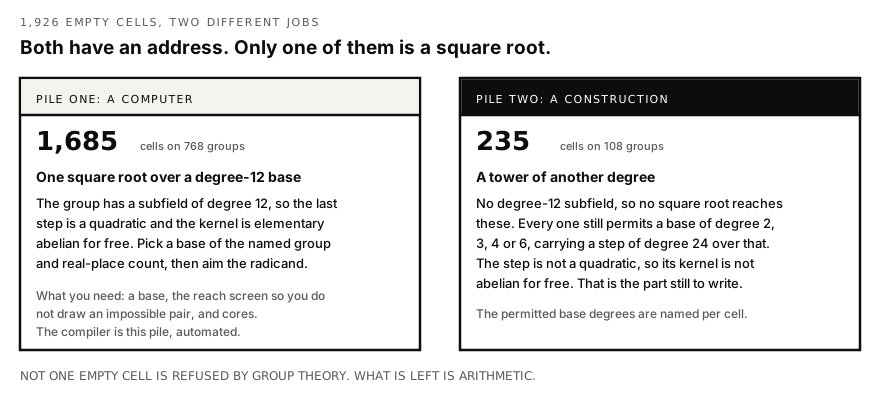
| 1,685 | 768 | One square root over a degree-12 base. The group has a subfield of degree 12, so the last step is a quadratic and the kernel is elementary abelian for free. Pick a base of the stated group and real-place count, then aim the radicand. |
| 235 | 108 | A tower of another degree. The group has no degree-12 subfield, so no square root finishes it. Every one of these still permits a base of degree 2, 3, 4 or 6, with a step of degree 24 over that on top. The page names which, per cell. |
| 6 | 3 | No opinion. These sit on primitive groups, which have no proper subfield at all, so the screen has nothing to say and says nothing. That is ignorance, not a refusal. |
Every base on this page is permitted and nothing more. A base in the table means the group does not forbid the cell. It does not say that a base field of that group and signature exists, that you can find one, or that the radicand can be aimed. That part is arithmetic and no page here settles it. Only the refusal direction is sound: a base absent from the list cannot write the cell, whatever the arithmetic does.
The screen fails open. A group it has not censused, and the five primitive groups, get no opinion rather than a refusal.
The second row is the one worth arguing about. Calling it a different construction is right and vague at once, so the walk names a permitted base degree for every one of the 235.
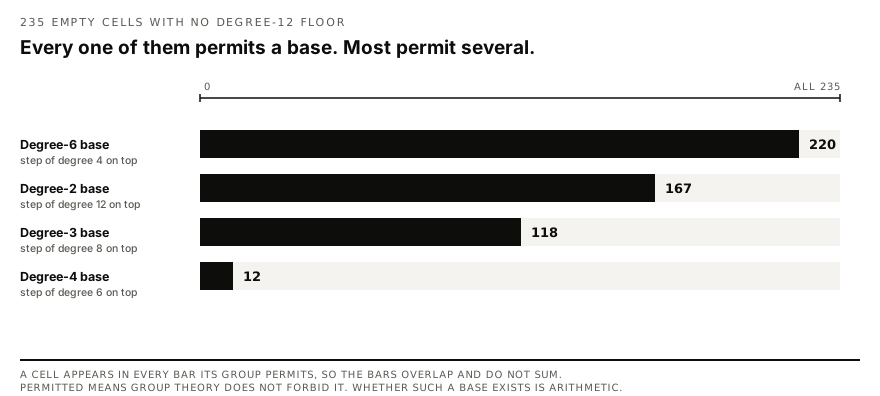
A degree-6 base is permitted for most of these cells. A degree-2 base asks for the longest step on top.
Take the whole list
| File | What it is |
|---|---|
| worklist.jsonl.gz | One line per open cell: the group, the real-root count, which of the three jobs it is, and every base the group permits. This is the file to work from. |
| worklist.json | The same thing keyed by group then real-root count, for a browser or a one-line lookup. This page reads it. |
| summary.json | The counts above, and how each job is defined. |
| README.txt | The field layout, the real-root identity, and exactly what a listed base does and does not claim. |
The list is the organizer's empty cells, joined against an exhaustive GAP census of the subfield lattice of all 25,000 groups and the packed involution walk. The builder is at github.com/jonwashburn/galois.
Before you spend a core on a cell, put the pair through the reach screen, which refuses 88.6% of drawable pairs. When you have a polynomial, the labeller names its group and the checker rechecks it. If you have a method and no machines, we will run it and you keep the credit.