Independent research · Austin
Limits of eight construction routes
Two proofs and six recorded computations identify limits of specific degree-24 constructions. Each entry states the conditions, the outcome and what it leaves open.
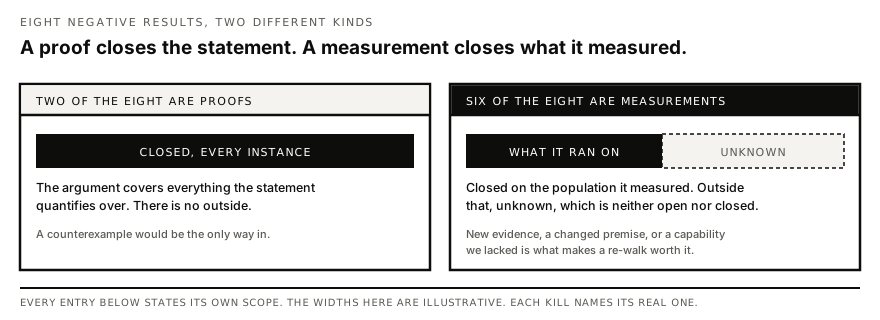
A route can stop yielding new groups while remaining useful for smaller discriminants or other targets. The entries distinguish those uses.
Two that are proofs
A degree-12-over-quadratic tower cannot reach a group with no block of size 12
- Why
- This inverted tower has a quadratic subfield and relative degree 12, so its action preserves two blocks of twelve roots. A group with no block of size 12 is excluded. Checked as an exact finite computation with
AllBlocksoverTransitiveGroup(24, t). - Scope
- Only the inverted tower, and only groups genuinely lacking a size-12 block. Of forty groups tested this way, twelve were excluded and the other twenty-eight do have a size-12 block system and are not touched by this. Nothing here says the tower fails on those.
A positive-norm radicand cannot reach a real-root count of 2 modulo 4
- Why
- The sign of the degree-12 norm is the product of the embedding signs, so a positive norm forces an even number of negative embeddings. The quadratic step then gives
and with that count even, r is divisible by four. So every real-root count congruent to 2 modulo 4 is out of reach whenever the prescribed rational norm square class is positive.
- Scope
- A quadratic step on a totally real degree-12 base with a prescribed positive rational norm class. It is a statement about that constraint and not about the base: choosing a negative norm class, or a base with complex places, changes the arithmetic. The general form is r = 24 − 4s − 2w, of which this is the parity corollary.
Six that are measurements
Unramified quadratic extensions added no groups in the measured bank
- Measured
- 846 class field builds over 12 bases returned 36 distinct groups and not one group or real-root count outside what was already covered. The discriminant ratio held at exactly 2.0000 on all 846.
- Scope, and what it is good for
- Across these 12 bases, the 846 builds added no group or real-root count beyond the existing bank. The method remains useful for small-discriminant constructions. The computation does not establish the same limit for other bases or stronger constructions.
In the measured twists, the real-root count changed and the group did not
- Measured
- 376 builds across 60 targets: every one hit its predicted real-root count, none reached a different group, and a full census found that all 24 distinct cells they landed on were already covered.
- Scope
- For the quadratic-over-degree-12 tower and the tested twists drawn from the base, the construction controlled the real-root count while retaining the group. Changing the group requires a different construction or additional evidence about twists outside this sample.
The degree-8 tower over mixed-signature bases reaches few groups per base
- Measured
- 950 builds produced 39 cells not previously covered, all of them heavily covered by other teams, at a rate of 0.41 groups reached per base and with a large discriminant gap against the best known.
- Scope
- These builds gave little improvement in group coverage or discriminant size. They did reach low real-root counts in cells this construction had not previously covered, a capability worth retaining when that signature is the target.
Eleven degree-12 groups carry no quadratic character at all
- Measured
- Exact Galois computation on totally real representatives, two per group where available: every quadratic-character slot came back trivial.
- Scope
- A supply fact about those eleven groups as bases for a quadratic-character construction. It says nothing about reaching the degree-24 groups above them by another route.
Uncorrelated draws cover the already-realized ratio-one groups
- Measured
- Among the 963 groups whose finest block system is six blocks of four, the 32 groups at correlation ratio one, covering 320 cells, are all already realized. Drawing a quartic over a sextic with no relation among its six conjugates returns nothing new here.
- Scope
- Ratio one only. The one-relation and higher strata are where the unrealized groups in this population sit, and those are a different draw with an explicit condition on it.
Klein-freeness selects most of the measured population
- Measured
- Full Klein rank is the ordinary value on the decomposed population: 651 of 1,162 groups, and none of the 296 that carry a field of degree 8 or 12. A test that selects for Klein-freeness therefore selects for the default and separates almost nothing.
- Scope
- Selecting for Klein-freeness leaves most of this population in play. The reverse implication provides a useful filter: a field carrying a subfield of degree 8 or 12 cannot land on any of those 651 groups, so it can be excluded before forming a resolvent.
How to use these results
A measurement describes the tested bases and construction. A proof applies throughout its stated hypotheses. Keep that distinction when choosing a route: a failed computation can rule out repeating the same search without ruling out a different base, premise or method.
A changed premise, a new base or a stronger construction can justify returning to one of these routes. If you have such evidence, we would like to hear from you.