Independent research · Austin
Seven findings in degree 24
Seven findings explain which construction routes the group permits and how those routes performed in Stage 1. Four are finite computations over the group catalog, two are rates from the pooled board, and one is an identity derived on paper.
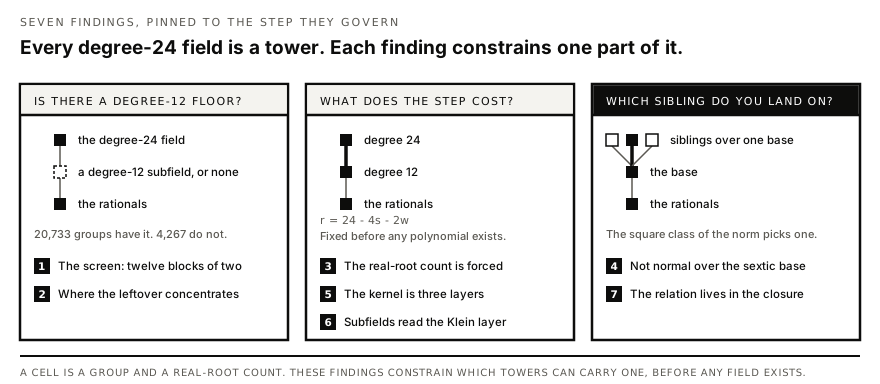
Every finding names the observation that would refute it. Papers beneath them are here.
Each card says first how it is known, because the seven are not the same kind of statement.
- Exact
- A finite computation over the transitive groups of degree 24, or a proof about them. No number field, no board, nothing sampled. Rerun it and the answer is the same.
- Derived
- Proved from the arithmetic on paper and confirmed numerically. Not formalized.
- Measured
- Read off the pooled Stage 1 board, or off a sample of fields. Evidence about what happened rather than a theorem, and it moves if the board moves.
Permitted is not existence. An exact finding here says the group does not forbid something. Whether a base field of that type exists, whether you can find one, and whether the conductor cooperates are arithmetic, and none of the seven settles them. Only the refusal direction is sound: what the group forbids, no arithmetic recovers.
1Exact: the splitMeasured: the rates
A block system of twelve blocks of two is the screen
A transitive group of degree 24 either admits that block system, equivalently the field has a subfield of degree 12 and the top step is quadratic, or it does not.
The kernel of the action on twelve blocks of size two sits inside a product of twelve copies of the symmetric group on two letters, so it is elementary abelian of exponent two automatically. A class-field step supplies exactly that. No other block shape has the property: blocks holding three or more points leave a kernel that can fail to be abelian. That much is exact, and 20,733 of the groups admit the system while 4,267 do not.
The rates are the separate, weaker claim: 98.46 percent of the groups with the system were realized against 72.79 percent of those without, and by cell 85.18 against 40.57.
The rates in full
| Degree-12 subfield | Groups | Realized | Rate |
|---|---|---|---|
| Present | 20,733 | 20,413 | 98.46% |
| Absent | 4,267 | 3,106 | 72.79% |
| Present, by cell | 141,249 | 120,316 | 85.18% |
| Absent, by cell | 24,587 | 9,974 | 40.57% |
Group counts are a GAP census and do not move. The realized columns are the pooled board at the Stage 1 close.
Count the block systems yourself, in GAP
ok := 0; no := 0;
for t in [1..25000] do
  G := TransitiveGroup(24, t);
  b := First(AllBlocks(G), B -> Size(B) = 2);
  if b = fail then no := no + 1; else ok := ok + 1; fi;
od;
Print(ok, " with a size-2 block, ", no, " without\n");
# expect 20733 and 4267
That is a GAP census on the groups. The realization rates cannot be checked without the board.
If the organizer's board, pooled across all teams and all methods, does not separate on this question, then the split is a fact about one compiler rather than about degree 24.
2Measured: rates on the pooled board
Hard cases sit where there is no degree-12 subfield
With a degree-12 subfield, solvable and nonsolvable groups both come out above 98 percent. Without one they fall to 74 and 54. Solvability is not what separates the hard cases; having a field to stand on is.
A nonsolvable core costs about eleven percentage points of naming board-wide, and nothing afterwards: once such a group has been realized once, more of its real-root counts get filled than for solvable groups.
The five rates
| Groups | Realized | Rate | |
|---|---|---|---|
| Nonsolvable | 807 | 674 | 83.52% |
| Nonsolvable, subfield present | 526 | 523 | 99.43% |
| Solvable, subfield present | 20,207 | 19,890 | 98.43% |
| Nonsolvable, subfield absent | 281 | 151 | 53.74% |
| Solvable, subfield absent | 3,986 | 2,955 | 74.13% |
The group counts are exact. The rates are the board and move with it.
Count the nonsolvable groups yourself, in GAP
ns := 0;
for t in [1..25000] do
  if not IsSolvable(TransitiveGroup(24, t)) then ns := ns + 1; fi;
od;
Print(ns, " nonsolvable\n");
# expect 807
The same pooled-board join as finding 1. The 807 count is a fact about the groups and does not move if the rates do.
3Derived, confirmed on three computations
The real-root count is exact before any field exists
On a quadratic step over a degree-12 base, the number of real roots upstairs is fixed by two integers you already know: how many complex places the base has, and at how many of its real places the radicand is negative.
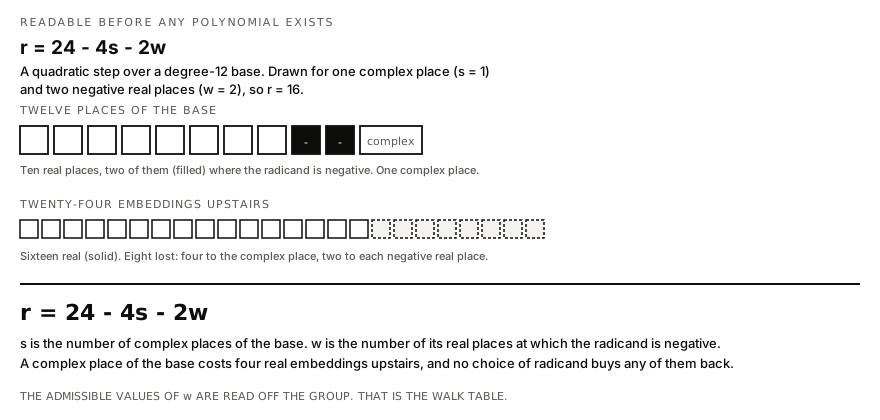
s complex places of the base, w negative real places. The admissible w are the weights of the block kernel on the real blocks.
Three computations confirm it with one exception, and the instrument refuses a real-root count the organizer accepts on 0 of 11,647 groups. The decoy that simply names every even count refuses on 11,636 of them.
The three confirmations, and the one exception
| Confirmation | Agreements | Violations |
|---|---|---|
| GAP walk of base-and-top pairs at block size 12 | 280,178 | 0 |
| Banked degree-12 bases with the cut field's real count | 22,825 | 1 |
| Two computations sharing no code, on live open cells | 20,917 | 0 |
The single field-side exception records a totally imaginary subfield under a field of eight real roots, which cannot happen, so it is a defect in that row rather than a counterexample.
Why each complex place costs exactly four
At a real place of the base, x² − a hands over two real embeddings when a is positive there and none when it is negative. Above a complex place every place upstairs is complex, because the completion contains the complex numbers. Each complex place therefore costs four real embeddings, and no radicand buys any back. That is the identity. The constraint on w is the walk table: run it on a base you have.
python3 reach.py --deg 12 --r1 12 --label 10301 --r 24
# walk for 24T10301: [0, 4, 8, 12, 16, 20, 24]
# r=24 allowed: yes
The longer counting form is the real-root count as a coset count.
A quadratic over a degree-12 base whose real-root count is not 24 − 4s − 2w, or a walk refusal of a signature the contest admits.
4Exact: the censusDerived: what it rules out
The other half is not normal over its base
On the 963 groups whose finest block system is six blocks of four, the degree-24 field is never normal over its sextic base, and no field lies strictly between the two. A ray-class step over that base cannot write these fields.
The block group is the symmetric group on four letters on 665 of them and the alternating group on 298. Both are larger than the block they act on, so the extension is not normal. Cauchy forces the only possible single abelian relative step on the 4,267 to be a cubic over a degree-8 base, and 866 of the 963 carry no field of degree 8.
The four quartic block groups, and which carry a degree-12 subfield
| Quartic block group | Groups | Degree-12 subfield |
|---|---|---|
| Cyclic | 1,397 | Always present |
| Four-group | 2,206 | Always present |
| Dihedral of order 8 | 15,733 | Always present |
| A4 or S4 (this population) | 963 | Never |
Print the sextic block groups yourself, in GAP
for t in [1..25000] do
  G := TransitiveGroup(24, t);
  blocks := Filtered(AllBlocks(G), B -> Size(B) = 4);
  if Length(blocks) = 1 then
    H := Action(G, Orbit(G, blocks[1], OnSets), OnSets);
    # Image on six points. Stabilizer of a point inside S4 or A4 is maximal,
    # so nothing sits strictly between the sextic and the degree-24 field.
    Print(t, " ", Size(H), " ", Size(Kernel(ActionHomomorphism(G,
      Orbit(G, blocks[1], OnSets), OnSets))), "\n");
  fi;
od;
Every printed image order should be 12 or 24, never 4. The uncorrelated draw on this population is spent: the 32 groups at correlation ratio one, covering 320 cells, are all already realized. What writes the rest is a relative quartic with an explicit relation among its six conjugates. See the 6×4 classification.
A group in this 963 that is normal over a sextic, or a cyclic, four-group, or dihedral-of-order-8 quartic block group with no degree-12 subfield.
5Exact on all 1,162 decomposed groups
The block kernel is three independent layers
The block kernel factors into a Klein part, a cubic part, and a sign part that do not constrain each other. The old correlation ratio was a product of those three.
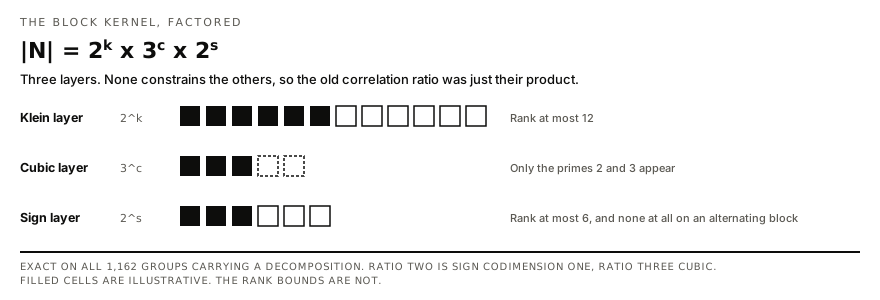
The Klein rank is capped at 12, the sign rank at 6. Neither cap moves the other.
On all 1,162 groups carrying a decomposition the recorded kernel order equals that product exactly. Ratio two is sign codimension one. Ratio three is cubic codimension one. Everything above them is a composite of the three.
Factor the block kernel yourself
For a group with six blocks of four, compute the kernel of the action on the blocks and factor its order. The only primes that appear are 2 and 3, and the 2-power splits as a Klein piece (rank at most 12) times a sign piece (rank at most 6). An alternating block has no sign piece.
One decomposed group whose kernel order is not of that form.
6Exact, one direction only
The Klein layer is legible from the subfield lattice
A field of degree 8 or of degree 12 inside the group forces the Klein layer below full rank. All 296 of the 1,162 that carry such a field have a Klein condition, with no exceptions. The 866 that carry neither split 215 with a Klein condition and 651 without.
A quartic drawn over a sextic already on the shelf hands you subfield degrees long before it hands you a Galois image. A draw whose field carries a degree-8 or degree-12 subfield cannot land on any of the 651 at full Klein rank, and can be discarded before a resolvent is formed. On the 866 the detector fires on nothing, because they are defined by carrying neither field.
Read the subfield degrees yourself, in PARI
# After you have a degree-24 polynomial f:
nf := nfinit(f);
degs := Set([d[1].degree | d <- nfsubfields(nf)]);
# if 8 or 12 is in degs, the Klein layer is not full rank
A decomposed group carrying a degree-8 or degree-12 subfield whose Klein layer is at full rank.
7Measured: 134 fields over one base
The relation lives in the closure, not in the block field
A block relation asks that the relative norm be a square in the Galois closure of the base. Imposing instead that it be a square in the block field is strictly stronger, and it pins the trivial character. A solver that makes that substitution can reach almost none of the open board.
134 accepted degree-24 polynomials over one base, labelled at 1,500 primes to a bound of 99,000 with margin at least five nats, split by the square class of the norm. The trivial character and the three twisted characters produce disjoint label sets at the same base and the same real-root count.
Split by the square class of the norm yourself
Over a fixed base, compute the square class of the relative norm in the block field and in a closure large enough to see the extra characters. Fields that land in different classes must not share a label at the same real-root count. The reader that named these 134 is published.
Two fields over that base, same real-root count, different square classes of the norm, same group name at a decisive margin. Or a solver that stays in the block field and still writes the twisted open cells.
What sets the reach of a construction
A class-field step supplies an abelian kernel and only that, so a group it can finish must carry a block system whose kernel is abelian. That is a necessary condition on the group and nothing more: whether a base field exists and the conductor cooperates is arithmetic. Finding 1 is the condition met for free, because twelve blocks of size two put the kernel inside a product of twelve copies of S2. Every other shape has to be checked one group at a time, which is what makes each of the 4,267 its own problem instead of a population.
Run the same accounting to the end and the residue is 419 admissible pairs over six simple cores, which no abelian kernel reaches. Across all 149 groups involved, GAP finds a complement to the solvable radical in every one, so the obstruction is fifteen fibre families over a small base rather than an embedding problem.
Both ends of that are statements about kernels, and the kernel of a block action is group data. So the reach of a method is a census over the 25,000 groups rather than a search over polynomials, and a construction built to take the residue is specified in advance by the kernel class it has to supply.