Independent research · Austin
To count the real embeddings of an intermediate field, count the right cosets fixed by complex conjugation. This connects a signature, a property of the field’s embeddings, to a finite calculation in its Galois group.
The real-root count is a coset count.
Theorems in Lean · RowLaw and RowLawGaloisReading
Let L/ℚ be Galois, and let M be a subgroup of Gal(L/ℚ). Complex conjugation, relative to a complex embedding of L, is an involution t in that Galois group. The number of real embeddings of the fixed field of M equals the number of right cosets of M that t leaves in place.
The count itself is finite group theory and does not mention number fields. The Galois reading identifies that count with the number of real places.
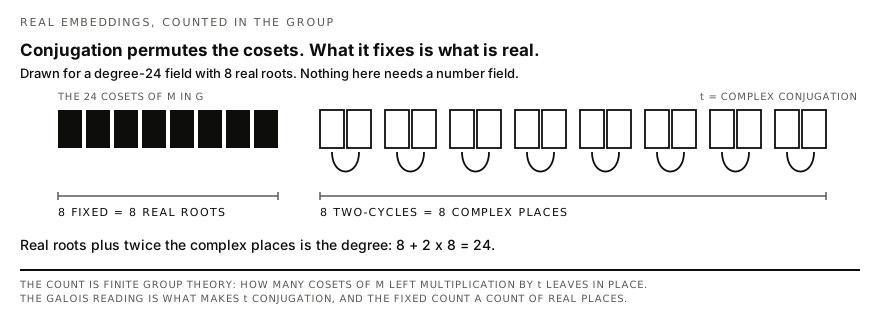
Fixed cosets are the real embeddings. Two-cycles are the complex places. Nothing in the picture is a number field.
Theorem · fixed-coset count
For a finite group G, a subgroup M, and an element t, the number of left cosets of M fixed by left multiplication by t is |CG(t)| · |{ g−1t g } ∩ M| / |M|.
The count never uses t2 = 1. That hypothesis belongs to the Galois reading, where t is complex conjugation and so has order at most two.
Theorem · odd Galois group
If Gal(L/ℚ) has odd order, then L is totally real, and every intermediate field is totally real. The number of real places of the fixed field of M equals the degree of that field.
An odd-order group has no element of order two, so the only possible conjugation is the identity. That every odd-order group is realizable over ℚ, and that every such realization is totally real, is the classical pair Shafarevich plus Artin-Schreier, not claimed here.
Theorem · unique involution
If Gal(L/ℚ) has a unique conjugacy class of involutions, then complex conjugation is the identity or that involution. The possible real-root counts of an intermediate field collapse to the degree, or to the fixed-coset count of that unique involution.
If that involution is central and lies in M, the fixed field is totally real. If it is central and does not lie in M, the fixed field has no real place, and its degree is twice the number of complex places.
Theorem · central signature law
If conjugation is central, an intermediate field is totally real or has no real embeddings.
What this does not say
These theorems do not realize a prescribed group over ℚ. They say which real-root counts a realization, once it exists, is allowed to have. A derived completeness statement for a family of symplectic groups through genus five is written; it is not a kernel-checked theorem, and it is not claimed here as one.
The inverse Galois problem over ℚ remains open. Shafarevich’s theorem already realizes every solvable group. The missing move for the general problem is elsewhere: proper solutions of embedding problems, not a new obstruction in cohomology.