Independent research · Austin
An ideal and a twist bit distinguish twenty-four conjugacy classes inside A4 wr C6. The classification supplies group labels for this 6×4 tower before a field is built.
Exact Galois labels for a 6×4 tower
Jonathan Washburn
12 August 2026 · Recognition Physics Institute, Austin
Abstract
Let W = A4 wr C6 act imprimitively on 24 points, with base group A46 and 2-part V = V46 ≅ C212. The subgroups of W that contain V and surject onto the top C6 are classified, up to conjugacy, by an ideal 𝔞a,b = ((x−1)a(x+1)b) of R = 𝔽3[x]/(x6−1) with 0 ≤ a,b ≤ 3, together with a twist class w ∈ R/(𝔞a,b + (x−1)R) subject to Nw ∈ 𝔞a,b, where N = 1 + x + ⋯ + x5. There are exactly 32 such pairs. Conjugation by a diagonal odd permutation identifies (M,w) with (M,−w), leaving 24 triples (a,b,ε), with ε ∈ {0,1} recording whether the twist vanishes and ε = 1 admissible only for a ∈ {1,2}.
These 24 triples give pairwise nonconjugate subgroups of S24. The argument recovers (a,b) from the dimensions of M and (x−1)3M and recovers ε from whether an extension splits. A group containing V has exactly one block system with blocks of size four. The group order is 213 37−a−b. The bit ε is the splitting invariant of 1 → M → G/V → C6 → 1. The Galois label is a function of the construction data, computed before any field is built. The signature is independent: for every one of the twenty-four, the involutions have fixed-point counts exactly {0,4,8,12,16,20,24}, so the group theory excludes no pair (label, signature) beyond r ≡ 0 (mod 4). All twenty-four groups are solvable, hence realizable over ℚ by Shafarevich; what is open for them is effective realization, not existence.
What is classified
There are 25,000 transitive groups of degree 24. This paper completely parametrizes twenty-four of them and says nothing about the other 24,976. The family is singled out by a structural condition: being a subgroup of A4 wr C6 that contains the full 2-part and surjects onto the top C6. The recurrence of the number twenty-four is a coincidence of two unrelated counts.
The usual order of work at this degree is to build a field and then ask which group it has. At degree 24 many groups differ only in fine module data, and the identification step is more expensive than the construction. If the group is a computable function of the data one chooses before building, identification is unnecessary for the family, and the target selects its own construction data.
Theorem · classification
Q-conjugacy classes in the family are in bijection with pairs (𝔞a,b, w) satisfying Nw ∈ 𝔞a,b. There are exactly 32 of them: one for each of the eight pairs (a,b) with a ∈ {0,3}, and three for each of the eight pairs with a ∈ {1,2}. The corresponding group has order 213 37−a−b.
Theorem · injectivity
If G(a,b,ε) and G(a′,b′,ε′) are conjugate as subgroups of S24, then (a,b,ε) = (a′,b′,ε′).
The proof is an algorithm. The order of G gives a+b. The dimension of (x−1)3(K/V) gives b. Splitting of the extension gives ε. No identification call is used. The argument never touches O2(G), which is why the failure of V to be the largest normal 2-subgroup when b = 3 does not interfere.
Theorem · labels
The twenty-four triples give twenty-four pairwise nonconjugate transitive groups of degree 24, and every group in the family is conjugate to exactly one of them. The transitive-group database assigns the labels in the table below. In particular the label is determined by, and determines, the ideal together with the vanishing or non-vanishing of the twist.
That the twenty-four groups are pairwise nonconjugate is proved. That the database calls them 24T24104, 24T13329, and so on is a lookup: a transitive label is an index into a fixed enumeration. The last two columns record what the database assigns to groups the theorem has already separated. An independent enumeration of the 10,014 conjugacy classes of subgroups of W/V confirms the count of 32 pairs.
The aim map
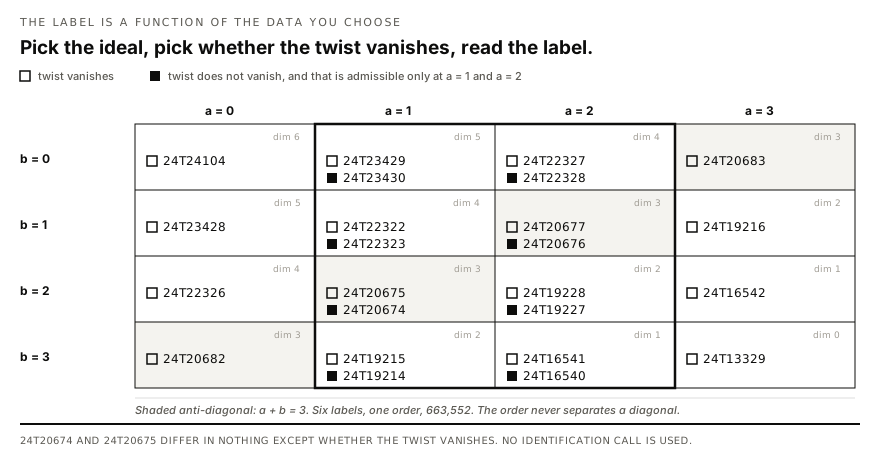
Nothing in the grid was read off a field. The table below is the same map with the orders written out.
| a | b | dim M | |G| | label, ε=0 | label, ε=1 |
|---|---|---|---|---|---|
| 0 | 0 | 6 | 17,915,904 | 24T24104 | |
| 0 | 1 | 5 | 5,971,968 | 24T23428 | |
| 0 | 2 | 4 | 1,990,656 | 24T22326 | |
| 0 | 3 | 3 | 663,552 | 24T20682 | |
| 1 | 0 | 5 | 5,971,968 | 24T23429 | 24T23430 |
| 1 | 1 | 4 | 1,990,656 | 24T22322 | 24T22323 |
| 1 | 2 | 3 | 663,552 | 24T20675 | 24T20674 |
| 1 | 3 | 2 | 221,184 | 24T19215 | 24T19214 |
| 2 | 0 | 4 | 1,990,656 | 24T22327 | 24T22328 |
| 2 | 1 | 3 | 663,552 | 24T20677 | 24T20676 |
| 2 | 2 | 2 | 221,184 | 24T19228 | 24T19227 |
| 2 | 3 | 1 | 73,728 | 24T16541 | 24T16540 |
| 3 | 0 | 3 | 663,552 | 24T20683 | |
| 3 | 1 | 2 | 221,184 | 24T19216 | |
| 3 | 2 | 1 | 73,728 | 24T16542 | |
| 3 | 3 | 0 | 24,576 | 24T13329 |
Blank entries are the cases where a non-vanishing twist is inadmissible. All twenty-four labels are distinct. Dimension alone does not determine the label: six distinct labels share the single order 663,552. The pair 24T20674 and 24T20675 differ in nothing except whether the twist vanishes.
Subfields and signatures
Twenty-three of the twenty-four labels have subfield lattice consisting of a quadratic, a cyclic cubic, and a cyclic sextic, and nothing else. In particular a field with one of those labels is not a quadratic extension of any field of degree 12. The compositum of the resolvent cubic algebras of the six fibres has degree 36−a−b over the sextic base, so (a,b) is exactly the correlation pattern of those cubics, degenerating to the base itself when 𝔞3,3 = 0.
For every one of the twenty-four, the involutions have fixed-point counts exactly {0,4,8,12,16,20,24}. The group theory excludes no pair (label, signature) beyond r ≡ 0 (mod 4).
Scope
This is a classification inside one wreath product, not a classification of degree 24. All twenty-four groups are solvable. Existence over ℚ is Shafarevich. Effective polynomials for a prescribed pair (label, signature) are a separate construction.