Independent research · Austin
Control the number of real roots and the sibling class by solving two blocks of one linear system. The note gives the conditions and a worked measurement over one degree-12 base.
The real-place count and the sibling class as one linear system
Jonathan Washburn · 17 August 2026
Let K/ℚ be a number field and u in K× with X2 − u irreducible over K. The real embeddings of K(√u) are two copies of each real embedding of K that is positive on u, so the real-place count upstairs is twice the number of those positive places. Evenness, vanishing when K is totally imaginary, and the obstruction to an odd real-root count are lemmas of that identity.
The relative norm of u into the orbit field of a relation among the conjugates sends squares to squares, so it descends to square classes. Written in an S-unit basis, both the sign vector and that class are 𝔽2-linear in the exponent vector. They stack as one map. A nonempty fibre is a coset of the kernel. On one 12T11 base the stacked map had rank 17, and a family of 768 elements written before any degree-24 polynomial existed split 542 to 226 by class, every one with 24 real roots. Building the 768 fields recovered both counts. A later draw of 200 inside one class returned three groups. The class and the signature are forced. The group name is not.
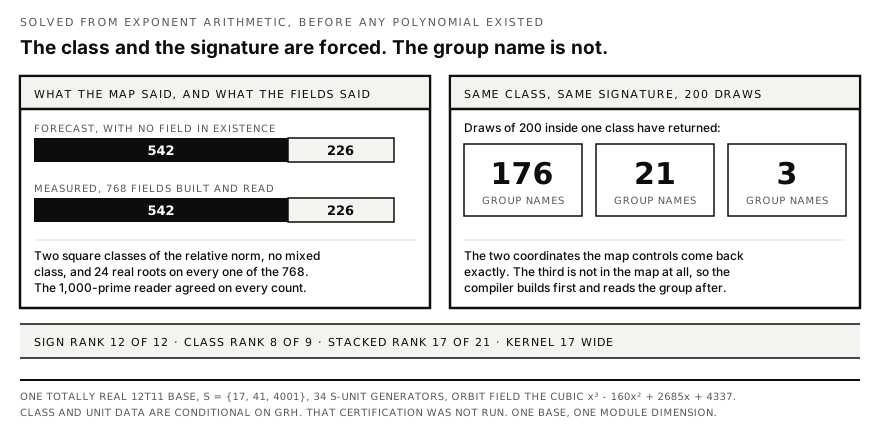
A forecast made with no field in existence is falsifiable in a way a fit is not. The two counts were written down first.
Quadratic splitting
A real embedding of K(√u) restricts to a real embedding of K. For a real place φ of K, both lifts are real exactly when φ(u) > 0, and neither is when φ(u) < 0. Hence
r1(K(√u)) = 2 · #{ real φ | φ(u) > 0 }.
If u is negative at exactly k of the r1(K) real places, the count upstairs is 2(r1(K) − k). On a totally real degree-12 field that is 24 − 2k.
The stacked map
Fix an S-unit basis of K. The sign of each basis element at each real place is a column of a matrix A. The square class of its relative norm into the orbit field is a column of a matrix B. The map x ↦ (Ax, Bx) is one linear map. Adding a kernel vector changes neither coordinate.
The group of K(√u) is not a coordinate. The compiler aims a class and a signature, builds a polynomial, and reads the group afterward.
The measured base
One totally real 12T11 field, S = {17, 41, 4001}, 34 S-unit generators, orbit field the cubic x3 − 160x2 + 2685x + 4337. Sign rank 12 of 12, class rank 8 of 9, stacked rank 17 of 21, kernel 17. A 768-element family split 542 / 226 by class, all at signature 24; the 1,000-prime reader agreed. Two hundred later draws in one class returned 176, 21, and 3 groups. Class and unit data from the usual initialization are conditional on the generalized Riemann hypothesis unless a separate certification is run. That certification was not run.