Independent research · Austin
A proposal to study inverse Galois over the rationals through rational points on four-branch Hurwitz curves. The argument separates the covering construction from the rational-point question.
Inverse Galois over the rationals as a rational point on a four-branch curve
Jonathan Washburn · 17 August 2026
A finite group with trivial center is the Galois group of a regular extension of ℚ(t) if and only if, for some number of branch points, the inner Hurwitz space has a rational point. That is Fried and Voelklein. Hilbert irreducibility then specializes to infinitely many realizations over ℚ. The abelian architecture has no such descent.
The moduli space of r branch points has dimension r − 3. Three branch points is rigidity. Five or more is expected to be empty of a general method. Four branch points is a curve. For groups with no rigid triple, inverse Galois over ℚ is a rational point on a rationally defined four-branch inner component. That sentence is derived. It is not a theorem that every such curve has a point, and it is not a construction of one.
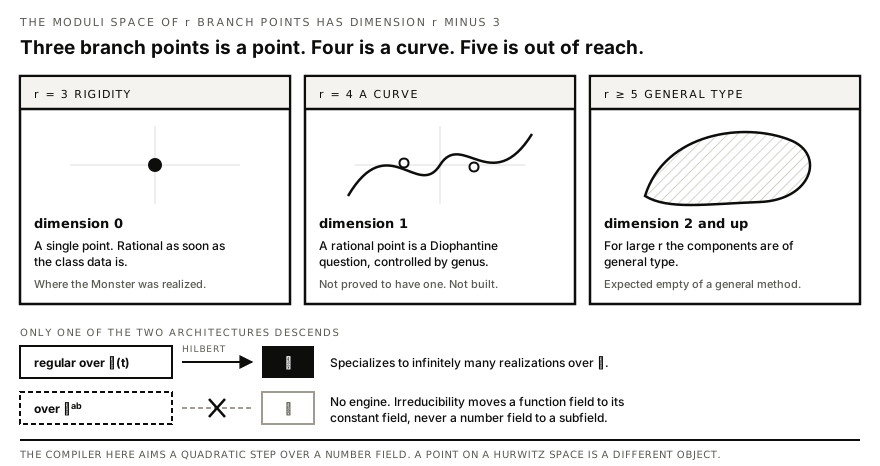
Dimension is what changes; the question stays the same one, whether a rationally defined component has a rational point.
Two architectures
Realizing a group over the maximal abelian extension of ℚ, even completely, does not reach ℚ. Only a regular realization over ℚ(t) has a descent engine.
The dimension ladder
Three branch points is where essentially every unconditional realization of a simple group over ℚ lives, the Monster included.
Falsifier
A finite group with trivial center, no rigid triple, and a rationally defined four-branch inner component proved to have no rational point; or a proof that some finite group is not a Galois group over ℚ; or a descent from the maximal abelian extension to ℚ that preserves the group.
The compiler on this site aims a quadratic step over a number field. It is a different object from a rational point on a Hurwitz space.