Independent research · Austin
How square classes and signs constrain a quadratic construction, with the conditions and measurements behind the aiming method.
The longer argument
16 August 2026
This note, dated 16 August 2026, connects the orbit field, the square class of a relative norm and the signs that determine the number of real roots. It then separates what the worked construction demonstrates from what remains to be calculated.
One linear system
A contest cell is a group and a real-root count. To build one through this quadratic construction, we control the signs and the sibling square class. These give blocks of linear conditions on the exponent list. Solving them together fixes the requested signature and class before the polynomial is built; the group is then identified from the result. Solving only one block and sampling the other can repeatedly produce cells already held.
The sibling is a square class
Fix a relation among the twelve (or twenty-four) conjugates. The product of that relation over its orbit is fixed by the stabilizer, so it lives in a field of degree equal to the orbit size. That degree is at most 924, and it does not grow with the parent order. The sibling along that orbit is the square class of the product in that field.
If the relation is a block of the parent, the orbit field is a subfield of the base, of degree 2, 3, 4, or 6. If the relation is not a block, the orbit field is generated by the roots and is not a subfield of the base. That second case is the same square-class condition living in a field a search inside the base cannot see, which is why a base-side search does not find it however long it runs.
No square root has to be formed as an algebraic number. The closure of the parent, whose degree is the parent order, is an instrument for reading signs the hard way. The coordinate itself does not need that closure. On a 12T11 base the unique cubic’s relative-norm square classes split 768 fields 542 to 226, in bijection with the recorded twist vectors, and the degree-24 closure was not formed.
A measured aim
On 15 August 2026 the sibling coordinate was written from exponent arithmetic before any polynomial existed. Then 768 fields were built and read at 1,000 primes. The forecast was two groups, 542 and 226, no mixed class, 24 real roots on every field. The reader agreed on every count. That is the aiming map under a frozen gate, on one module dimension over one base.
The same map is demonstrated there and unmeasured on every other base and every other module. Pointing the other square class on that base wrote new fields; a square relative norm is not the whole module. Whether one character per generating orbit pins the class uniquely is a finite computation on the group, not yet run.
What looked like a group wall
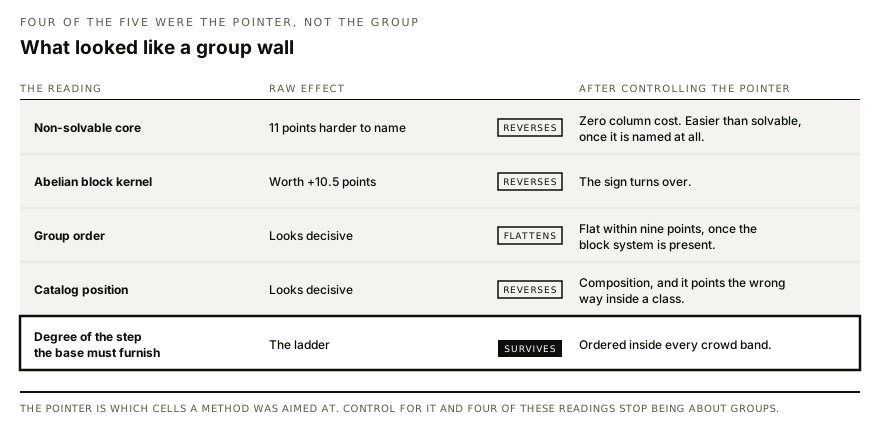
The pointer is which cells a method was aimed at. It is the same confounder in all five rows, which is why controlling for it once settles all of them.
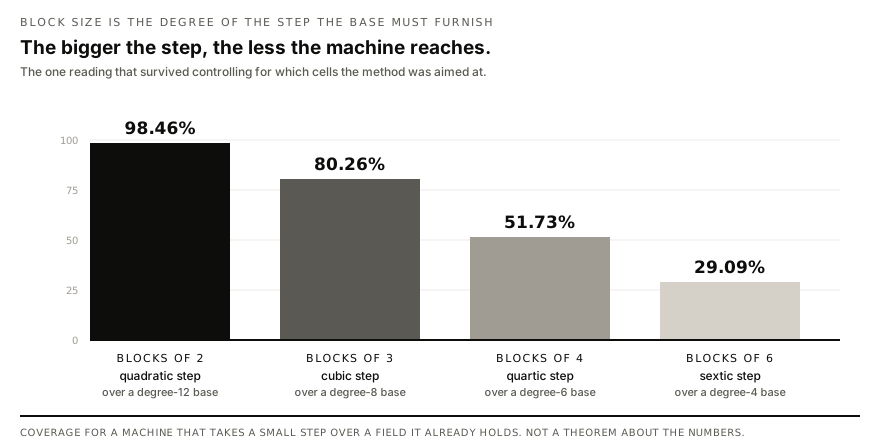
The surviving reading, drawn. Block size is the degree of the step, so the axis is how much new field the base has to supply.
One dial
Over a totally real base, exhaustive enumeration finds one refusal: the sign of the norm. A complex place defeats that parity. It costs four real roots and removes two sign coordinates while removing only one generator, so it also loosens the sign side. All-real is exactly critical, twelve generators for twelve dimensions, which is why full reach appears on only six percent of those bases. The optimum of that trade is not computed.
The scoped signature law
A claim that a group’s structure fixes its signatures is false. A control found 373 held cells that the claim called impossible. The surviving theorem is the all-real branch: 22 and 24 real roots are forced. Against 7,417 held cells the scoped statement denies none; the nearest wrong version denies 11. A second instrument, built from data the first never saw, agrees on 22,599 rows and contradicts on none. They split on 15,734 shapes below the forced branch, which is where the first claim had overreached.
What is not settled
As of 16 August 2026, the aiming map had been demonstrated on one module dimension over one base and had not been measured elsewhere, so it carries evidence from that base rather than from the catalog. Whether one character per generating orbit pins the square class uniquely is a finite computation on the group, and it has not been run. The trade between a complex place and the sign parity has a known shape and no computed optimum. These are the specific calculations needed to extend the argument beyond the worked case.