The Papers

Space is the outside of recognition. Consciousness is its inside.

A point is everything you can’t tell apart.

Live · one switch

Every count is computed in your browser

Configurations twelve states, each a place and a shade

Points what the test can tell apart

2points

The test is on. It reads six configurations LEFT and six RIGHT, and it cannot tell the six on a side apart. Each side is one point: twelve configurations, two points.

What you are looking at. On the left are twelve configurations: twelve complete states of a small system, each a place in the square and a shade. The cyan line is a test. It gives every configuration one reading, LEFT or RIGHT. On the right are the points: configurations with the same reading are gathered into one. Switch the test off and nothing tells any configuration from another, so all twelve are one point. That is the whole construction. The rest of the page adds one thing at a time.

Recognition Geometry starts with tests and builds the points of space from them. A point is every state of a system that the tests read alike.

Telling one thing from another is recognition. Recognition Geometry builds space from it. It starts with three things: the states a system can be in (the paper calls them configurations), a rule saying which states count as near each state, and tests that give each state a reading. Then it proves what such a space holds. As a set, its points differ only where their readings differ; which points lie near which comes from the nearness rule, not from the readings. And adding a test can only split points, never merge them.

The mathematics underneath is standard; what is new is the order, recognition first and space second, made exact in five axioms. Recognition Science, the institute’s physics, needed that order, because it starts from distinction, not from space. The headline above is Recognition Science, not a result of the paper: every act of recognition has an outside, the reading it gives, and an inside, which is experience (section 10).

Tags such as Thm 1 name the paper’s results (Thm theorem, Prop proposition, Cor corollary, Def definition, Ex example) and link to the paper.

THE FILM

Recognition Geometry

A short film follows one question, “What is a point?”, from Euclid’s definition and Hooke’s microscope through Riemann and Leibniz’s garden to the answer this page lets you try.

Film · 7 min · English captions

01 · THE QUESTION

For two thousand years, geometry usually began with the points already there.

Drawing

The order, reversed

The usual orderSpacethe points are already thereMeasurementsfunctions defined on the points
The paper’s orderTestseach gives every configuration a readingPointseverything the tests read alike

What you are looking at. The two orders. Geometry usually takes space as given and defines measurements on its points. The paper takes the tests as given and builds the points from them.

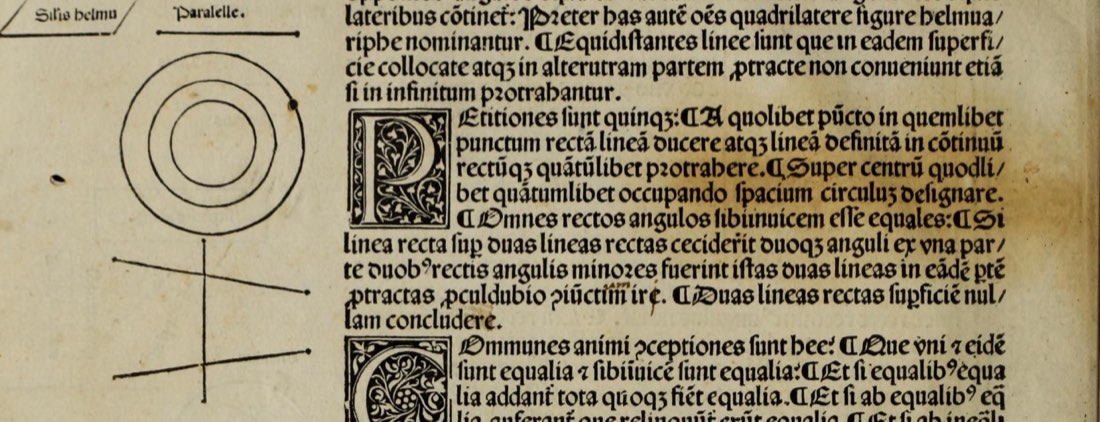
Euclid, around 300 BC, defined a point as “that which has no part”, then listed what must be granted, including that a straight line can be drawn from any point to any point.

Isaac Newton said it outright. In his Principia of 1687 he wrote that “Absolute Space, in its own nature, without regard to any thing external, remains always similar and immoveable”, and later in the same Scholium: “because the parts of Space cannot be seen, or distinguished from one another by our Senses, therefore in their stead we use sensible measures of them” (Andrew Motte’s English translation, 1729; “sensible” here means detectable by the senses).

Riemann opened his 1854 lecture on the foundations of geometry by noting that geometry assumes the notion of space as given, and then questioned it: what sets our space apart, he argued, can only be learned from experience.

Others had put measurement first too: the paper surveys operational quantum theory, point-free topology and more. It names its own contribution as “the inversion of the usual order: rather than assuming physical space exists and defining measurements as functions on it, we take measurements (recognizers) as primitive and construct the observable space as the quotient”, carried through in a minimal set of axioms. Three words do most of the work:

Configuration
a complete description of a system’s state.
Reading
an outcome of a test: a number on a dial, a click of a detector, a yes or a no. The paper calls readings events.
Test
a rule (mathematicians say a map) that gives every configuration exactly one reading, the same every time, with at least two different readings occurring. The paper calls a test a recognizer.

An ideal thermometer is a test. The configuration is everything about the air in a room, every molecule’s position and speed; the reading is one number.

Latin text of Euclid’s postulates and common notions, with large decorated initials. In the left margin: three concentric circles, and two lines leaning toward each other, crossed by a third.
1482 · VENICE · ERHARD RATDOLT · EUCLID’S ELEMENTS · THE POSTULATES AND THE MARGIN FIGURES

02 · ONE TEST, ITS POINTS

Same reading, same point. Different points, different readings.

Drawing

The same twelve configurations, a different test

Configurations the same twelve

reads darkreads light

Points what Light or dark can tell apart

The test

Light or dark

2points

Light or dark reads seven configurations DARK and five LIGHT. Two readings occur, so there are two points. Each point lies in separate pieces of the square.

What you are looking at. The twelve configurations from the top of the page, read by one test, Light or dark. A point is everything the test reads alike, wherever it lies: the seven dark configurations are one point, the five light ones another. There are exactly as many points as readings that occur.

In 1716, in his fourth paper in the exchange with Samuel Clarke, Leibniz wrote of a gentleman who ran all over the garden at Herrenhausen looking for two leaves exactly alike, and found none. Two things nothing can tell apart, Leibniz wrote, are one thing under two names.

The paper uses a weaker, test-by-test version of that rule. Two configurations that a test gives the same reading are indistinguishable to it, though they stay different configurations. Gather all the configurations with one reading into a class; the paper calls the class a resolution cell and treats it as a single point. The set of these points is the recognition quotient: the configurations, divided up by what the test can tell apart. For the thermometer, all the rooms that read 20.0 degrees together make one point.

Different points always give different readings (Thm 1): the map from points to readings is one-to-one, which mathematicians call injective. So there are exactly as many points as readings that occur (Prop 1), and as a set of points the quotient tells apart exactly what the test tells apart, no more and no less. Any question that gets the same answer for every room in a point, such as “does it read above 15 degrees?”, is really a question about the point, in exactly one way (Thm 2), and any other space of points that tells apart the same things is this one up to a unique renaming of its points.

The construction is the quotient of a set by a map. The paper calls it mathematically equivalent to several well-known structures, among them: the orbits of a group of symmetries, such as the circles a point traces as a disc turns; the level sets of a function, such as all the contour lines at one height on a map, taken together; and the partitions used in probability (Ex 5–7).

  • Established in the paper: Theorem 1, Proposition 1, Theorem 2
  • Worked out on this page: the thermometer example and this drawing

03 · MORE TESTS

Add a test, and points can split. They never merge.

Live · one control

The same twelve configurations

Configurations each cyan line is a test

Points a dashed frame was one point before the last test

Tests on

4points

Two tests are on. Each configuration has a pair of readings, and all four possible pairs occur: four points. Of the two points before, both split. None merged.

What you are looking at. The first test is Left or right. The control adds Above or below, then Light or dark. Tests used together give each configuration a list of readings, and two configurations are one point exactly when every reading on the list agrees. Each dashed frame was one point before the last test was added: every new point lies inside one frame, and none reaches across two. With all three tests on, one frame holds a single point, because no configuration reads RIGHT · BELOW · LIGHT, and a reading that does not occur makes no point.

Two tests, R₁ and R₂, used together give each configuration a pair of readings; the paper calls this the composite test, written R₁ ⊗ R₂. Two configurations get the same pair exactly when each test reads them alike (Thm 3). So the new points are exactly the overlaps of one point from each test that contain configurations (Cor 1). Every new point lies inside one old point of each test, and every old point contains at least one new point, so each old point splits into new points or stays whole (Thm 4).

In the demonstration above, Left or right makes two points; add Above or below and there are four. Take a test away and the overlaps join back into the old points. The paper’s phrase for all this: “more measurement yields more geometry.”

  • Established in the paper: Theorems 3 and 4, Corollary 1
  • Worked out on this page: the twelve configurations and their counts

04 · NEARNESS AND THE AXIOMS

Five axioms. Nearness is the only geometry in them.

Live · one choice

The paper’s Example 9

The configurations are the numbers on a line. One test reads 0 for a number at or below zero and 1 for a number above zero, so there are two points. Only the nearness rule changes.

ZERO READS 0READS 1 A NUMBER’S NEIGHBORHOOD: ITSELF A NUMBER’S NEIGHBORHOOD: THE WHOLE LINE POINT 0POINT 1

The four sets of points

  • Neither pointOPEN
  • Point 0 aloneOPEN
  • Point 1 aloneOPEN
  • Both pointsOPEN

The nearness rule

4open sets of points

Each number has a neighborhood that holds it alone. Every set of numbers is then open, so all four sets of points are open: each point alone is an open set.

What you are looking at. A nearness rule gives every configuration its neighborhoods: the sets of configurations that count as near it. A set of configurations is open when every configuration in it has a neighborhood that lies inside the set, and a set of points is open when the configurations in those points make an open set. Change the rule and the open sets change. The test, its readings and its two points stay exactly as they were. In the paper’s words, “the same recognizer on the same configuration space can lead to different observable geometries, depending solely on the chosen locality structure”.

Which points sit near which is not in the readings. It comes from RG2’s neighborhoods: they give the configurations a topology, the mathematics of nearness (Def 1), and it carries over to the points (Props 2, 3). So the space of points can carry structure that the test alone does not fix.

An axiom is a starting assumption, taken without proof. The paper’s axioms are named RG0 to RG4 (it also numbers them Axioms 1 to 5, so RG3 is its Axiom 4). The construction of points in sections 02 and 03 needs only the first two and a test.

  • RG0 · Configurations. A set of them, at least two. The axiom gives them no distance and no coordinates.

  • RG1 · Events. A set of possible readings, at least two.

  • RG2 · Nearness. Every configuration has neighborhoods: sets of configurations counted as near it. Three rules hold. Each neighborhood of a configuration contains that configuration. For any two neighborhoods of a configuration, there is a neighborhood of that same configuration inside both. And whenever a configuration lies inside a neighborhood, it has a neighborhood of its own that fits inside that neighborhood. So a neighborhood surrounds every configuration inside it, not only the configuration it is a neighborhood of. One example: if the configurations are the positions in the plane, take as the neighborhoods of each position all the discs centered on it, of every size, without their rims. The paper takes the neighborhoods as given, “analogous to how a manifold’s atlas is specified rather than derived” (the paper’s Remark 1).

  • RG3 · Finite resolution. For every configuration and every test, there is a neighborhood of the configuration where that test gives only finitely many readings.

  • RG4 · Comparison. A comparison gives every pair of configurations a reading. A configuration compared with itself reads “equal”, and at least one pair reads something else (section 07).

  • Established in the paper: Definition 1, Propositions 2 and 3, Example 9
  • Assumed, not derived: the neighborhoods (Axiom RG2, Remark 1)

05 · FINITE RESOLUTION

Finitely many readings, endlessly many configurations: some must share.

Live · one slider

Six readings in one neighborhood

7configurations · 6 readings

Seven configurations, six readings. There are not enough readings to go round: wherever the configurations fall, at least two share one. Here one reading is shared, and the fullest holds two.

What you are looking at. One neighborhood, seen by a camera that gives six readings there: a configuration’s reading is the pixel it falls on. The slider sets how many configurations the neighborhood holds. Up to six, each can have a reading to itself. From seven on, at least two must share one, wherever they fall. A neighborhood that holds endlessly many configurations is past every stop on the slider, for six readings or for any finite number of them.

In 1665 Hooke began his Micrographia with a needle’s point, so sharp, he wrote, that the naked eye cannot distinguish any parts of it. Under the microscope it was a broad, blunt, very irregular end, and the dot that ends a sentence looked “like a great splatch of London dirt.” In 1873 Ernst Abbe wrote that every light microscope has a smallest distance it can tell apart, at best about half the wavelength of blue light.

RG3 asks for something simpler than a smallest distance: each test gives only finitely many readings in some neighborhood of each configuration (section 04), as any patch of a camera’s picture holds finitely many pixels. Now suppose one of the neighborhoods RG3 supplies holds endlessly many configurations. Finitely many readings can’t give each of them its own, so at least two share a reading: there the test is not one-to-one (Thm 7). The theorem says no more than that. The infinite pigeonhole principle does: endlessly many configurations fall into finitely many points, so some single point holds endlessly many of them.

RG3 is an assumption about tests, motivated by the finite precision of real instruments, not a proof that the world is grainy. Without RG3 the paper’s other axioms still apply, and ordinary continuum geometry is allowed, which the paper treats as the idealized limit of infinite precision. In its words, the continuum “should be understood primarily as a mathematical idealization rather than as an ontological claim”.

  • Established in the paper: Theorem 7
  • Assumed, not derived: finite resolution (Axiom RG3)
  • Worked out on this page: the step from Theorem 7 to a point that holds endlessly many configurations

06 · SYMMETRY

Related by a symmetry means read alike. Not always the other way around.

Live · one choice

The paper’s Example 10

The configurations are the positions in a plane. The test reads x² + y², the squared distance from the center, so every position on one circle reads alike. A is (1, 0) and B is (0, 1).

THE MIRROR ONE POINT:ALL THAT READS 1 (0, −1): WHERE THEMIRROR CARRIES B STAYS PUT A QUARTER TURNCARRIES A TO B A (1, 0)B (0, 1)

Permitted moves

Not joined

A and B read alike: both read 1. The permitted moves are doing nothing and the mirror. The mirror leaves A where it is and carries B to (0, −1). No permitted move carries A to B: they read alike and are not joined.

What you are looking at. The magenta circle is one point: every position that reads 1. A and B both lie on it, so the test reads them alike. Two configurations are joined when a permitted move carries one to the other. Joined configurations always read alike. The drawing shows the other direction failing: with only the mirror permitted, A and B read alike and nothing joins them. Permit every move that changes no reading and can be undone, and a quarter turn joins them.

In 1872 Klein wrote that geometric properties are the ones no permitted transformation changes. Here a move carries every configuration to a configuration, as turning the field does in the instrument in section 08. A move preserves recognition when it changes no reading, and such a move keeps indistinguishable pairs indistinguishable (Thm 5). The paper borrows the word “gauge” from physics, where a gauge transformation is a change in the description of a system that affects no observable quantity at all. The paper uses the word more broadly: here “no observable” means no reading of the chosen tests. A turn that changes no reading can then count as a gauge transformation, though it moves the system and physics would call it an ordinary symmetry.

The paper fixes a group of permitted moves, each one reading-preserving and able to be undone, called the admissible gauge group, and calls two configurations gauge equivalent, or joined, when a permitted move carries one to the other. Then gauge-equivalent configurations always read alike (Thm 6), and each such move leaves every observable point in place. Why permit only some moves? In physics the intended gauge group is usually picked out by more than the readings: by how the system actually evolves, by locality or by smoothness, as the paper notes.

The converse can fail when only some of the reading-preserving moves that can be undone are permitted. Take the reading x² + y² on the plane, the squared distance from the center, and let the permitted moves be doing nothing and the reflection across the x-axis: (1, 0) and (0, 1) read alike, and no permitted move joins them (Ex 10). Permit every reading-preserving move that can be undone, and the two notions coincide.

  • Established in the paper: Theorems 5 and 6
  • Not claimed by the paper: that configurations which read alike are always related by a permitted move (Example 10)
  • Worked out on this page: how a permitted move acts on the observable points

07 · COMPARISON

A balance compares. With a few conditions, comparisons give a distance.

Drawing

Poincaré’s three weights

A balance that cannot feel a difference of one gram, loaded with Poincaré’s three weights two at a time. The number under each is the zero-one distance: 0 when the balance reads equal, 1 when it tells the two apart.

10 g11 g
10 g against 11 greads equaldistance0
11 g12 g
11 g against 12 greads equaldistance0
10 g12 g
10 g against 12 gright heavierdistance1

From 10 g to 12 g the distance is 1. By way of 11 g it is 0 + 0. A distance is never longer than a detour, so on this balance the zero-one rule is not a distance. Condition 3 below rules such a balance out.

What you are looking at. A comparison takes two configurations and gives a reading; here the two loads are the configurations and the balance is the comparison. Comparisons give a distance only under conditions. This balance breaks the third one: equal and equal do not add up to equal.

A balance compares two things: left heavier, right heavier, or equal. RG4 takes such a comparison as a starting point and assumes no symmetry, no transitivity and no numbers: comparing a with b need not mirror comparing b with a. If some readings mean “greater”, the comparisons put configurations in an order of sorts, though not necessarily a true ranking: a can come before b and b before c without a coming before c.

A recognition distance is a pseudometric: a rule giving every pair of configurations a distance that is never negative, is zero from a configuration to itself, is the same both ways, and is never longer than a detour through a third configuration. Unlike an ordinary distance, it can be zero between two different configurations; merge those configurations and it becomes an ordinary distance (the paper’s Section 3.6).

The paper calls a recognition distance operationally grounded when it is zero exactly if every comparison gives a reading that counts as “indistinguishable” (for the balance, “equal”). The paper builds one case, the zero-one distance: 0 when every comparison reads indistinguishable, and 1 as soon as one comparison tells the two apart. Under the three conditions below it is a pseudometric (Def 16, Ex 11), and the paper applies it to an ideal balance, one whose “equal” is transitive. Other concrete constructions, which depend on the chosen comparisons, are left to further work.

THE THREE CONDITIONS

  1. Each comparison reads a configuration against itself as “indistinguishable”.
  2. The family of comparisons includes each one reversed: the same comparison with its two sides swapped. The reversed comparison counts the same readings as indistinguishable. This second requirement is this page’s addition: the paper assumes the reversal and does not state the requirement explicitly.
  3. “Every comparison reads indistinguishable” is transitive: if it holds for a and b, and for b and c, it holds for a and c.

A real balance that can’t feel very small differences can read a equal to b and b equal to c, yet a lighter than c; then condition 3 fails and the zero-one rule is not a distance. Our senses do the same. In 1893 Henri Poincaré, describing experiments on sensation in “Le continu mathématique”, wrote that a weight of 10 grams can’t be told from one of 11 grams, nor 11 from 12, though 10 and 12 can be: A = B, B = C, A < C, which he called the formula of the physical continuum. A test’s “read alike” never behaves like this: two configurations read alike exactly when their readings are equal, so if a reads the same as b, and b the same as c, then a reads the same as c.

  • Established in the paper: Definition 16, Example 11, Section 3.6
  • Assumed, not derived: the comparison conditions for an operationally grounded distance (Section 3.6)
  • Worked out on this page: the second requirement in condition 2, and this drawing

08 · THE BENCH

Every step on one field, and the fuller working figures.

Each drawing above shows one thing. The figures here have more controls and work the same results with more freedom. The instrument puts every step of the construction on one field. Open one to use it.

The instrumentfive tests, two moves, zoom and a distance, on one field

The instrument

Each dot is a configuration, here a position in the square and a shade, light or dark. Switch on a test and every configuration gets a reading. Configurations that every switched-on test reads alike make one observable point, and the large number counts the points; with no test on, nothing is told apart, and the whole field counts as one point, the large magenta disc. The yellow buttons under Symmetry move the whole field: watch whether a move changes any reading.

LIVE

Arrow keys move between dots. Enter or Space picks a dot; pick two to compare them. Escape clears the picks. Plus zooms in, minus zooms out, and 0 resets the zoom.

Click two dots to compare them and see their distance.

OBSERVABLE POINTS

1

from endlessly many configurations

Arrow keys, Home and End step through the points. Each point’s readings are announced.

THIS POINT READS

–

The field holds endlessly many configurations; the dots are a sample.

Try it: switch on Near the center alone and turn the field; no reading changes. Then add Left or right and turn again; now some do.

TESTS

SYMMETRY

ZOOM

One test, its pointssection 02 · three tests to pick from, a line to drag

Try it in the figure: pick a test, and the points form under the readings. With Even or odd and several bands, one point is made of separate pieces of the square.

More testssection 03 · a ruler and a line to drag

In the figure, the first test, R₁, is a ruler and the second, R₂, is a line you can drag. Move it and watch the tally of points that split, stayed whole or merged.

Finite resolutionsection 05 · zoom on a neighborhood; a camera and an exact meter

In the figure, zoom in on the disc around one configuration and watch the camera’s readings in it fall to a few. Then switch to the exact meter, the continuum, where every configuration reads differently and RG3 fails.

Symmetrysection 06 · drag A and B, choose the permitted moves

In the figure, drag A and B, then choose which moves are permitted.

Comparisonsection 07 · a balance and five weights

In the figure, the two configurations being compared are the two loads, one on each pan, and the balance, read either way round, is the comparison. The DISTANCE in the instrument above is the same zero-one rule, with “same reading or not” on each switched-on test as the comparisons.

Drag a weight onto a pan, or press it to move it: tray, left pan, right pan.

LEFT HEAVIEREQUALRIGHT HEAVIER

DISTANCE0

09 · THE PAPER’S FOURTH EXAMPLE

Physical space is the ledger, read by position.

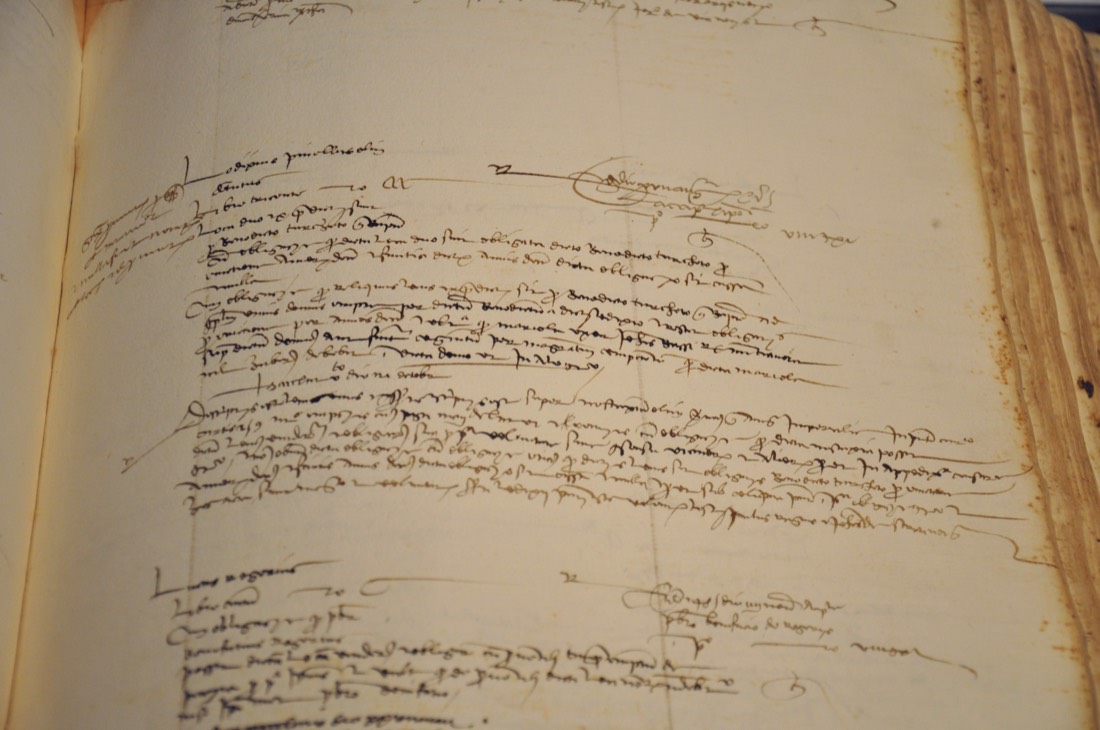
The paper’s fourth example applies the construction to Recognition Science, where the states of reality are the states of the ledger: the record of every entity and its properties, in the paper’s words “the complete ontological record of all entities and their properties”. The test is position: it reads where a given entity is. Each point of physical space is then one position the ledger records, and two points differ exactly when their positions do (Ex 4).

Doesn’t a position test already assume space? Largely, yes. The neighborhoods are assumed (section 04), and in this example the number of dimensions and the distances come from the position readings: the ledger already records coordinates, and position reports them. The construction supplies neither, and the nearness passed down from the neighborhoods need not match those distances. What the construction adds is what each point is: the class of all ledger states that put the chosen entity there.

A photograph of an open ledger: handwritten entries in brown ink, in blocks of short lines across a ruled page, with the thick edge of the book at the right.
1485 · GENOA · CASA DI SAN GIORGIO · LIBRO DELLE COLONNE · PHOTOGRAPHED 2012, ARCHIVIO DI STATO DI GENOVA
EACH ROW IS ONE LEDGER STATE, READING A POSITION; ROWS THAT MEET AT ONE DOT READ THE SAME POSITION

10 · WHAT IT MEANS, IN RECOGNITION SCIENCE

Every act of recognition has an outside and an inside.

This part is Recognition Science. It is not a result of the paper. The paper is mathematics: beyond its fourth example it says nothing about the ledger, and it says nothing about consciousness. Recognition Science uses it for the outside half of its account of experience.

  1. Telling apart comes first.

    Some things can be told apart (the starting fact). Space is not a container underneath distinctions, waiting to be filled.

  2. Why the mill showed only parts.

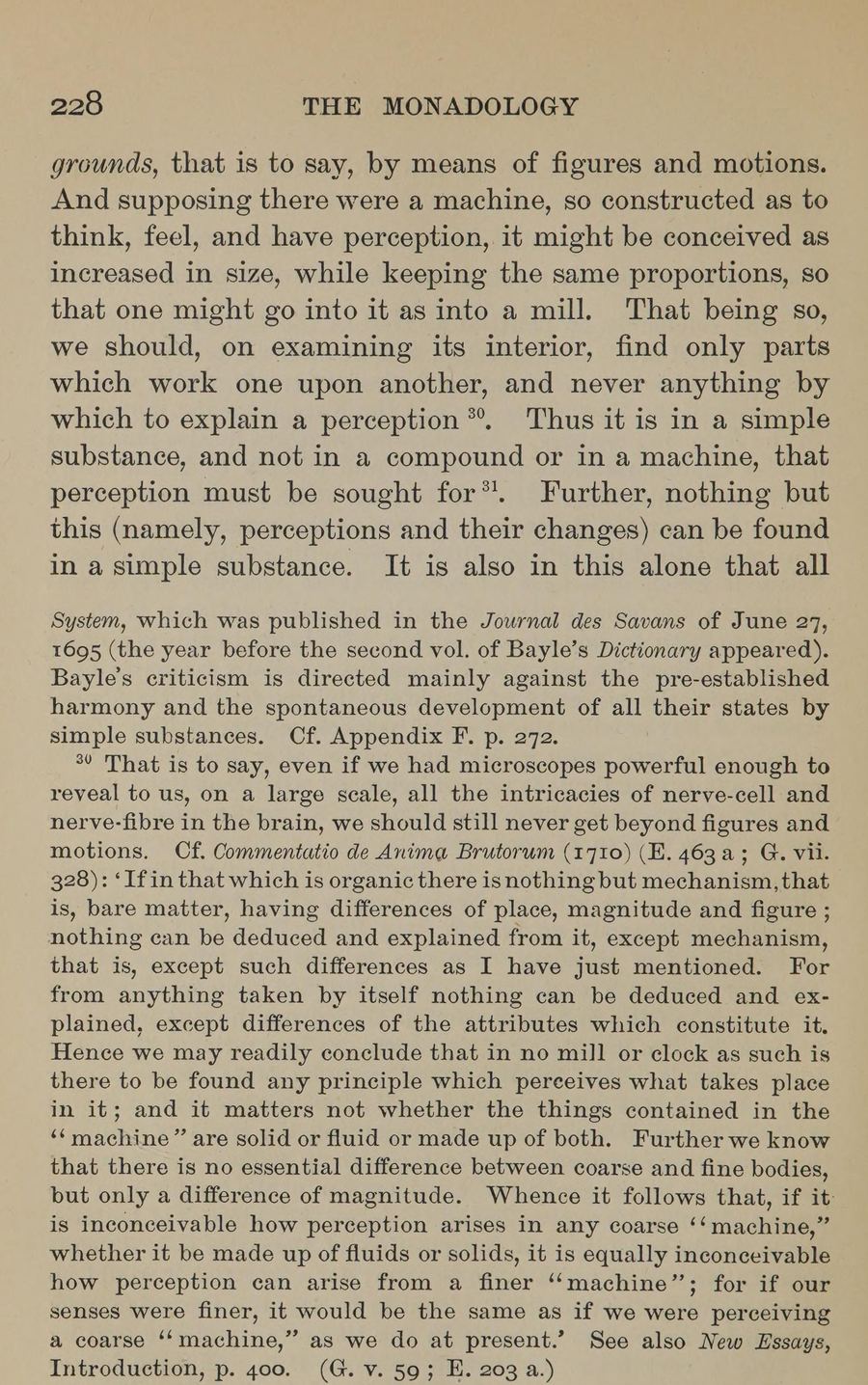
    In 1714 Leibniz imagined a machine that thinks and perceives, enlarged so that one could walk into it as into a mill; inside, one would find only parts working on one another, never anything that explains a perception (the full passage).

    Every look into space, whether into the mill, through a microscope or with a scanner, shows places, shapes and motions: the outside of recognition. It never shows the feeling itself, because the feeling is the inside of those same acts, not one more reading among them.

    Page 228 of Robert Latta’s 1898 translation of Leibniz’s Monadology. The main text continues section 17: a thinking machine enlarged so that one might go into it as into a mill, where we should find only parts which work one upon another, and never anything by which to explain a perception. Below, in smaller type, note 30: even with microscopes revealing every nerve-cell and nerve-fibre in the brain, we should never get beyond figures and motions, followed by Leibniz’s 1710 passage on the mill and the clock.
    1898 · OXFORD · ROBERT LATTA · LEIBNIZ, THE MONADOLOGY · PAGE 228: SECTION 17 AND NOTE 30 · PUBLIC DOMAIN
  3. Experience runs through everything space is built from.

    Every event has an inside, so experience runs all the way down (the universal-consciousness paper).

11 · WHERE IT STANDS

What the paper proves, assumes and does not claim, and what this page worked out.

Established in the paper

  • Different points give different readings: the first isomorphism theorem for sets, or factoring a function through its image (section 02).Theorem 1, Proposition 1
  • Anything that takes one value across each point is a property of the points, in exactly one way: the universal property of a quotient, which the paper calls “the standard universal property of quotient spaces” (section 02).Theorem 2
  • The neighborhoods give a topology that passes down to the points: a generated topology and the quotient topology (section 04).Definition 1, Propositions 2 and 3
  • The same test on the same configurations, under two different nearness rules, gives two different spaces on the same two points (section 04).Example 9, Remark 10
  • Two tests together read two configurations alike exactly when each test does, so their points refine both tests’ points: the common refinement of two partitions (section 03).Theorems 3 and 4, Corollary 1
  • Gauge-equivalent configurations read alike: invariance on orbits (section 06).Theorems 5 and 6
  • In a neighborhood with finitely many readings, a test can’t give endlessly many configurations each its own: the pigeonhole principle (section 05).Theorem 7
  • Under three conditions, the zero-one distance is a pseudometric (section 07).Definition 16, Example 11
  • A distance that is zero between different configurations becomes an ordinary one once they are merged: from a pseudometric to a metric (section 07).Section 3.6

Assumed, not derived

  • The neighborhoods (section 04).Axiom RG2, Remark 1
  • Finite resolution (section 05).Axiom RG3
  • The comparison conditions for an operationally grounded distance (section 07).Section 3.6

Not claimed by the paper

  • That configurations which read alike are always related by a permitted move (section 06).Example 10
  • That the world is discrete or that continuum geometry is false (section 05).
  • That a test’s quotient carries a metric or a number of dimensions of its own (section 07, section 09).
  • Anything about the ledger beyond its fourth example, and anything about consciousness or experience (section 10).

Worked out on this page

  • The thermometer example, and every count in the instrument and figures, computed in your browser from the paper’s definitions.
  • The step from Theorem 7 to a point that holds endlessly many configurations, by the infinite pigeonhole principle (section 05).
  • The second requirement in condition 2 for the zero-one distance (section 07).
  • How a permitted move acts on the observable points, one line from the definition (section 06).
  • The twelve configurations and their three tests, the six readings shared among configurations, and the three weights on the balance: small examples drawn for this page from the paper’s definitions (the top of the page and sections 02, 03, 05 and 07).

12 · THE PAPER

Citation, dates and license.

Jonathan Washburn (Recognition Physics Institute, Austin), Milan Zlatanović (Faculty of Science and Mathematics, University of Niš; corresponding author) and Elshad Allahyarov (Recognition Physics Institute; Heinrich-Heine-Universität Düsseldorf; and other affiliations listed in the paper), “Recognition Geometry,” Axioms 15(2), 90 (2026). doi:10.3390/axioms15020090.

Received 30 December 2025, revised 17 January 2026, accepted 19 January 2026, published 26 January 2026. Academic editor: Angel Ricardo Plastino. Open access under the Creative Commons Attribution (CC BY) license; copyright the authors.