Independent research · Austin
A 13 August 2026 note identifying three degree-12 parents and constructions for them, together with a rank-1 result for 2-group actions. These are ingredients for a tower, not a claimed degree-24 field.
Leftover parents and the octic 2-side
Jonathan Washburn
13 August 2026 · Recognition Physics Institute, Austin
Abstract
A cell is a pair (G, r): a transitive group G of degree 24 together with a real-root count r. The leftover signatures are r ∈ {8,12,16,20,24}. On groups with twelve blocks of size two, leftover cells are counted by the transitive type of the degree-12 subfield. Three of those types now have named constructors: 12T227 (276 leftover cells) from 6T6 times a sixth-degree factor, 12T186 (259 leftover cells) from a generic sixth-degree extension of 6T4, and 12T142 (203 leftover cells) from a reciprocal quadratic over a totally real 6T6. Those are identifications. No degree-24 field was built.
On groups whose block system is eight blocks of size 3, a census of 1,570 never-held labels carries a printed chief chain of the subgroup that fixes every block. The 2-power factors of that chain multiply to the order k2 of the 2-part of the block kernel, on every row. A 2-group acting on a nonzero 𝔽2-space fixes a nonzero vector, so every composition factor has rank 1 whenever the octic group is a 2-group. All 177 labels with a wider 2-step sit on the 24 octic groups of non-2-power order, and those 177 labels carry 773 leftover cells. Exactly three labels have k2 = 256. They carry the only three open cells at signature 22 on the census.
Cells and leftover signatures
Occupying a cell means producing one irreducible degree-24 polynomial with the named group and the named real-root count. The leftover signatures are the five even values 8, 12, 16, 20, and 24. Two block-system shapes carry most of the remaining leftover cells.
For a quadratic extension of a degree-12 field, the degree-24 action preserves twelve blocks of size two. The action on the twelve blocks has transitive type 12Tm, called the parent. Leftover cells of this shape are counted by parent.
In the 8×3 shape the group preserves eight blocks of size 3. The image of the action on the blocks is a transitive subgroup Q of S8. The kernel of that action is the block kernel. Its 2-part is a subspace W ⊆ 𝔽28 that Q permutes. The leftover rungs a label can serve are Hamming weights of vectors of W, read against the real places of a stocked octic.
The note supplies no degree-24 polynomial occupying one of these cells. The counts come from the recorded census. The three parent constructors are proposed identifications: a construction of the named degree-12 type, after which the target real-root counts require controlling signs on that degree-12 field.
Three leftover parents
A leftover-live table of 8,825 rows records 25,999 leftover cells. Of those, 22,494 sit on 262 named degree-12 parents, and 3,505 have no named parent. Three parents that had no named constructor now do.
| Parent | Leftover cells | Degree-24 groups | Group order |
|---|---|---|---|
| 12T227 | 276 | 96 | 1,536 |
| 12T186 | 259 | 99 | 768 |
| 12T142 | 203 | 90 | 384 |
12T227. The sixth transitive group of degree 6 is 2A4, of order 24. A sixth-degree factor over a 6T6 sextic produces a Galois group of order 24 · 26 = 1,536. The leftover parent of that order assigned to this stem is 12T227. Two other leftover parents also have order 1,536. The identification is the stem, not the order alone.
12T186. The fourth transitive group of degree 6 is A4, of order 12. A generic sixth-degree extension over a 6T4 sextic produces a Galois group of order 12 · 26 = 768. Three leftover parents have that order. The construction is kept only at 12T186. Catalog fields of type 12T186 already exist; they are not this constructor.
12T142. Catalog fields of type 12T142 have a unique sextic subfield, of type 2A4. The proposed constructor is the reciprocal quadratic x2 − αx − 1 over a totally real 6T6. A reciprocal quadratic over 6T8 lands in a different order. A different quadratic over 6T6 lands at 12T99.
The recorded reach test evaluates 1,500 labelled fields from the same construction at a fixed coefficient bound. If all land in already-covered cells, the construction supplies no new coverage in that test.
The printed 2-primary chain
The never-held 8×3 census has 1,570 labels. Fifty octic groups appear. Each row records two 2-power integers k2 and q2, with k2 dividing q2, and a printed layer word. The product of the factors with p = 2 equals k2 on all 1,570 rows. The product of the factors with p = 3 equals the recorded 3-core order on all 1,570 rows. The word is a chief chain of the subgroup that fixes every block.
The integer k2 is the order of the 2-part of the block kernel. As a subspace of 𝔽28 that 2-part has size k2. The octic group of the row has order q2/k2. That quotient is single-valued on every one of the fifty groups.
Among the 1,189 nonsplit labels with k2 ≥ 4, the printed 2-side is one-wide throughout on 1,012 labels and carries at least one wider step on 177. Those 1,012 labels carry 4,182 leftover cells.
Wider steps need an odd-order automorphism
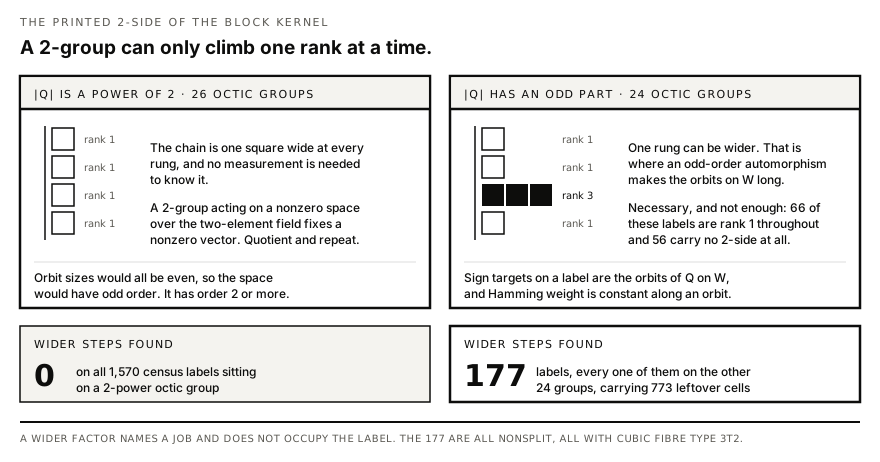
The left panel is forced by the theorem below and needed no census. The census is what shows the right panel is not empty.
Theorem
Let Q be a finite 2-group acting linearly on a nonzero 𝔽2-vector space W. Then Q fixes a nonzero vector of W, and every composition factor of W as a Q-module has 𝔽2-rank 1.
Proof. The zero vector is fixed. If every nonzero vector had a nontrivial orbit, the orbit sizes would be powers of 2 at least 2, so |W| ≡ 1 (mod 2). But |W| is itself a power of 2 and |W| ≥ 2, a contradiction. A nonzero fixed vector gives a rank-1 quotient. Repeat on the kernel.
A printed 2-step of rank greater than 1 is impossible when |Q| is a power of 2. Measured on the 1,570-label census, the 26 octic groups of 2-power order carry zero wider steps. All 177 wider-step labels sit on the other 24 groups. The condition is needed and is not enough: those 24 groups also carry 66 labels whose printed 2-side is nonempty and entirely rank 1, and 56 with no 2-side at all.
The 177 labels are all nonsplit, and all have cubic fibre type 3T2. They carry 773 leftover cells. Because Q permutes coordinates, the Hamming weight of a vector of W is constant along a Q-orbit. Sign targets on a label are the Q-orbits on W. A wider factor is the place an odd-order automorphism of Q can make those orbits long. These orbits specify the sign targets the construction still has to realize.
The three labels of order 256
Exactly three census labels have k2 = 256: 24T24638 (8T32), 24T24639 (8T33), and 24T24725 (8T41). Then W = 𝔽28, so the sign side carries no linear condition. From an octic with ρ real places the servable signatures run ρ, ρ+2, …, 3ρ. These three labels carry the only three open signature-22 cells on the 1,570 labels. Fifteen of the 21 off-leftover cells on them are supplied by stocked octics; six wait on a totally real octic for 8T32 and 8T41.
Scope
The three parent constructors are identifications of a degree-12 type with a construction. Occupying a leftover cell still requires a degree-24 polynomial that labels as the aimed group at that signature. A printed wider step names a composition factor; it does not occupy the label. Named leftover parents still without a constructor include 12T138 and 12T188, at 252 cells each. Catalog fields of an already-named 12T type are a different supply from a newly constructed field of that type.