
Essays · THE ARROW OF TIME
Time’s direction is the direction the record grows.
Stir milk into coffee and the curl never comes back, though every collision in the cup runs backwards without breaking a rule. Reality keeps a permanent record of every event, the ledger, and nothing in it is ever erased. The one-way street is in that record: it only takes new entries.
LIVETHE CUP AND THE RECORD
THE RECORD
1lines
never gets shorter
THE CUP KNOWS0 bits
a swap never changes it
ITS REPORT KNOWS0 bits
what the milk count keeps
THROWN AWAY0 bits
what the merge removed
The dots are a drawing of molecules. The swaps, the report, the counts and the rule that the record only grows are exact.
Try it: stir, run it backwards, then keep only the report and run it backwards again.
THE ANSWER IN FIVE STEPS
- 1Cost points nowhere. Comparing two quantities costs the same both ways: doubling costs exactly 1/4, halving costs exactly 1/4.
- 2The balance comes back. The record doesn’t. The ledger only adds.
- 3A perfect swap makes no entropy. It trades each arrangement for an equally likely partner, so it can always be undone and throws nothing away.
- 4A merge makes entropy: exactly the detail it throws away.
- 5The count. One piece of the ledger: its starting state carries 6.25 bits of information about where it began, its first turn throws away 35.7% of that, and its balance comes back on average every 76 turns, exactly φ⁹ = 38 + 17√5, about 76.01, with φ the golden ratio. Its record never comes back. (A turn is one step in the writing of the record.)
01 · THE FILM · 8 MIN 47 S
Why Your Coffee Never Un-Stirs
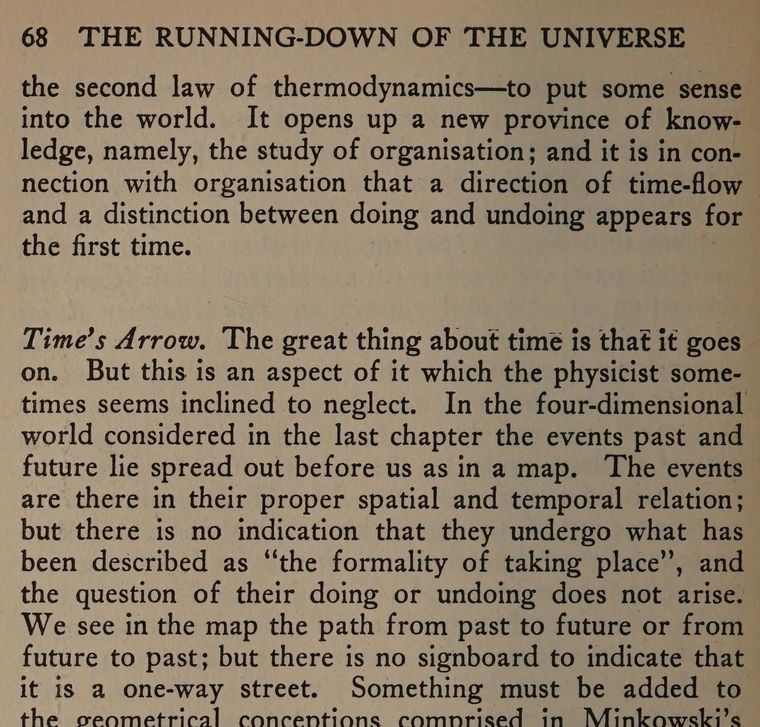
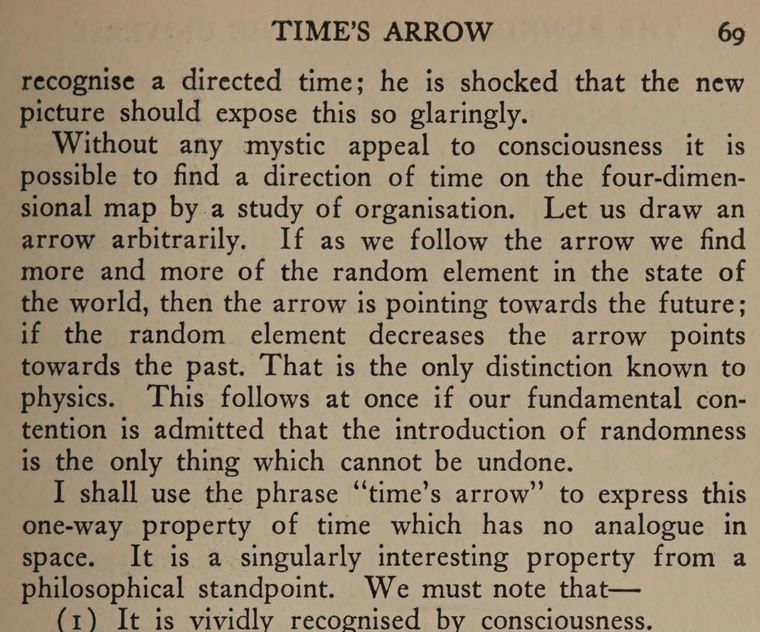
The film follows the search: Lumière’s wall, Carnot’s engine, Clausius’s entropy, Maxwell’s being, Boltzmann’s count, Eddington’s signboard. It arrives at one line: “Time’s direction is the direction the record grows.”
02 · THE WALL · 1896
In 1896 a wall rose out of its own dust
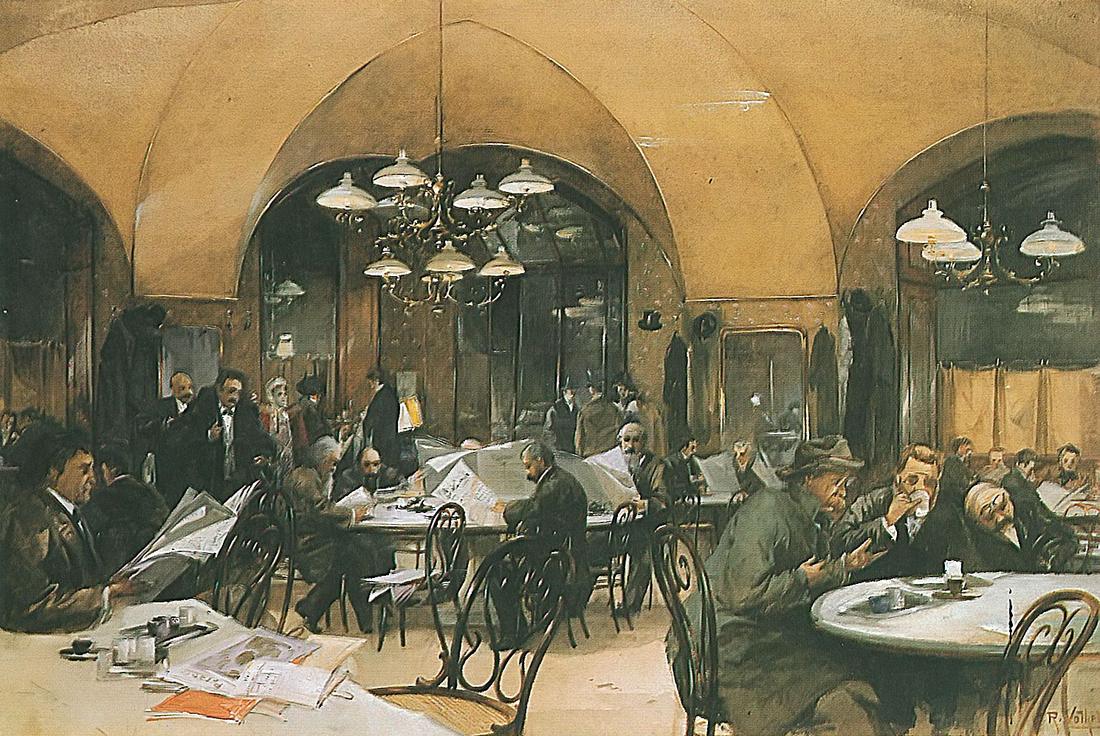
Louis Lumière filmed men pulling down a wall, and the film had its greatest success run backwards: the wall rose out of the dust.1 You know it’s backwards before you can say why. Run two billiard balls backwards and nobody can tell. The milk in your coffee is only molecules colliding with molecules, and each collision runs backwards without breaking a rule. Put them all together and the clip is impossible. So where does the one-way street come from?
03 · THE ENGINE · 1824
Carnot’s best engine is the one that runs backwards
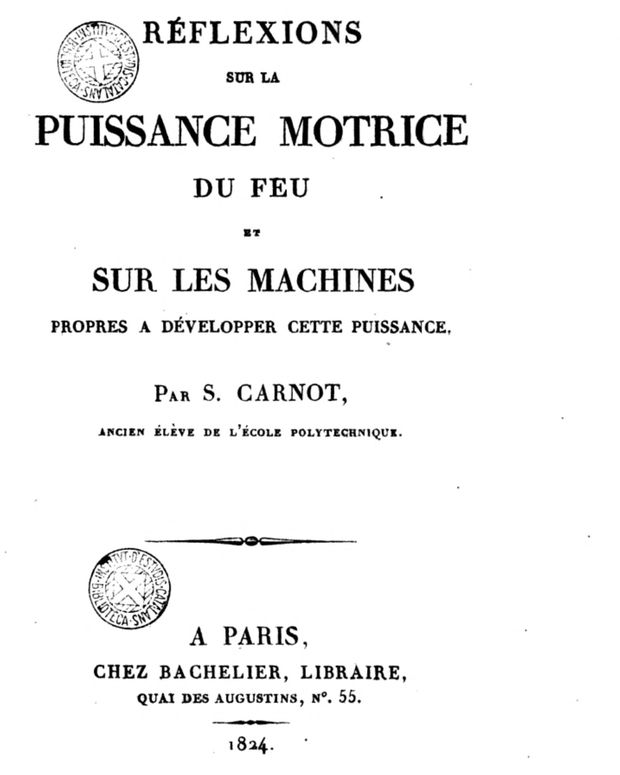
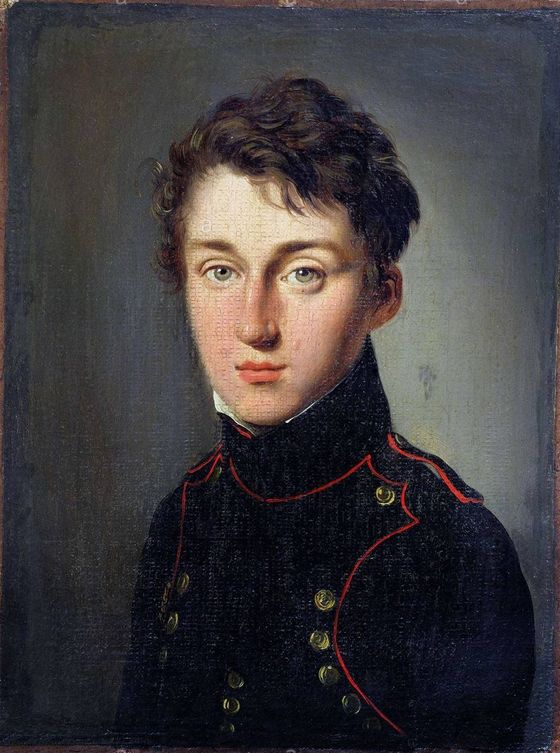
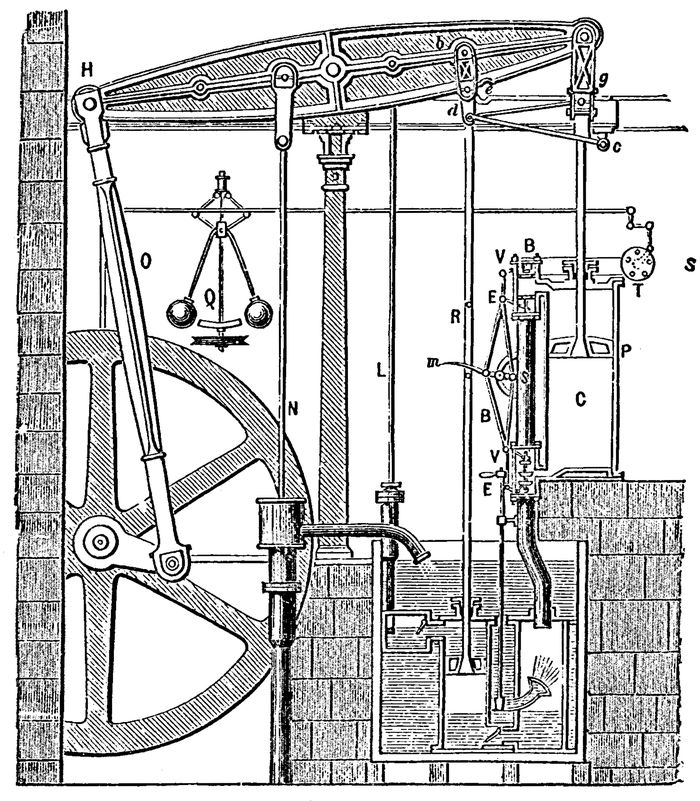
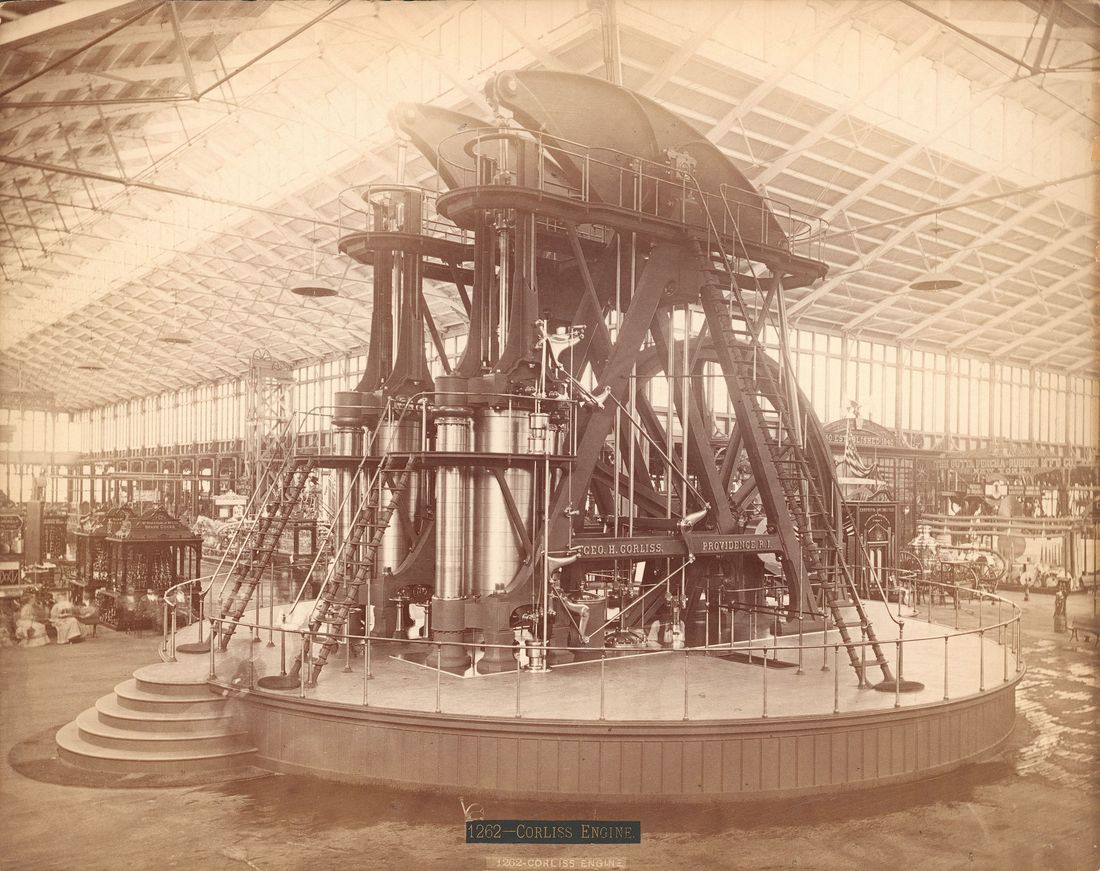
Sadi Carnot was twenty-eight when he paid to print 600 copies of his book on the power of heat.2 Heat makes power, he wrote, by passing from a hot body to a cold one, as a waterfall makes power. To find the most an engine can do, he imagined one whose every operation can be run in the inverse direction and order, the heat returning to its source. It wastes nothing. He worked in the caloric picture of heat, a weightless fluid, which is wrong, and the rule survived. Step 3 is the same idea in the ledger’s accounting: a perfect swap, which trades each arrangement for an equally likely partner, can always be undone, so it throws nothing away and makes no entropy.
STEP 3 THREE COINS, A PERFECT SWAP
04 · THE LAW AND THE WORD · 1850 TO 1865
By 1865 the arrow had a law and a name
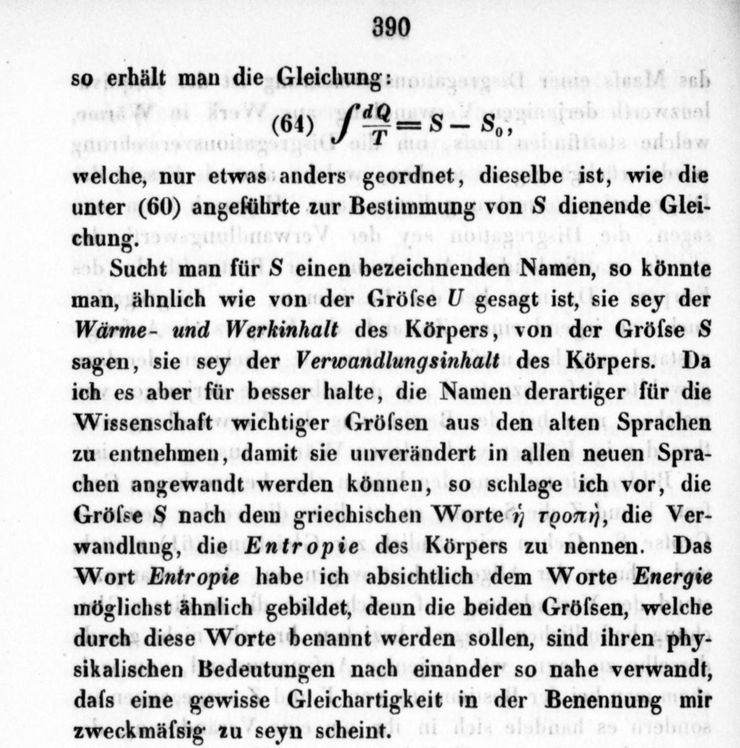
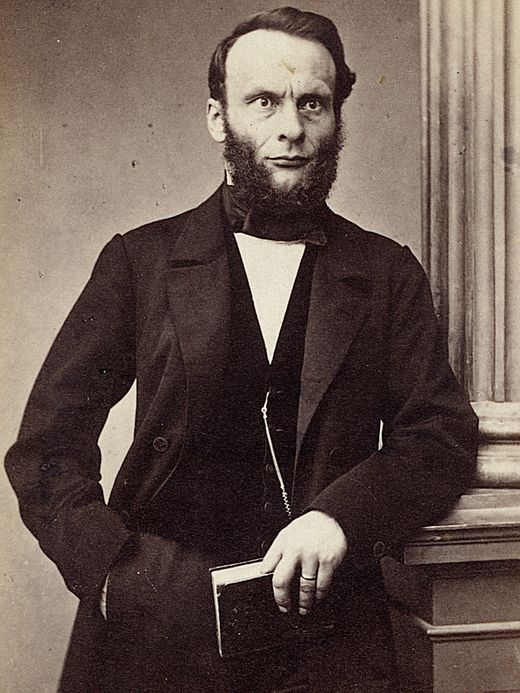
In 1850 Clausius ruled out heat passing from a cold body to a warm one with nothing else changing, and by 1854 he called that the principle his whole development rests on.3 Meanwhile William Thomson, later Lord Kelvin, wrote in 1852 that there is at present in the material world “a universal tendency to the dissipation of mechanical energy,”4 and in 1854 Helmholtz followed the tendency to its end: a universe “condemned to a state of eternal rest.”5 In Zürich in 1865 Clausius named the quantity entropy, from the Greek for transformation, and closed his memoir: the entropy of the universe tends to a maximum.6 Step 4 turns his word into a number you can count: the detail a step throws away.
05 · THE BEING · 1867 TO 1876
A being who sees every molecule can undo the mixing
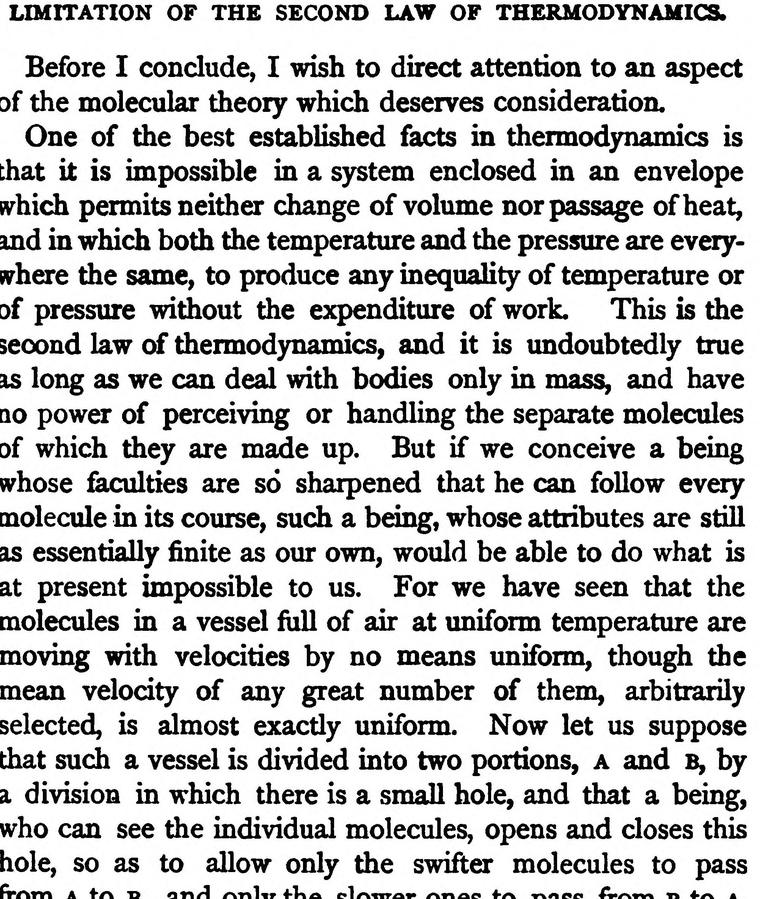
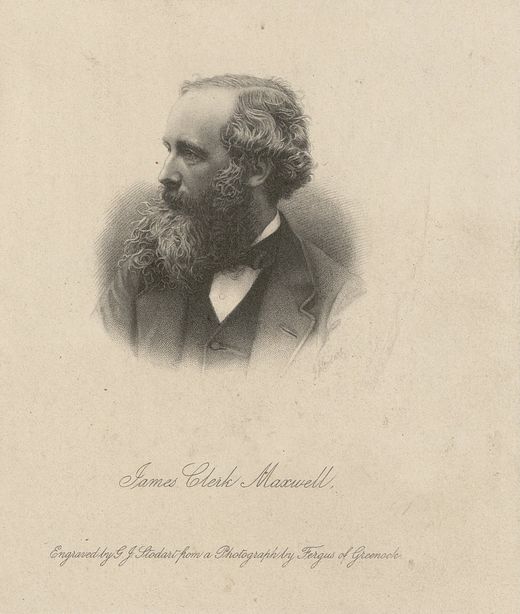
On 11 December 1867 Maxwell wrote to Peter Tait of “a finite being who knows the paths and velocities of all the molecules” and can do nothing but open and close a hole between two vessels. Let him pass the right molecules each way, and “the hot system has got hotter and the cold colder and yet no work has been done.” Only we can’t, he wrote, “not being clever enough.”7 Thomson pencilled another route onto the letter: reverse the motion of every particle in the universe. In 1874 he printed it: the foam at the foot of a waterfall would reunite and descend into the water.8 Loschmidt, Boltzmann’s teacher, wrote the same of every system in 1876.9 The Run it backwards button is that reversal. The cup alone can’t do it: it keeps only a coarse report, and the detail that made the curl was merged away.
06 · THE COUNT · 1875 TO 1901
Entropy became a count, and the count is on a gravestone
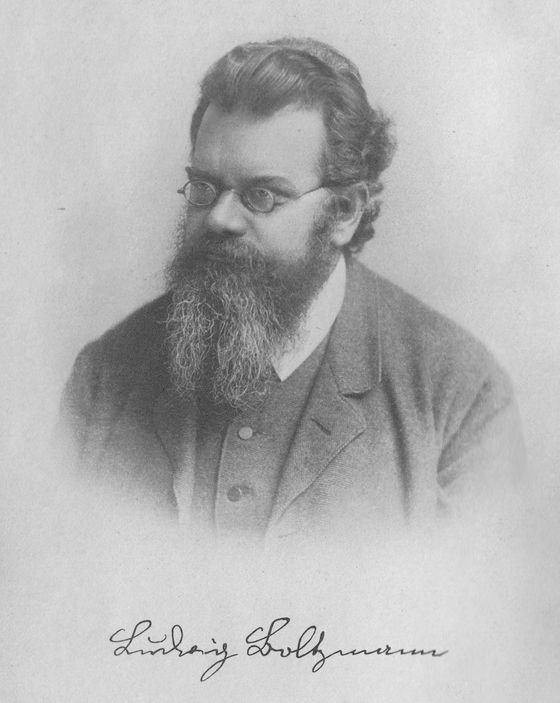
Boltzmann answered Loschmidt by counting. The reversed states exist, and they are extremely improbable; in 1877 he wrote that entropy can be identified with the probability of the state.9 Gibbs had made the same point in 1875: once gases have mixed, “the impossibility of an uncompensated decrease of entropy seems to be reduced to improbability.”10 Planck’s 1901 paper set it down as S = k log W, entropy tied to the disorder with which energy is spread out.11 The line is carved on Boltzmann’s grave in Vienna, though he never wrote it that way.12 In Step 4, W is the number of arrangements the report can’t tell apart: for “two heads” on three coins, W is 3, and the merge throws away log₂ 3 ≈ 1.585 bits.
STEP 4 THREE COINS, A MERGE
- arrangements that look the same
- 3
- bits thrown away
- 1.585
07 · THE WAIT · 1890 TO 1947
Zermelo said every state must come back. Boltzmann priced the wait.
Poincaré proved in 1890 that a closed mechanical system returns, as close as you like, to any state it has been in. In 1893 he drew the consequence for heat: no demon, only “a little patience.”13 In 1896 Zermelo turned the proof on entropy: it can’t increase forever.14 Boltzmann granted the mathematics and priced the wait: for a cubic centimetre of air, a number with more than a billion billion digits, while the number of seconds lived by every person on every planet of every visible star, each living a trillion years, would still be far from fifty digits long.15 Kac proved the rule in 1947: the average wait to return to a state is one divided by its chance once everything has settled.16 One piece of the ledger returns to balance every 76 turns on average; a hundred pieces balanced at once, a 189-digit number of turns. Coming back isn’t forbidden. The wait is just absurd.
STEP 5 THE WAIT FOR ALL PIECES TO BE BALANCED AT ONCE
1
- the wait
- 76.01 turns
- digits
- 2
one box for each digit
08 · THE START · 1895 TO 1897
Boltzmann assumed an improbable start. The record needs no special start.
If mixing is the likely way, why isn’t everything mixed already? Boltzmann gave two answers. In 1895 he passed on an idea of his old assistant, Dr. Schuetz: the whole universe rests in equilibrium, and our world is a rare fluctuation away from it, “no longer small” in probability once the universe is great enough.17 In 1897 he said it outright: the universe, or a very large part around us, started from a very improbable state, an assumption that cannot be proved.18 The textbook answer to the coffee still traces its arrow to a universe that began at very low entropy. The ledger’s arrow doesn’t need that: every entry adds a line, whatever state the piece is in.
09 · THE SIGNBOARD · 1927 TO 1928
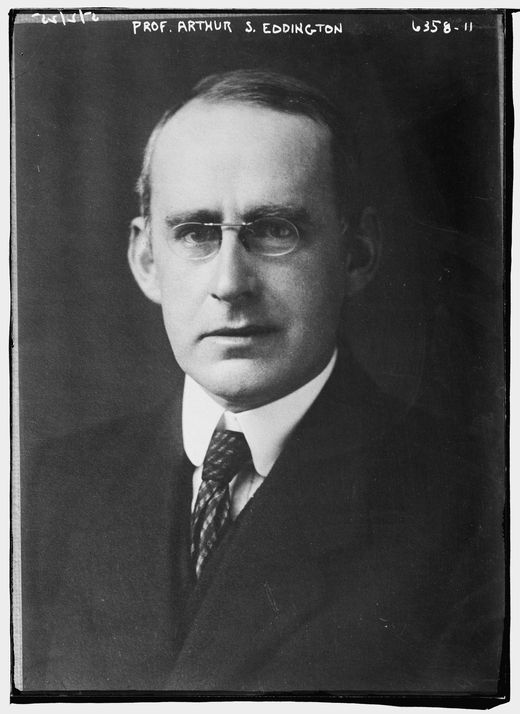
Eddington found no signboard on the map of events
At Edinburgh in 1927 Arthur Eddington gave the Gifford Lectures that became The Nature of the Physical World. The primary laws of physics, he wrote, are “entirely indifferent as to which way you consider time to be progressing.”19 The ledger’s cost is indifferent in the same way. Comparing two quantities in the ratio x costs J(x) = (x + 1/x) ÷ 2 − 1, the one formula meeting three requirements, a combining rule and a calibration, so doubling and halving cost exactly 1/4 each (Step 1).20 On the map of all events there is, he wrote, “no signboard to indicate that it is a one-way street.” The ledger gives the arrow a place you can point to, because it only takes new entries: write an entry and then its opposite, and the balance comes back while the record gains two lines (Step 2). Time’s direction is the direction the record grows.
STEP 1 THE COST OF A COMPARISON
- x
- J(x)
- 1/x
- J(1/x)
STEP 2 THREE ACCOUNTS, ONE FOR EACH DIMENSION OF SPACE
account 1
account 2
account 3
lines in the record
0
10 · THE BILL · 1961 TO 2012
A merge has a price, and in 2012 an experiment measured it
In 1961 Rolf Landauer at IBM argued that a device whose output doesn’t say what its input was, one with no single-valued inverse, must give off heat, which serves to make signals “independent of their exact logical history.” Each bit restored appears as kT ln 2 of heat.21 Charles Bennett puts the rule in general form: merging two computation paths must be accompanied by a corresponding entropy increase elsewhere, because the closed whole conserves its fine-grained entropy.22 Step 4 gives the same account of a merge: it makes entropy, exactly the detail it threw away. In 2012 Bérut and colleagues trapped one colloidal particle in a double well, erased its bit and measured the heat: for slow erasure it settles at Landauer’s bound.23 The cup’s lost detail isn’t destroyed. It’s in the ledger.
11 · STILL OPEN
Three steps are still open
The count in Step 5 is for one piece of the ledger: three accounts under four rules. Three things aren’t finished: the proof that every step in a real cup of coffee follows Step 4’s accounting, which is the second law of thermodynamics in full; why the piece must follow its four rules; and how this arrow fits with the one in Part 2’s clock table, where the busy clocks of everyday activity, like a heartbeat or the hum of a fridge, each go round a lap through three types, one way only.25 That nothing is ever erased rests on unitarity, which is known physics, and on the ledger’s own rule that writing a new entry never alters an earlier one, proved in a preliminary manuscript that is not peer reviewed.24
12 · SOURCES
Sources
German and French passages are translated for this page.
- L. Lumière, Démolition d’un mur (1896), notice, Bpi, Centre Pompidou. https://www.centrepompidou.fr/fr/ressources/media/87sbBOc ↩
- S. Carnot, Réflexions sur la puissance motrice du feu (Paris, 1824), pp. 28, 35. https://archive.org/details/bub_gb_QX9iIWF3yOMC. Print run: https://www.larousse.fr/encyclopedie/personnage/Nicolas_L%C3%A9onard_Sadi_Carnot/111814. Dates, caloric: https://mathshistory.st-andrews.ac.uk/Biographies/Carnot_Sadi/ ↩
- R. Clausius, Ann. Phys. 79 (1850) 500, p. 503, doi 10.1002/andp.18501550403; 93 (1854) 481, pp. 487-488, doi 10.1002/andp.18541691202 ↩
- W. Thomson, Phil. Mag. 4 (1852) 304, p. 306. doi 10.1080/14786445208647126 ↩
- H. Helmholtz, lecture at Königsberg, 7 February 1854, in Popular Lectures on Scientific Subjects, tr. E. Atkinson (1873), pp. 171-172. https://archive.org/details/popularlectureso00helm ↩
- R. Clausius, Ann. Phys. 125 (1865) 353, pp. 390, 400. doi 10.1002/andp.18652010702. English: T. A. Hirst (1867), https://archive.org/details/mechanicaltheor04claugoog ↩
- J. C. Maxwell to P. G. Tait, 11 December 1867, in C. G. Knott, Life and Scientific Work of Peter Guthrie Tait (1911), pp. 213-214. https://archive.org/details/lifescientificwo00knotuoft ↩
- W. Thomson, Nature 9 (1874) 441, p. 442. doi 10.1038/009441c0 ↩
- J. Loschmidt, Wiener Berichte 73 (1876) 128, p. 139, and L. Boltzmann, Wiener Berichte 75 (1877) 62 and 76 (1877) 373, as translated and reported in the Stanford Encyclopedia of Philosophy, “Boltzmann’s Work in Statistical Physics.” https://plato.stanford.edu/entries/statphys-Boltzmann/ ↩
- J. W. Gibbs, Trans. Connecticut Acad. 3 (1875-76) 229; Scientific Papers 1 (1906) 168. https://en.wikisource.org/wiki/Scientific_Papers_of_Josiah_Willard_Gibbs%2C_Volume_1/Chapter_IIIa ↩
- M. Planck, Ann. Phys. 4 (1901) 553, p. 556. doi 10.1002/andp.19013090310 ↩
- Neue Deutsche Biographie, “Boltzmann, Ludwig.” https://www.deutsche-biographie.de/sfz7362.html ↩
- H. Poincaré, Acta Math. 13 (1890) 1, doi 10.1007/BF02392506; Rev. Métaphys. Morale 1 (1893) 534, https://www.jstor.org/stable/40891482 ↩
- E. Zermelo, Ann. Phys. 57 (1896) 485. doi 10.1002/andp.18962930314 ↩
- L. Boltzmann, Ann. Phys. 57 (1896) 773, appendix. doi 10.1002/andp.18962930414 ↩
- M. Kac, Bull. Amer. Math. Soc. 53 (1947) 1002. doi 10.1090/s0002-9904-1947-08927-8 ↩
- L. Boltzmann, Nature 51 (1895) 413, p. 415. doi 10.1038/051413b0 ↩
- L. Boltzmann, Ann. Phys. 60 (1897) 392. doi 10.1002/andp.18972960216 ↩
- A. S. Eddington, The Nature of the Physical World (1928), pp. 66-69. https://archive.org/details/natureofphysical1928eddi ↩
- J. Washburn and M. Zlatanović, Mathematics 14(6), 935 (2026). https://doi.org/10.3390/math14060935 ↩
- R. Landauer, IBM J. Res. Dev. 5 (1961) 183. doi 10.1147/rd.53.0183 ↩
- C. H. Bennett, Stud. Hist. Phil. Mod. Phys. 34 (2003) 501. doi 10.1016/S1355-2198(03)00039-X ↩
- A. Bérut et al., Nature 483 (2012) 187. doi 10.1038/nature10872 ↩
- “Recognition Boundary Theory: How One Ledger Holds Many Perspectives,” preliminary manuscript, Recognition Physics Institute (28 October 2026; not peer reviewed), Theorem 2.14. https://recognitionphysics.org/publications/ ↩
- Part 2 of this series, “Time”: https://recognitionphysics.org/essays/time/. The piece’s law and numbers: https://recognitionphysics.org/simulation/ ↩
The balance can come home. The record can’t.
That’s the one-way street, and it’s why yesterday is still there. Your coffee forgets how it was stirred. The ledger never forgets anything.