
Essays · Origins
The universe began with one mark.
Astronomers trace the expansion of space back about 13.8 billion years to a hot, dense state and call it the Big Bang. That is what’s measured. The first thing that happened is a different question. The answer is one mark in the record: the smallest change there is, written in one of six places. No law picks which.
Watch the film (8 min 50 s), or read on.
Try it: put the first mark in any of the six places.
LIVEThe record, written from line one
THE WHOLE STORY ON ONE LINE
THE RECORD · LINE ONE
no marks yet · counted in marks, not seconds
NOT DERIVED YET
not the heating, not the expansion, not the first atomic nuclei, not the cosmic microwave background
MEASUREDTODAY
expansion traced back about 13.8 billion years to a hot, dense state
The farther the galaxy, the faster it recedes: Hubble’s line, 1929.
Six counts: six places for a mark.
000 … 111 (three yes-or-no’s, 1 for yes)
MARKS
0a count of marks, not seconds
COST SO FAR
0never comes down
POSSIBLE HISTORIES
1counts, not odds
FIRST COMPLETE MOMENT
not yetCORNERS TOUCHED 1/8
THE RECORD
The books, the cube and the costs are exact. Which mark goes where is your choice here; in reality no law picks.
RATIO OF THE NEXT COMPARISON
The cost law sets no ratio: J gives a cost for every ratio and picks none.
Line one needs a ratio other than 1: its two sides aren’t equal. That premise is adopted, not derived.
WRITE
A new page keeps this record; nothing is erased.
THE FILM · 8 MIN 50 S
How Did the Universe Begin?
The film follows the search: Lemaître’s calculation, Hubble’s line, the hiss in the horn at Holmdel, COBE. It arrives at one line: the universe began with one mark.
THE ARGUMENT
First an argument nobody won, then a curiosity
1260s–1923- 1260s
Aquinas. “By faith alone do we hold, and by no demonstration can it be proved, that the world did not always exist.”
- 1781
Kant. Gives a proof of each answer. Against a beginning: in empty time no moment holds “a distinctive condition of being, in preference to that of non-being.”
- 1917
Einstein. His universe stays still, held there by a term added “as required by the fact of the small velocities of the stars.”
- 1922–23
Friedmann. The same equations without the stillness give worlds that start from a point, “tens of billions of usual years” since the “creation of the world.” Einstein calls it suspicious, then retracts: the error was his. Friedmann files these worlds under “curiosities.”
THE SPEEDS
Speeds first, then the line, then the beginning
1917–1931- 1917
Slipher. The year Einstein’s universe is held still, Vesto Slipher reports 25 spiral nebulae, 21 receding, averaging 570 km/s: “about thirty times the average velocity of the stars.” He reads the net recession as our own drift.
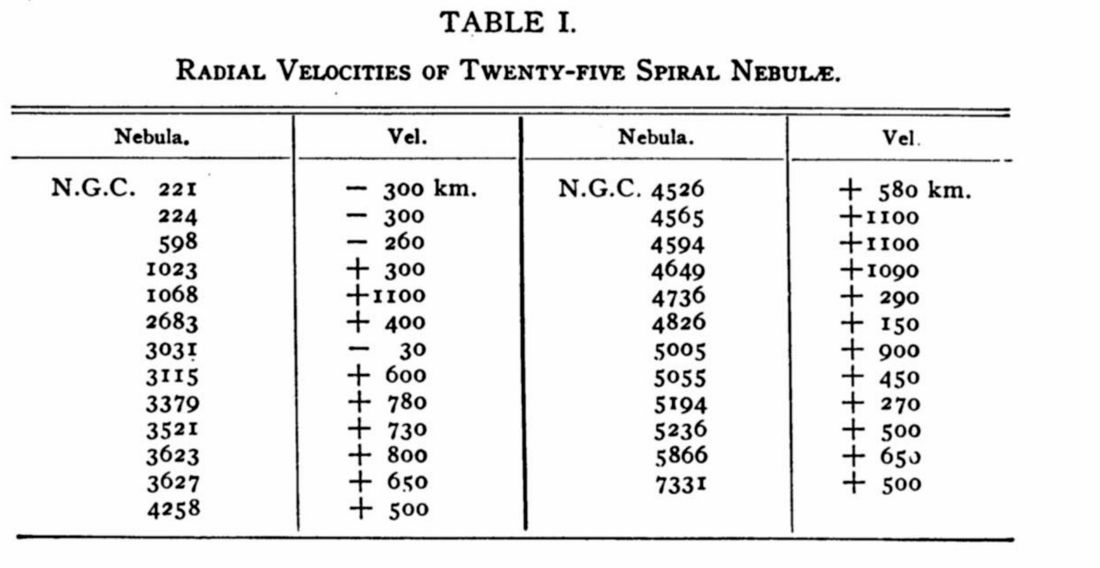
1917 · FLAGSTAFF · SLIPHER’S TABLE I, AS PRINTED 1917 · FLAGSTAFF · SLIPHER’S TABLE I, AS PRINTED N.G.C. km/s 1917 · FLAGSTAFF · SLIPHER’S 25 SPEEDS, REDRAWN FROM TABLE I - 1927
Lemaître. A priest, in French, in a Brussels journal: an expanding universe, 625 km/s per megaparsec. It “passed almost unnoticed.” No big bang is in it; that idea arrives four years later.
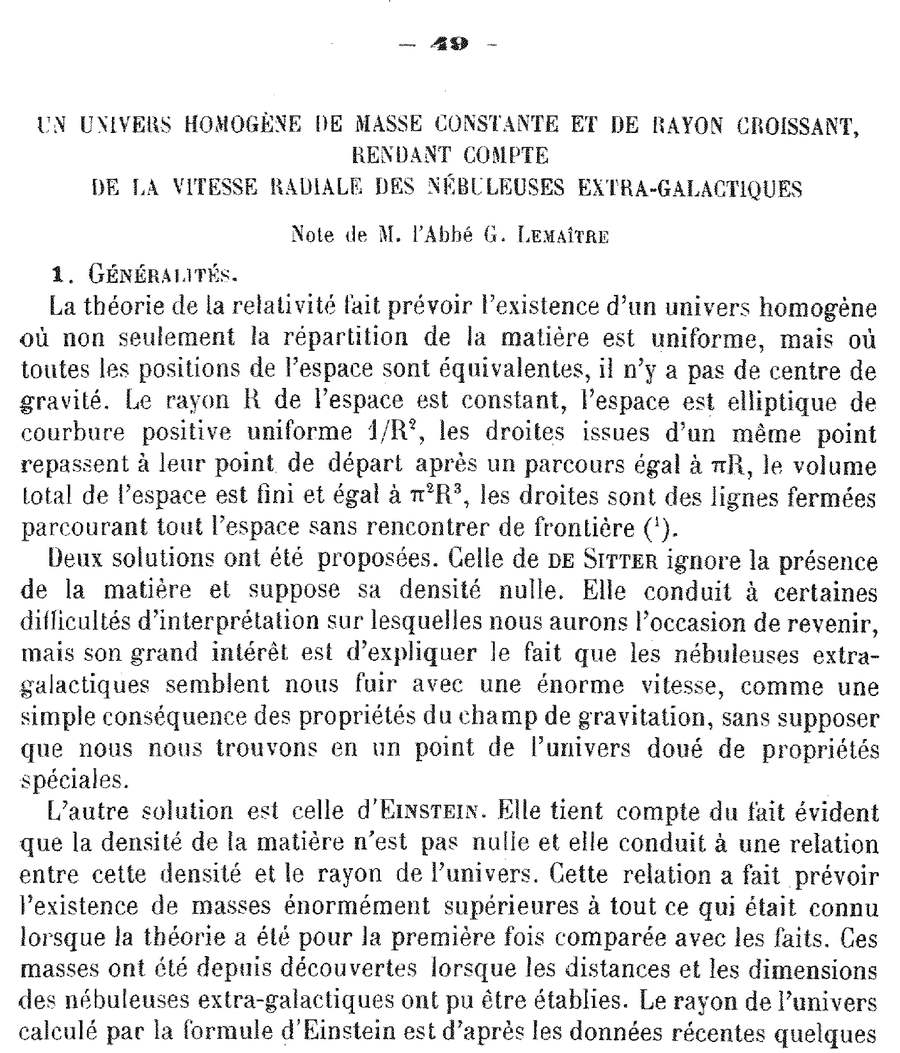
1927 · BRUSSELS · LEMAÎTRE’S PAPER, SIGNED L’ABBÉ G. LEMAÎTRE - 1929
Hubble. He sets 24 distances against speeds, most of them Slipher’s, and draws the line: the farther, the faster. The paper never says expansion or names Slipher.
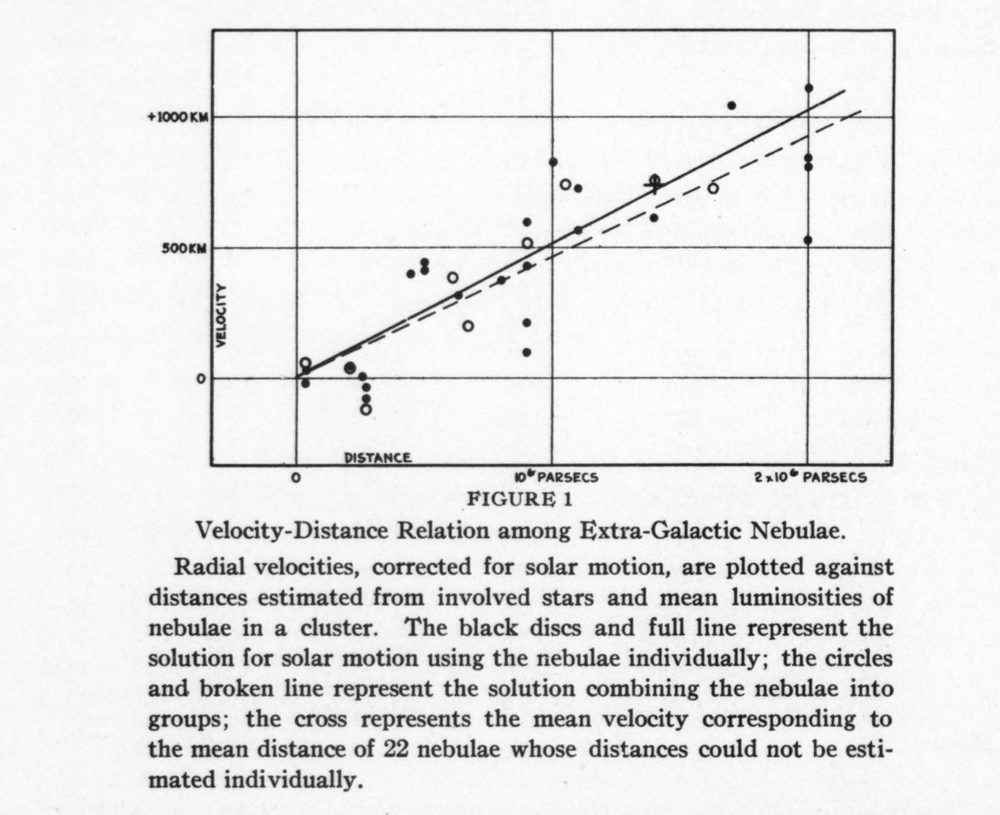
1929 · MOUNT WILSON · HUBBLE’S VELOCITY-DISTANCE FIGURE 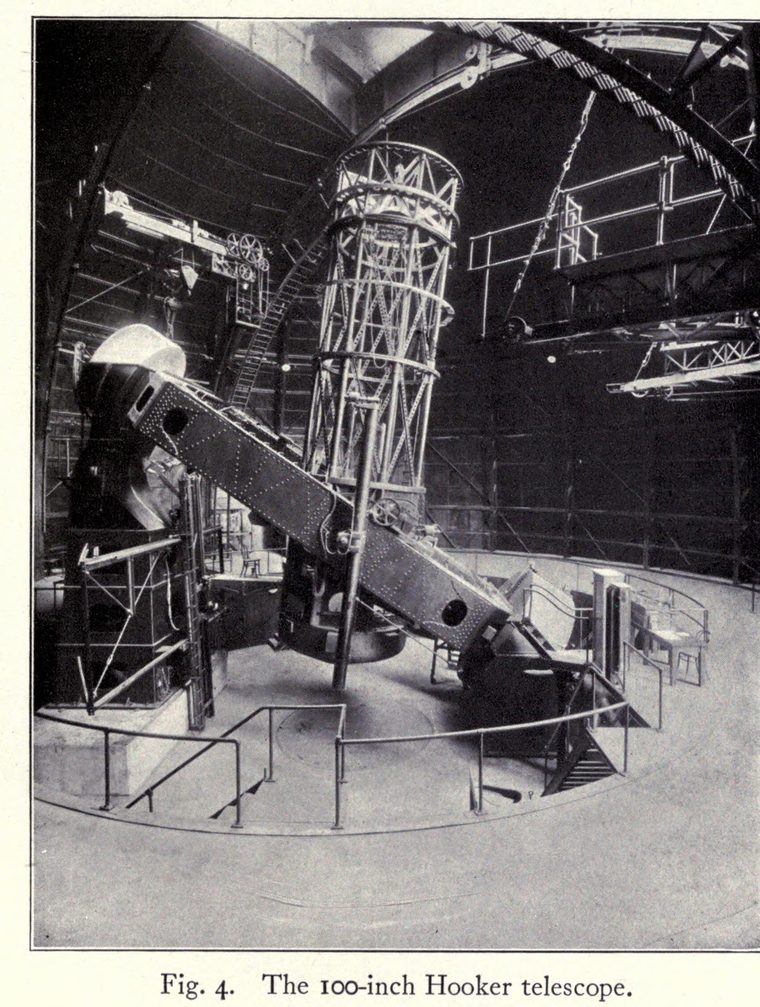
1922 · MOUNT WILSON · THE HUNDRED-INCH TELESCOPE · HALE, THE NEW HEAVENS - 1931
Lemaître. Answering Arthur Eddington, who finds a beginning “repugnant,” he runs time back to “a single quantum.”
THE GLOW
Forecast, named, misread, then found by accident
1948–1965- 1948
Alpher, Herman. A hot start leaves a glow of “about 5° K,” which, Penzias writes, they took to be masked by cosmic rays and starlight.
- 1949
Hoyle. On the BBC he names the picture he rejects “one big bang,” having “nothing except the spoken word.” The name stuck.
- 1961
Ohm. His report on the Holmdel horn’s Echo receiver: the system runs “almost exactly three degrees” above its parts, Penzias writes. Ohm reads the gap as the parts’ uncertainty.
Ohm, 1961, as printed. His error bars overlap, and he took 21 ± 1 K. Penzias later read the difference as “almost exactly three degrees.” - 1964
Doroshkevich, Novikov. The first paper to call the glow detectable as microwaves names that horn “the best available instrument,” then misreads Ohm’s report, taking the atmosphere’s “sky temperature” for the glow. Its translation “escaped the notice of the other workers,” Penzias writes.
- 1964–65
Penzias, Wilson. Calibrating that horn, they expect a “null result” and find 3.5 K of excess noise from every direction. A call to Robert Dicke’s Princeton group, setting up a search for it, explains the noise.
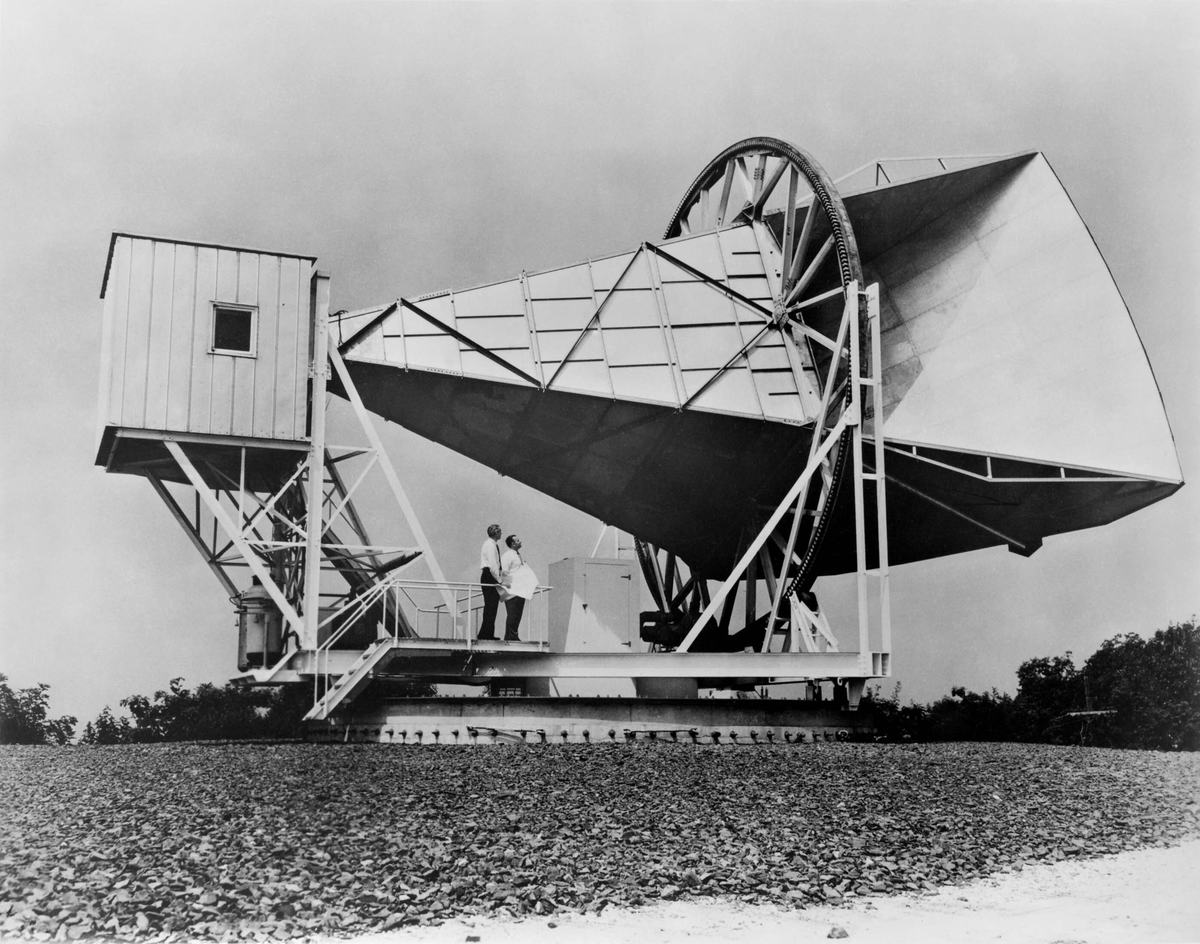
1962 · HOLMDEL, NEW JERSEY · BELL LABS HORN ANTENNA · NASA
WHAT IS MEASURED
A hot, dense state, 13.8 billion years back
1970–2018- 1970
Hawking and Penrose. Under conditions they state, “space-time singularities are to be expected”: paths of matter or light that cannot be continued.
- 1990
COBE. John Mather shows the first spectrum: a blackbody, 2.735 K within 0.06 (now 2.725 K within 0.001). Over a thousand people “rose in a standing ovation.”
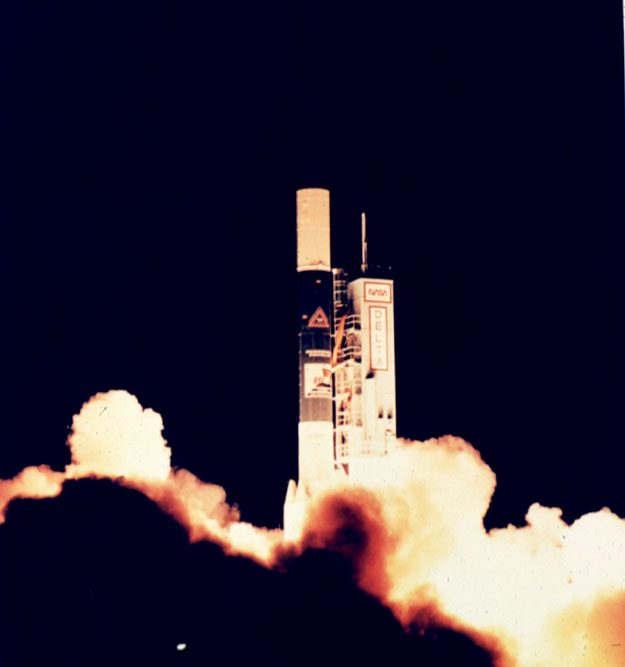
1989 · VANDENBERG, CALIFORNIA · COBE LAUNCH · NASA 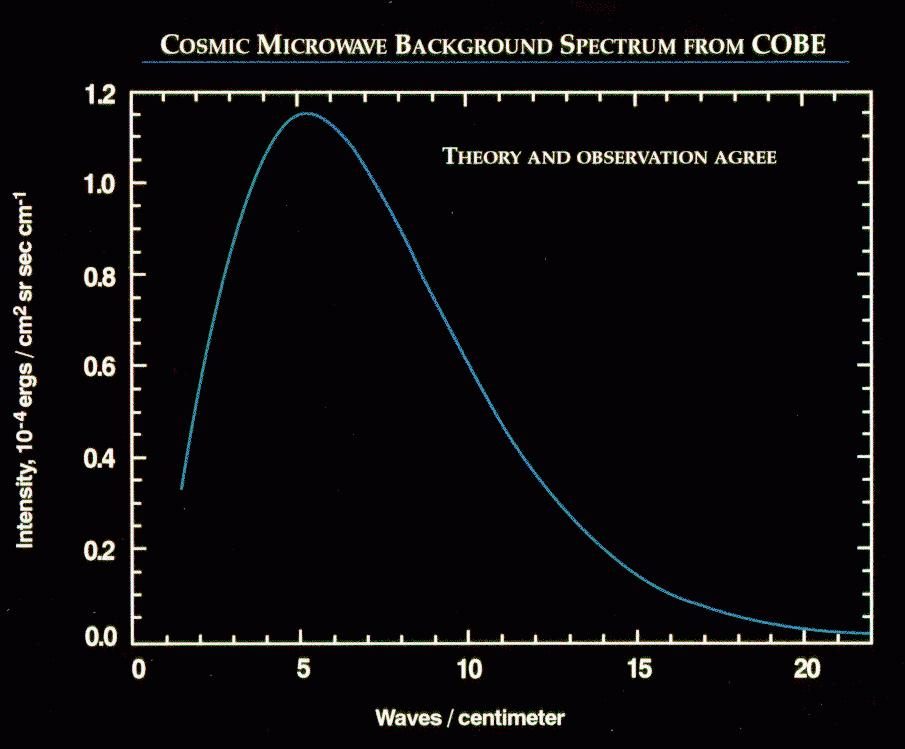
1990 · COBE FIRAS · THE AFTERGLOW’S SPECTRUM · NASA - 1992
COBE. Ripples in the glow, one part in 100,000.
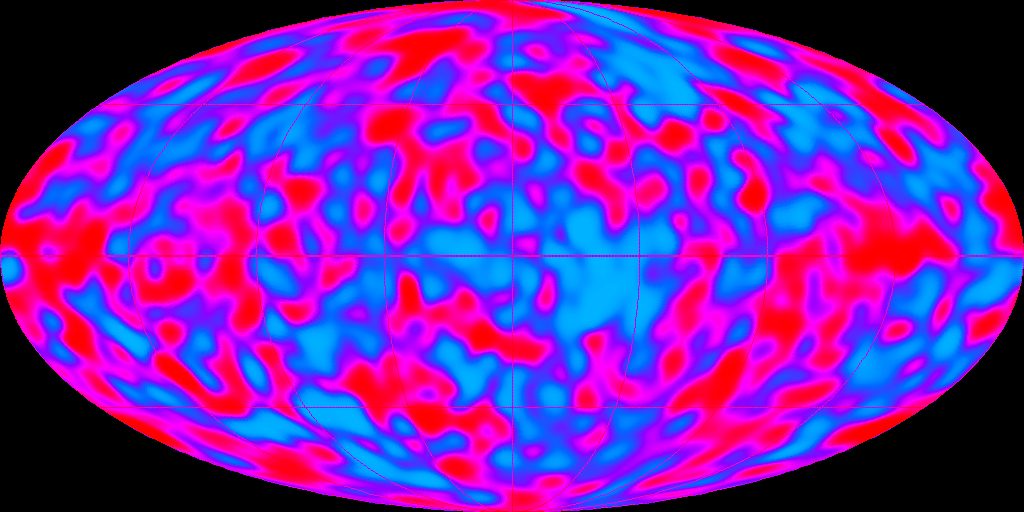
1990–92 · COBE DMR · THE AFTERGLOW, ALL SKY · NASA - 2018
Planck. The expansion of space, traced back: 13.797 ± 0.023 billion years.
the glow’s temperature in COBE’s first spectrum, 1990, within 0.06 K.
billion years of expansion, traced back: Planck 2018, 13.797 ± 0.023.
That is what’s measured. It doesn’t say what the first thing was, what it cost, or whether anything picked it.
THE RECORD · FOUR STARTING POINTS
A record, a yes or no, a cost, three directions
Recognition Science, the physics our institute develops, starts from four facts, each with its reason. Reality keeps a permanent record of every event, and nothing in it is ever erased: the basic laws of physics never destroy information, and in quantum mechanics the present fixes the past exactly. The smallest event is telling two things apart, a single yes or no; in the record, one such distinction is one mark. A comparison costs: J(x) = (x + 1/x)/2 − 1 at ratio x, zero at balance, the same for x and 1/x. Three requirements, a combining rule and a calibration leave only this formula. Space has three dimensions: lasting structure needs linking, and loops link only in three. The entries add up to a table of counts, the books: three rows, one per direction; two counts a row, one per side.
STEPS 1 AND 2 · THE FIRST MARK
One mark, and six places for it to go
Friedmann’s point and Lemaître’s single quantum each hold the whole universe at once. The first entry is the smallest change there is: one mark on one count. Calculated: two marks cost more than one however they land (at ratio 2: one mark 1/4, two marks 1/2 or 9/8). Adopted, not derived: the first entry is one mark recording one comparison whose two sides aren’t equal. The books start blank, every count at zero. The first mark has six places to go, three directions with two sides each, and the six first books are all different. Cost can’t choose: it depends on the ratio, never on the count.

The six first books: one mark each, all six different.
STEP 3 · THE REVERSE AND THE COST
It went in with its reverse, and it cost 2J(r)
Every mark records a comparison, and every comparison goes in with its reverse, the same comparison read the other way round. The two cancel on balance, so nothing is owed. Their costs can’t cancel; J is never negative, so they add. At ratio 2 the comparison costs J(2) = 1/4, its reverse 1/4, the entry 1/2. In general the pair costs 2J(r), more than zero for every ratio except 1. From the first entry the running total of cost rises and never comes down: three pairs at ratio 2 take it from 0 to 1/2, 1, 3/2. The cost law doesn’t set the first ratio.
STEP 4 · NO LAW PICKS
All six allowed, one cost, no law to choose
Did anything pick which of the six? Kant asked what picks a moment in empty time. Three facts answer: all six marks are allowed, all six cost the same, and each leaves different books. Chess draws the split: before anyone moves, the rules fix White’s twenty legal first moves, and only the scoresheet says which was played. The laws are the rulebook; the record is the scoresheet. In quantum physics the answer a measurement records isn’t set in advance. In 1931 Lemaître appealed to quantum indeterminacy too: the story of the world need not be written down in the first quantum “like a song on the disc of a phonograph.” Each later mark has six places again: 6 possible histories after one mark, 36 after two, 216 after three, 1,679,616 after eight.
a drawing of what the laws allow
1: 6 · 2: 36 · 3: 216 · 8: 1,679,616 · 103: past 1 followed by 80 zeros
STEP 5 · EIGHT MARKS
The first complete moment takes at least eight marks
Three directions, one yes-or-no each: 2 × 2 × 2 = 8, the eight corners of a cube. Each mark flips one yes-or-no, one step along one road. A complete moment is a trip that touches every corner and ends where it started: seven other corners, then home, eight landings. So it takes at least eight marks. From 000 there are 12 tours, six loops each walked either way. Each step can be written with either mark on its road, so a tour has 2⁸ = 256 written forms, and 12 × 256 = 3,072 of the 1,679,616 eight-mark histories make the trip. Each mark changes the number of yeses by one and home has none, so a trip ends only after an even number of marks, 8, 10, 12, never 9. The laws allow a complete moment at mark 8 and don’t say it happened then: “at least eight” is the exact claim. A count of marks isn’t a number of seconds.
THE 12 TOURS FROM 000
histories · about one in 547 · even counts only
WHERE THIS STOPS
The link to the hot, dense state isn’t derived yet
NOT DERIVED YET
How the first entries connect to the hot, dense state astronomers measure isn’t derived yet: not the heating, not the expansion, not the first atomic nuclei, not the cosmic microwave background.
The five steps say what a beginning is made of: the smallest change there is, one mark in a table of zeros, entered with its reverse, at a cost, like every entry since. Every entry goes in under the same rules, adding to a total that never goes down.
The dinosaur’s yawn, the asteroid and your seventh birthday party are all written below line one, in the same ink.
The laws say what’s allowed. The record holds what happened.
Citations
- Aquinas, Summa Theologiae I, q. 46, a. 2. Kant, Critique of Pure Reason (1781).
- Einstein (1917, 1931, 1945), in O’Raifeartaigh et al., Eur. Phys. J. H 42, 431 (2017). link.springer.com
- Friedmann, Z. Phys. 10, 377 (1922) link.springer.com; Einstein, Z. Phys. 11, 326 (1922) link.springer.com, 16, 228 (1923) link.springer.com; Friedmann’s 1923 book, trans. Belenkiy, ASP Conf. Ser. 471 (2013).
- Slipher, Proc. Am. Philos. Soc. 56, 403 (1917).
- Lemaître, Ann. Soc. Sci. Bruxelles A47, 49 (1927); Rev. Quest. Sci. 129 (1958).
- Hubble, Proc. Natl. Acad. Sci. 15, 168 (1929). pnas.org
- Lemaître, Nature 127, 706 (1931). nature.com
- Alpher and Herman, Nature 162, 774 (1948). nature.com
- Kragh, Astron. Geophys. 54, 2.28 (2013). academic.oup.com
- Ohm, Bell Syst. Tech. J. 40, 1065 (1961) ieeexplore.ieee.org; Doroshkevich and Novikov, Dokl. Akad. Nauk SSSR 154, 809 (1964); Penzias and Wilson, Astrophys. J. 142, 419 (1965); Nobel Lectures: Penzias, Wilson (1978), Mather (2006); Mather et al., Astrophys. J. 354, L37 (1990).
- Hawking and Penrose, Proc. R. Soc. A 314, 529 (1970). royalsocietypublishing.org
- Planck Collaboration, “Planck 2018 results. VI. Cosmological parameters,” Astron. Astrophys. 641, A6 (2020). aanda.org
- Unitarity: Sakurai and Napolitano, Modern Quantum Mechanics, 2nd ed. (2011), section 2.1.
- The unique cost: Washburn and Zlatanović, “Uniqueness of the Canonical Reciprocal Cost,” Mathematics 14(6), 935 (2026). mdpi.com
- Three dimensions: Rolfsen, Knots and Links (1976); Pardo-Guerra and Washburn, “Three Dimensions from a Recognition Requirement,” Preprints.org 202609.1990 (2026).
- Eight steps: Pardo-Guerra and Washburn, “The Process Dimension of Recognition: Arity, Cost, and the Persistence of the Completed Act,” Entropy 28(11), 1167 (2026). mdpi.com
- Our published papers: recognitionphysics.org/publications/. The first entry, six places, histories, tours and even counts: our working papers “The First Recognition Event and Its Price” and “Every Lawful History, Carried at Once,” and our paper on the first complete pass of the cube (recognitionphysics.org/simulation/).