
Essays · SPACE · WHY THREE
Two loops hook in three dimensions, and in no other.
Space has three dimensions because a record's marks are loops, and loops can hold each other in three dimensions only. For more than two thousand years the number was a decree, then a force law, then an assumption. This page follows the people who went after its reason, and the step that gives it one.
LIVE
Arrow keys move the loop. Page Up and Page Down lift it in 4. R starts again.
HOOK COUNT
1
Pokes through the ink loop's soap film (a Seifert surface): plus one way, minus the other.
HOOKED
A shape holds another when their dimensions add up to one less than the space: 0 + 1 = 2 − 1, 1 + 1 = 3 − 1, 1 + 2 = 4 − 1.
The magenta loop pokes through the film once. Hook count 1.
Live: the hook count is measured from the drawing every frame. The fourth direction can't be drawn on a flat screen; dashes and a slider stand in for it.
Drag the magenta loop. In 3 it never gets free. In 4, lift it and slide it clear.
FOURTH DIRECTION
- 2 · too cramped
- 3 · just right
- 4 · too roomy
- HOOKED
- APART
- NEVER HOOKED
- FOURTH DIRECTION
- Two loops on a balloon's skin. The ink loop cuts it into two patches; the magenta loop sits in one.
- To hook, it would have to cross the ink loop.
- It shrank to a dot: never hooked. Hook count 0.
- A loop holds a dot: 0 + 1 = 2 − 1.
- The magenta loop pokes through the film once. Hook count 1.
- Every move that frees one runs it through the other.
- The magenta loop pokes through the film once. Hook count 1.
- The same hooked pair, with one more direction to move in.
- Lifted into the fourth direction, it passes the ink loop untouched.
- Apart, nothing cut. Hook count 0.
- The magenta loop pokes through the film once. Hook count 1.
- It can't come down here: the loops would meet.
- Every move that frees one runs it through the other.
THE ANSWER
- STARTING POINTA record holds: what's written can't be unwritten by moving things around.
- STARTING POINTA mark in the record, and whatever reads it, are loops.
- STARTING POINTSpace closes up on itself, with no edge and no handles.
- WORKED OUTTwo loops that no smooth motion can undo exist in three dimensions only.
- RESULTSo space has three dimensions.
The first three are starting points, not derived here. Every step after them is.
01 · THE FILM · 8 MIN
The whole answer, told in found prints, photographs and film
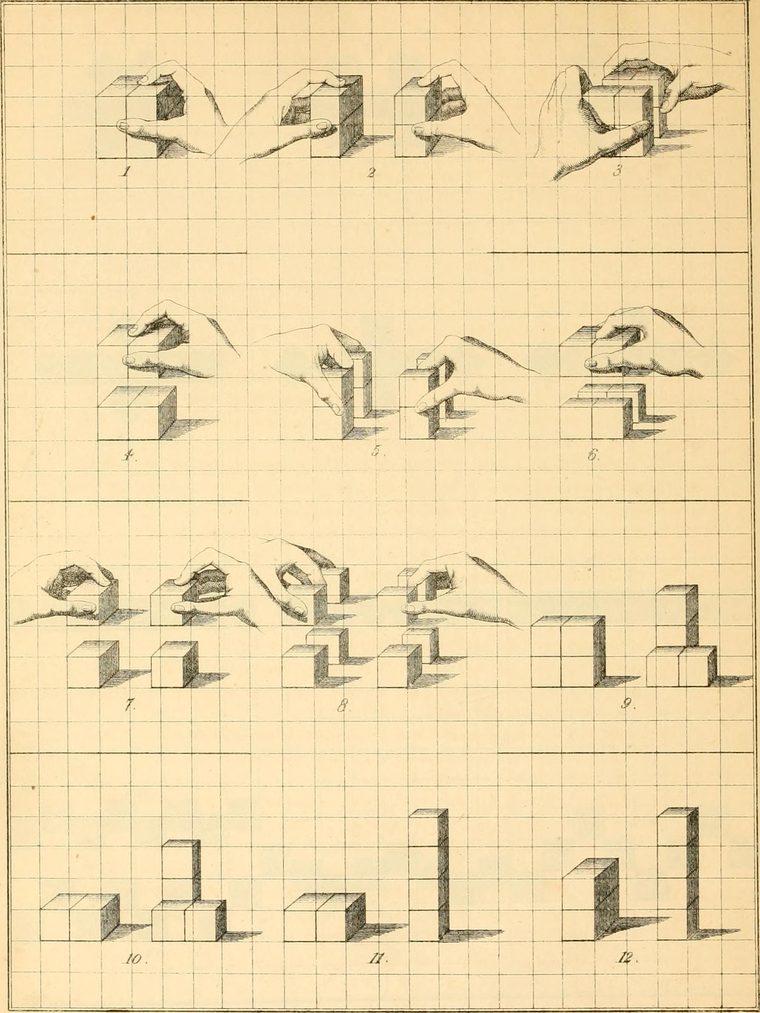
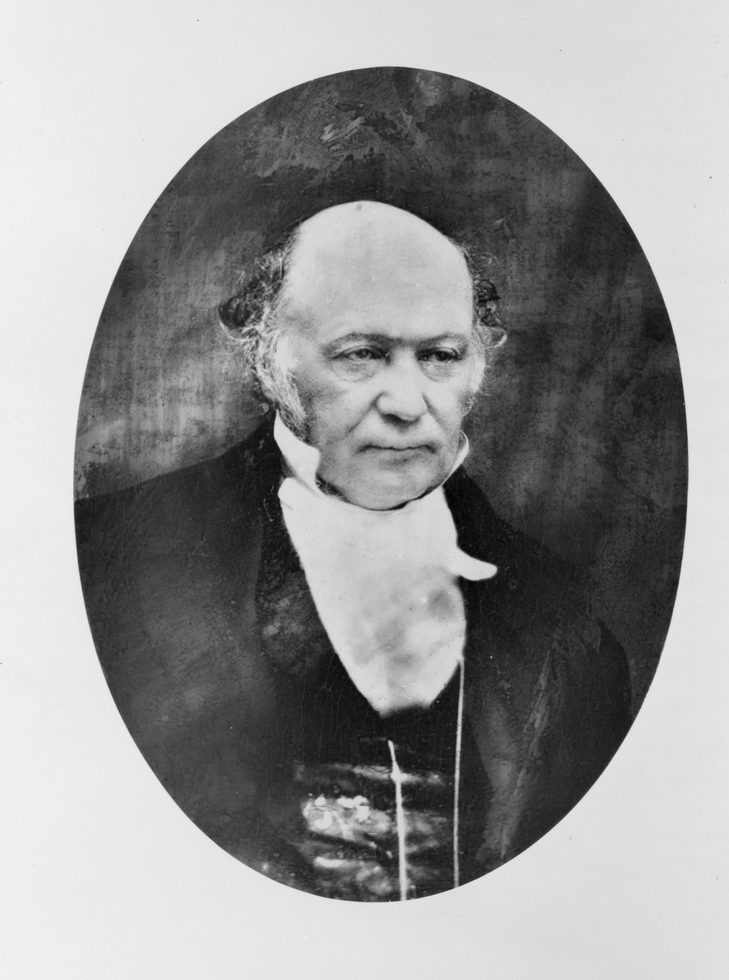
Tait's smoke rings, Zöllner's sealed cord, the Sphere in Flatland, Hamilton's bridge: every picture is a found print, plate, photograph or film.
c. 350 BC – 1783 · ATHENS, KÖNIGSBERG
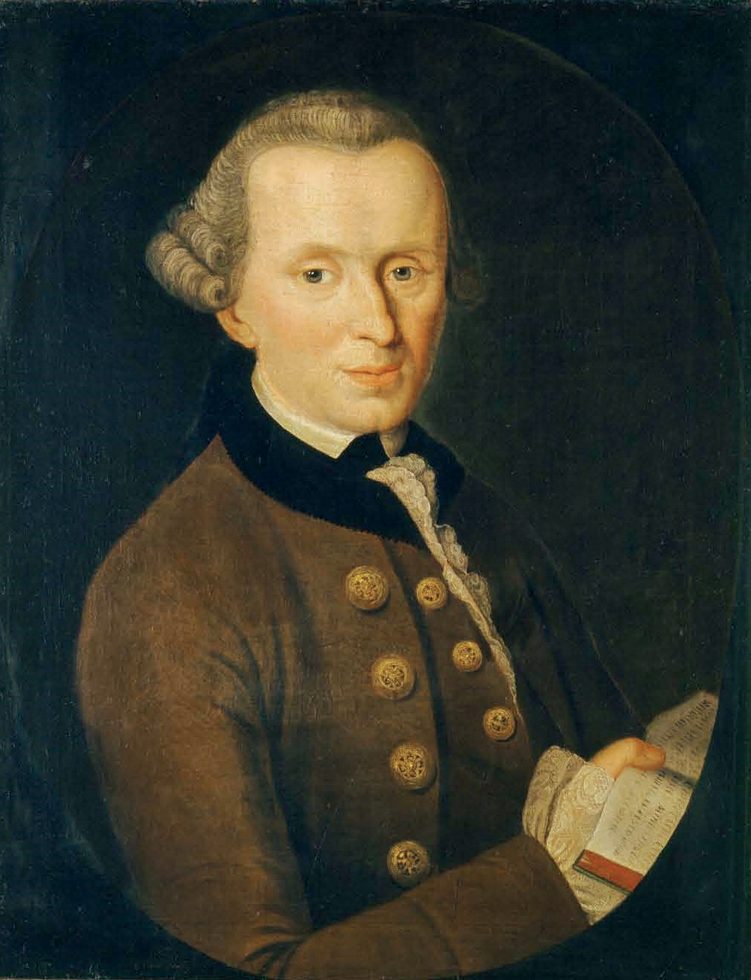
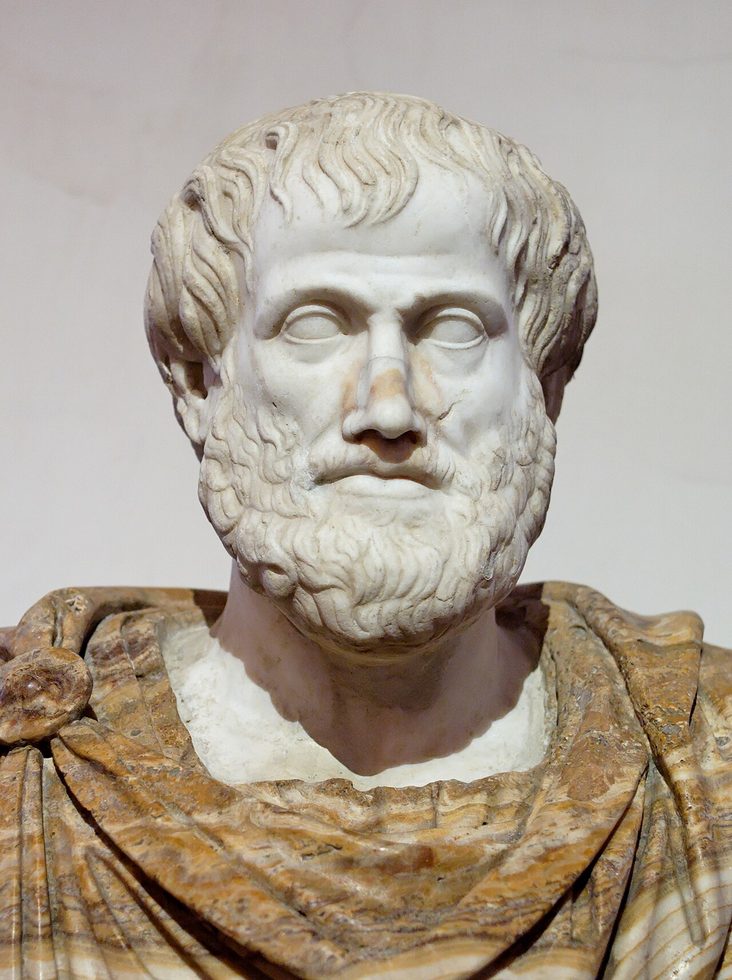
Aristotle decreed three. Kant tried a force law, then called it intuition.
Aristotle closes the question in On the Heavens: "the three dimensions are all that there are", and three is "the first number to which the term 'all' has been appropriated." That is a definition. In 1747 Kant dedicated his first book. It calls Leibniz's proof from three perpendicular lines circular, ties the number to the inverse-square law of force, and is "ready to reject" the idea when a riper judgment finds it weak. By 1783 the perpendicular lines are back in Kant's own argument, now resting "immediately on intuition." A word, a law, a mind: each hands the number to something else. This page hands it to what a record needs.
1833 · 1854 · GÖTTINGEN
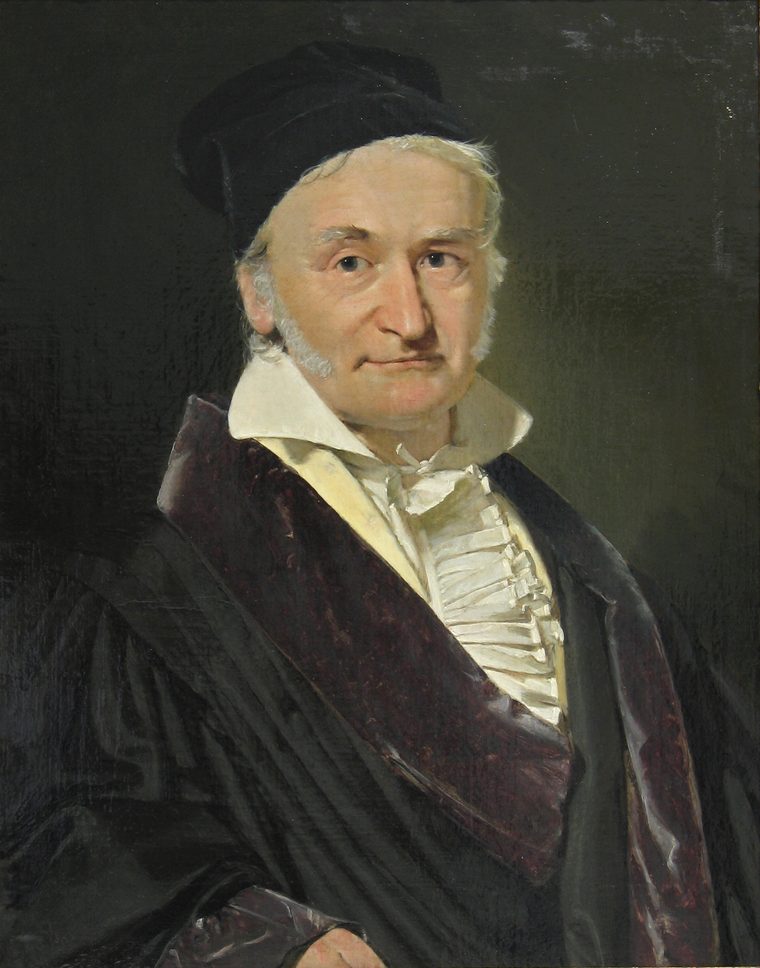
Gauss counted the hooks. Riemann let space close up.
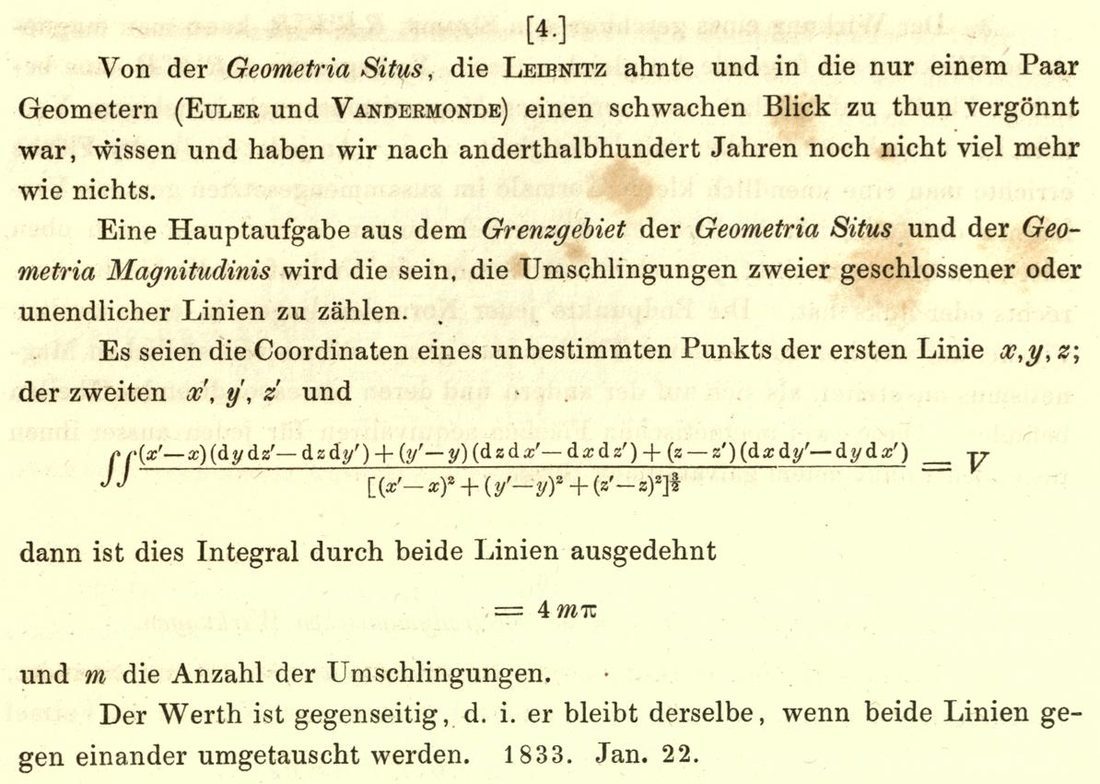
On 22 January 1833 Gauss wrote that of the geometry of position "we know and possess, after a century and a half, very little more than nothing", and named a main task: count how often two closed lines wind round each other. His integral gives 4π times a whole number, the same from either line, and a whole number can't change smoothly. It is the dial's hook count. On 10 June 1854, in the same town, Riemann called three dimensions "an assumption" and let space be finite without an edge. A balloon's skin is its two-dimensional picture. The argument starts from that shape: space closes up on itself, with no edge and no handles.
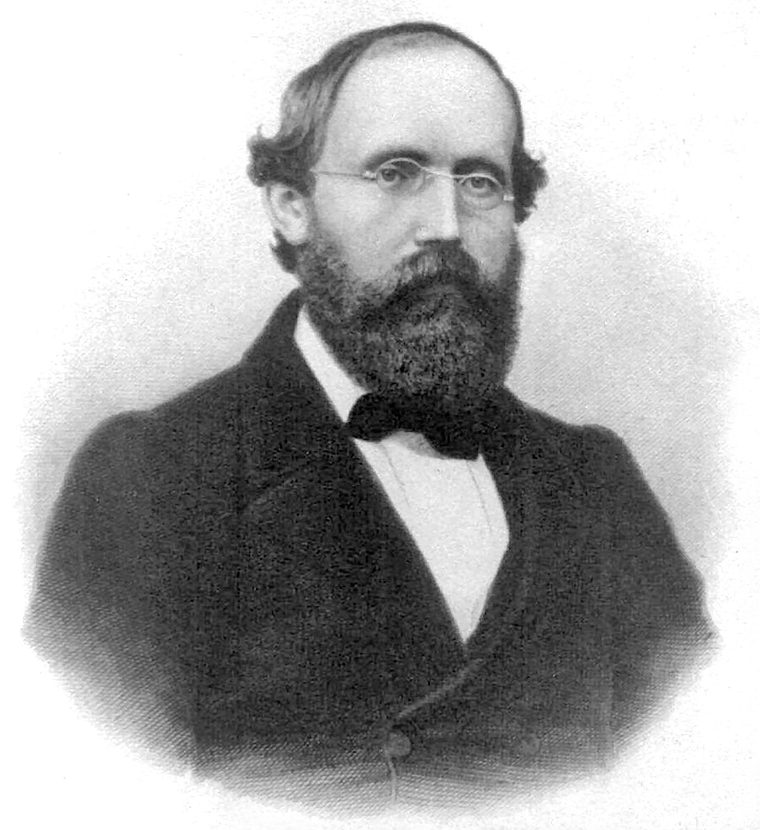
1867 · EDINBURGH · KELVIN AND TAIT
Kelvin wanted atoms that hold forever, and built them from linked rings
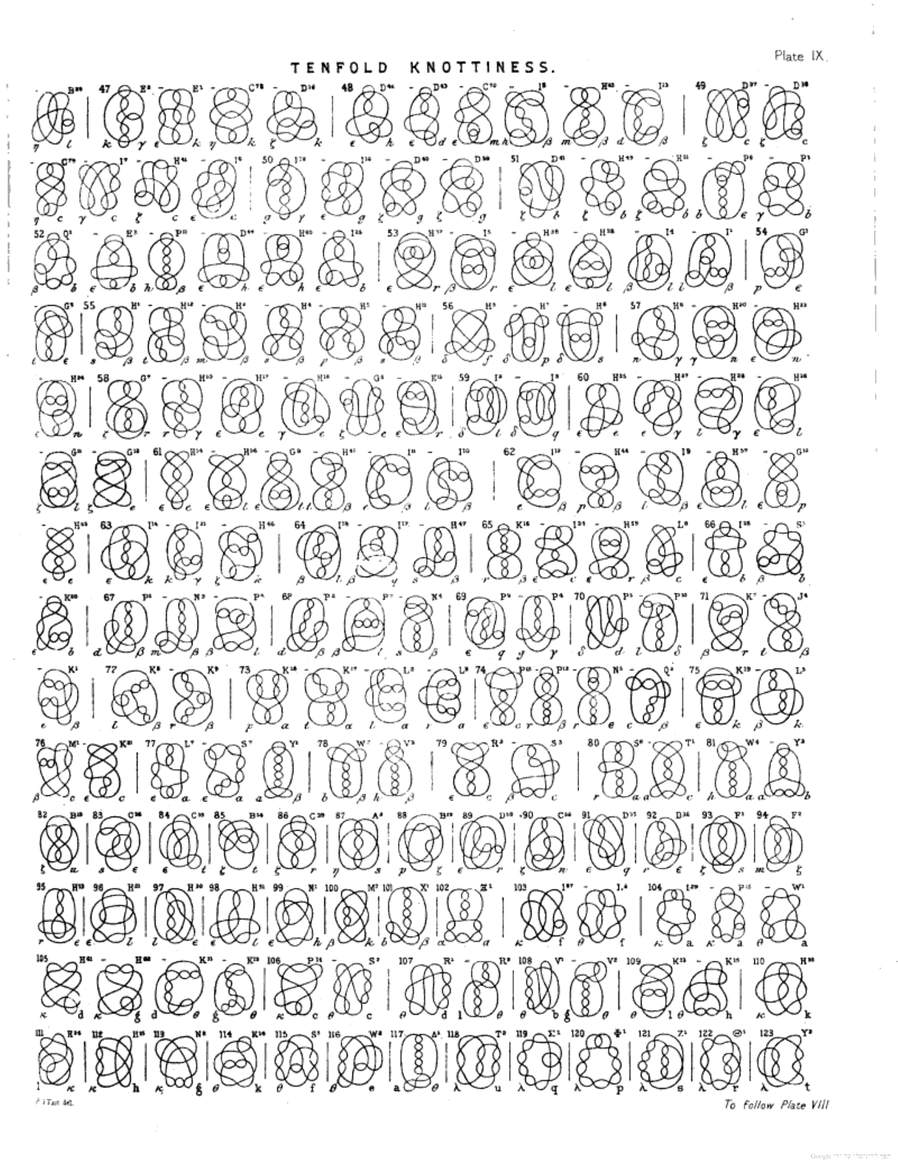
Early in 1867 Peter Tait showed William Thomson, later Lord Kelvin, a box with a hole in one side and a towel across the other. One blow on the towel fired a ring of smoke. Kelvin saw atoms: closed swirls in a frictionless fluid, with "an absolutely unalterable quality". Two rings linked together can't be undone however the fluid moves, he wrote, and he thought a sodium atom was "two approximately equal vortex rings passing through one another like two links in a chain". The atoms were wrong. Tait set out to list every knot by its crossings, and with the Reverend Thomas Kirkman he carried the tables to ten crossings. Kelvin wanted something that holds, made of loops that hook. A record's mark is exactly that.
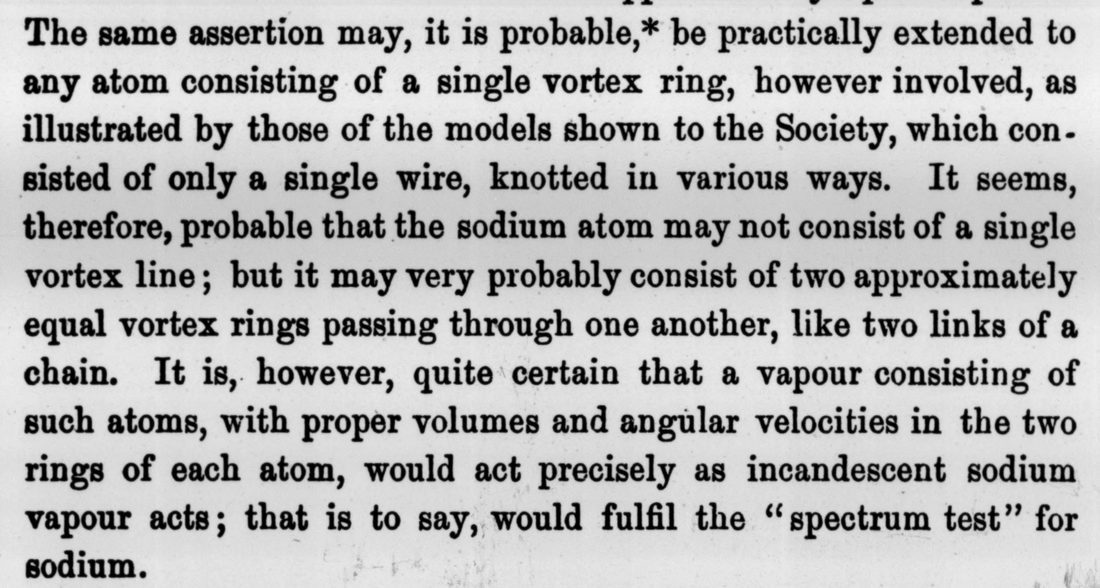
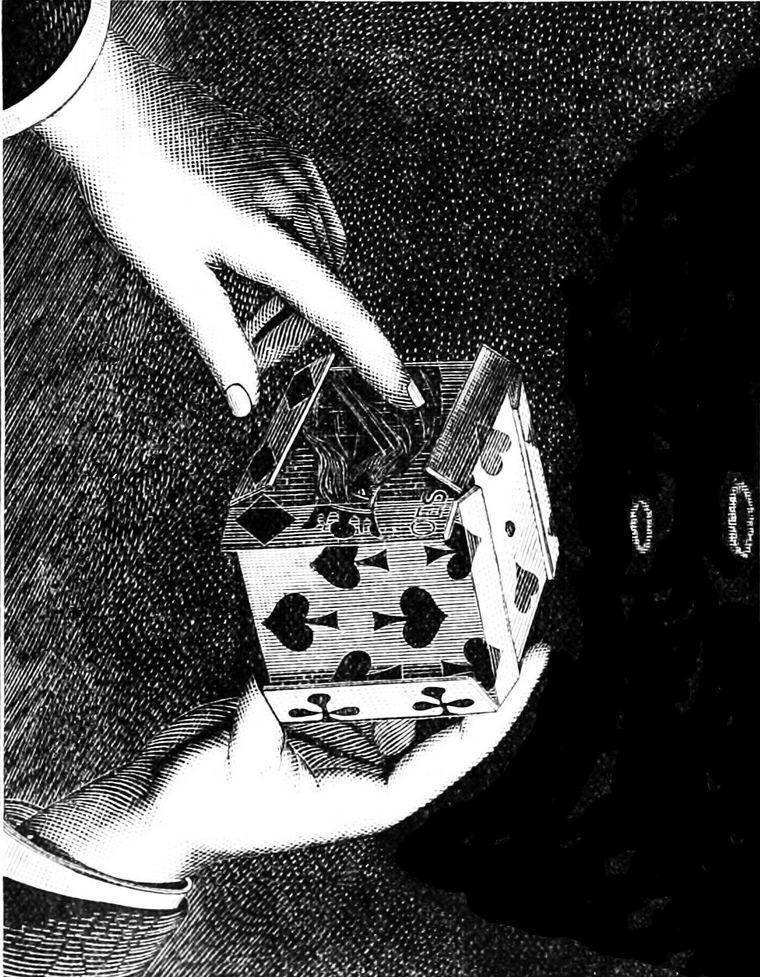
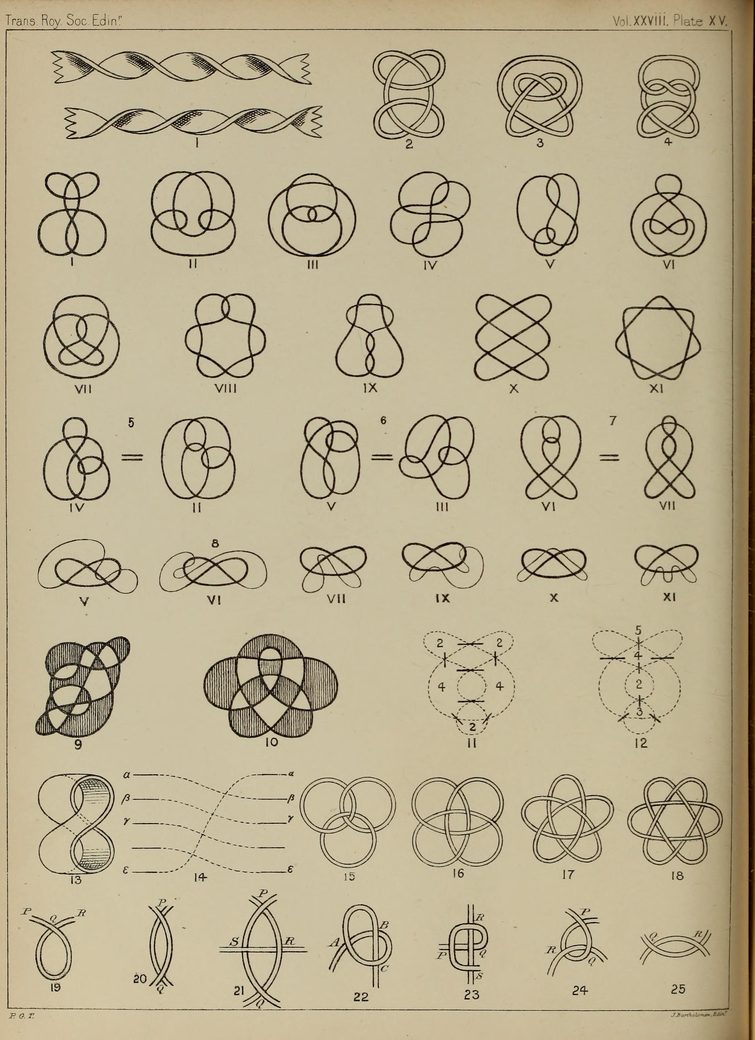
1877 – 1960 · EDINBURGH, LEIPZIG, LONDON
A sealed cord can knot only through a fourth direction, and a medium took the credit
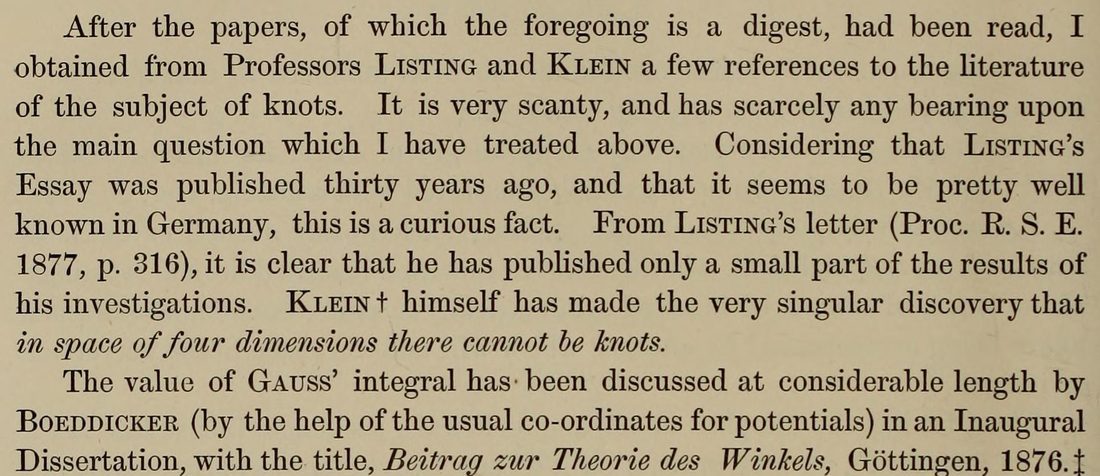
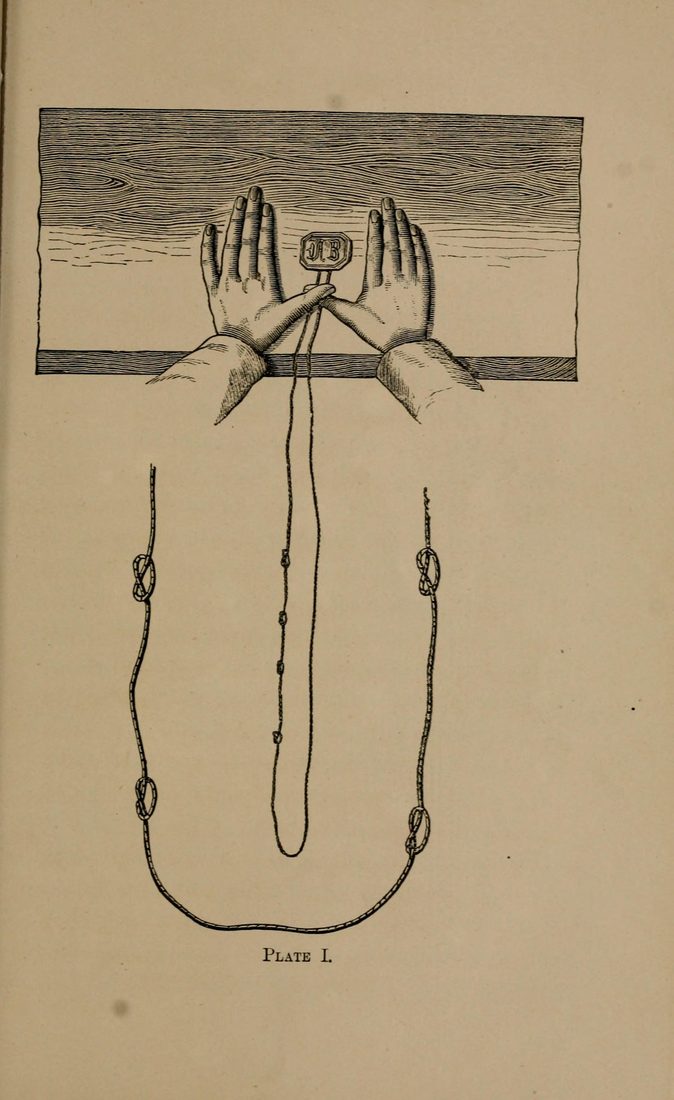
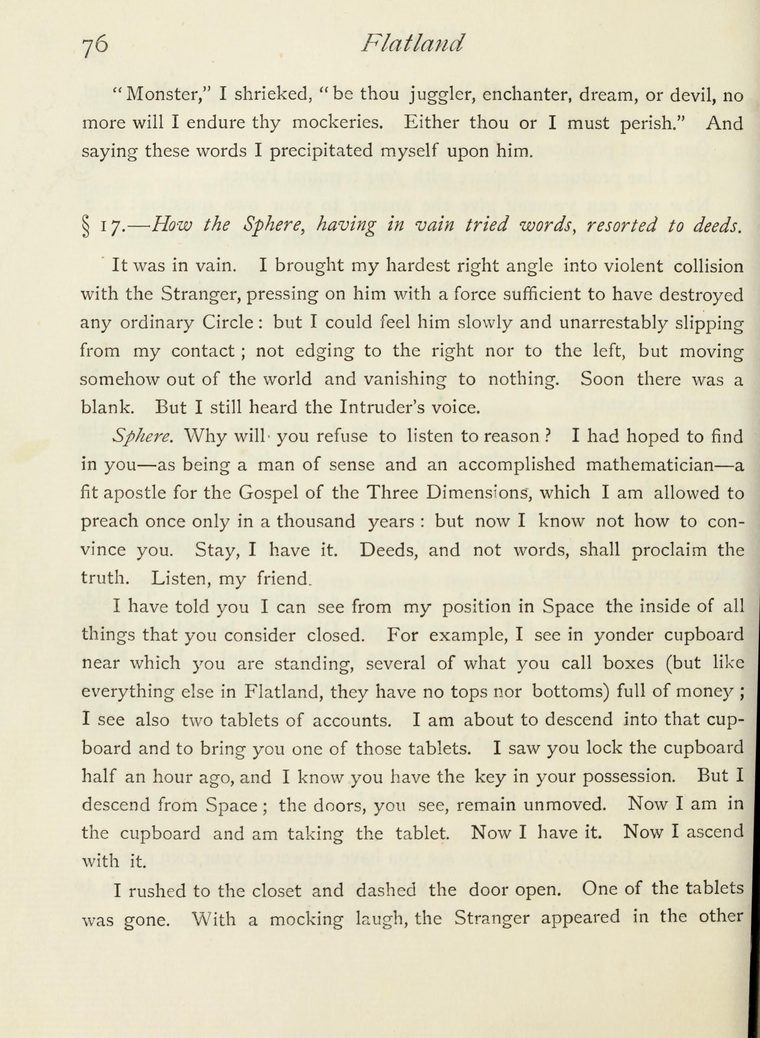
In 1877 Tait wrote that Felix Klein had shown there are no knots in four dimensions. That December in Leipzig the astrophysicist Friedrich Zöllner tied a cord's ends together, sealed the join with his own seal, and wrote that a being with four directions must be able to knot it without loosening the seal. With the American medium Henry Slade present, he wrote, the cord had four knots in minutes. His geometry was right and Slade was a fraud: a University of Pennsylvania commission found what it saw of him "fraudulent throughout" (1887). In Flatland (1884) a Sphere takes a tablet out of a locked cupboard: "the doors, you see, remain unmoved." Zeeman's 1960 unknotting result covers it: a loop can't stay knotted in four or more dimensions.
1877 – 1912 · BRAUNSCHWEIG, PARIS
Dimension is the number that survives every deformation
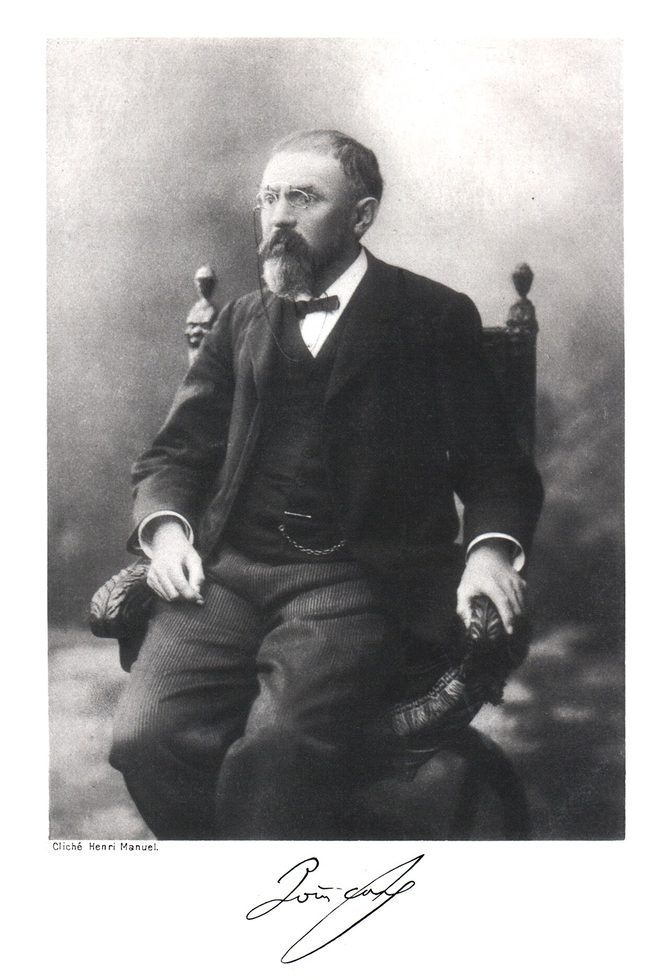
On 20 June 1877 Georg Cantor sent Richard Dedekind a proof that the points of a square match the points of a line, one to one. On the 29th, still waiting for the verdict, he wrote: "je le vois, mais je ne le crois pas." What does "two dimensions" count, then? Dedekind replied that he still held dimension to be "the first and most important invariant" of a continuous space, and Brouwer proved it in 1911. In 1912, the year he died, Poincaré asked why space has three dimensions. Apart from our instruments, he wrote, space is "amorphous": it keeps only what survives continuous deformation, and "its fundamental property, I was about to say its only property, is to be a continuum of three dimensions." A record's mark holds the same way: no smooth deformation undoes it.
1917 · LEIDEN
In four dimensions a planet falls into its sun or flies away
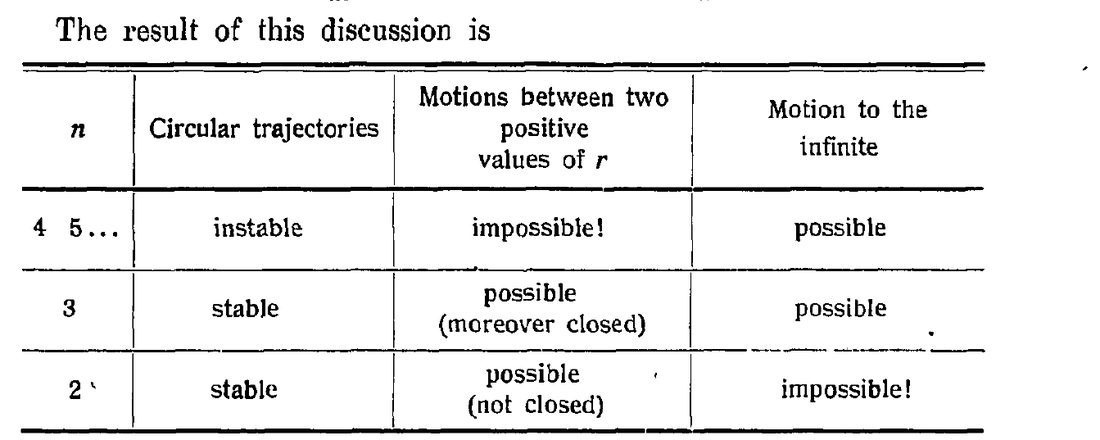
Paul Ehrenfest opened his 1917 paper, communicated by Lorentz to the Dutch Academy, by doubting the question: does space "exist"? Is it three-dimensional? "And then the question 'why'!" He answered with physics. Let gravity fall off as Gauss's law requires in each dimension, and follow a planet. In four or more dimensions it "falls on the attracting centre or flies away", in spirals. In two, orbits never close. Only in three do bound orbits close into ellipses while a body can still escape. So do the fields: the electric field has a number for each direction, the magnetic field one for each pair, and the counts match only at three. His reason is about motion. This page's is about records.
1922 · PRINCETON · ALEXANDER
Alexander's duality: only in three dimensions does a loop leave a hole to wind around
In 1922 James W. Alexander proved how a closed curve divides the space around it. In two dimensions it leaves two patches, and a loop in one patch shrinks to a dot. In three it leaves a hole, and a loop threaded through it can't be pulled out by any smooth motion. In four or more it leaves no such hole: one loop lifts over the other. That is the step under the answer. A mark and its reader are loops that no smooth motion can unhook, and such a pair exists in three dimensions and no other. Every step from the starting points is worked out. The loop result is in a preprint by Pardo-Guerra and Washburn (2026); it is not peer reviewed.
TWO REASONS, KEPT APART
The first, about loops, says why space has three directions. The second, about the cube, says what three can do that fewer can't, and counts with three rules it starts from: one yes/no per direction, one flip per step, a complete trip. Neither one proves the other.
1884 · 1888 · LONDON · ABBOTT AND HINTON
Three directions make a cube, and a cube makes eight
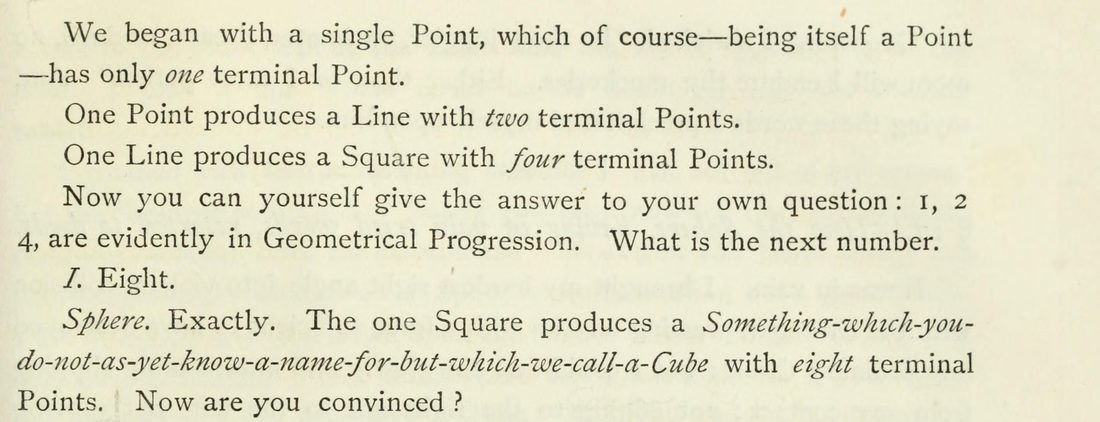
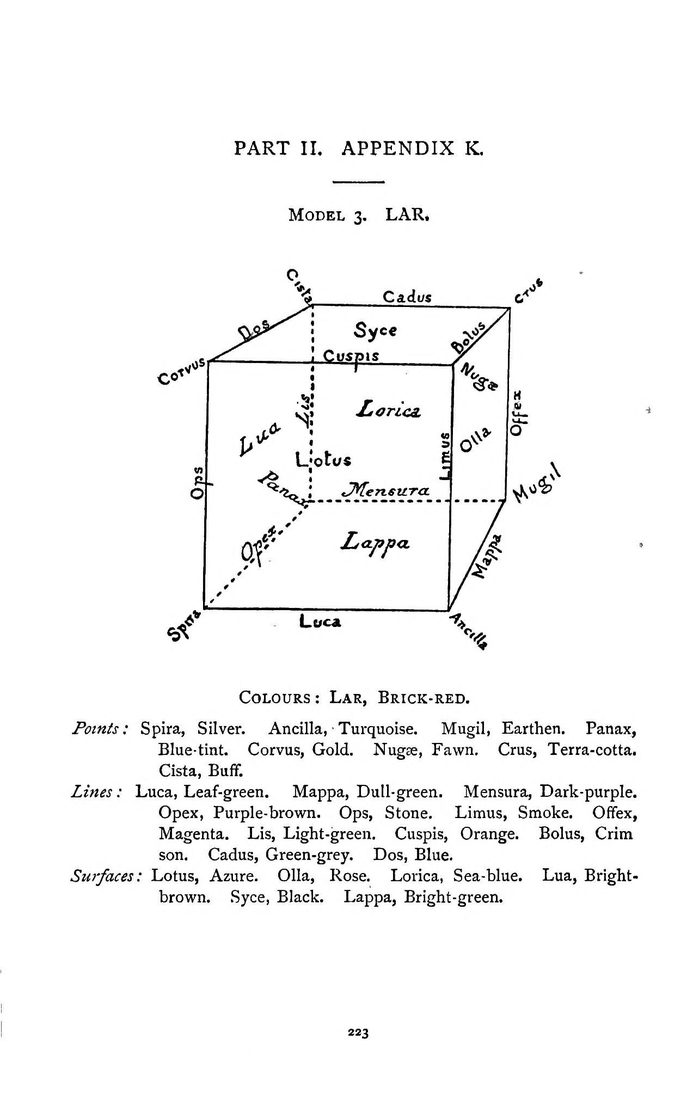
Give each direction one yes/no, the smallest distinction, and three directions make 2 × 2 × 2 = 8 combinations. Join combinations that differ by one answer and you have a cube: eight corners, twelve roads. In Flatland the Sphere walks the Square through the count: one terminal point for a point, two for a line, four for a square. The Sphere asks, "What is the next number?" and the Square answers, "Eight." In 1888 Charles Howard Hinton printed a cube with every point, line and surface named. A trip that flips one yes/no per step, touches every corner and comes home needs at least eight steps, and the cube has one of exactly eight. Why exactly eight, with none to spare, is not yet derived.
1843 · DUBLIN · HAMILTON
Order starts at three: Hamilton's triplets and a 14-step trip
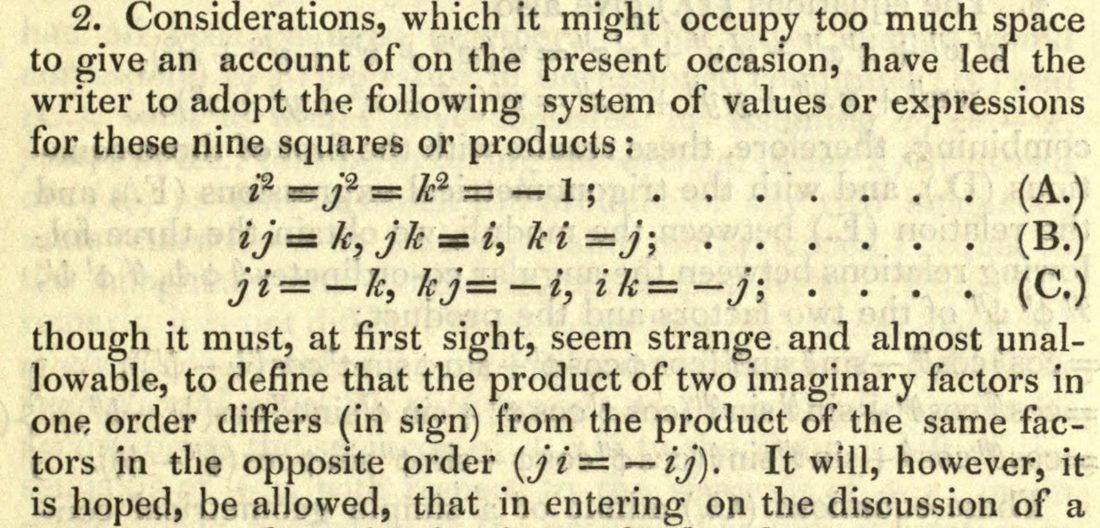
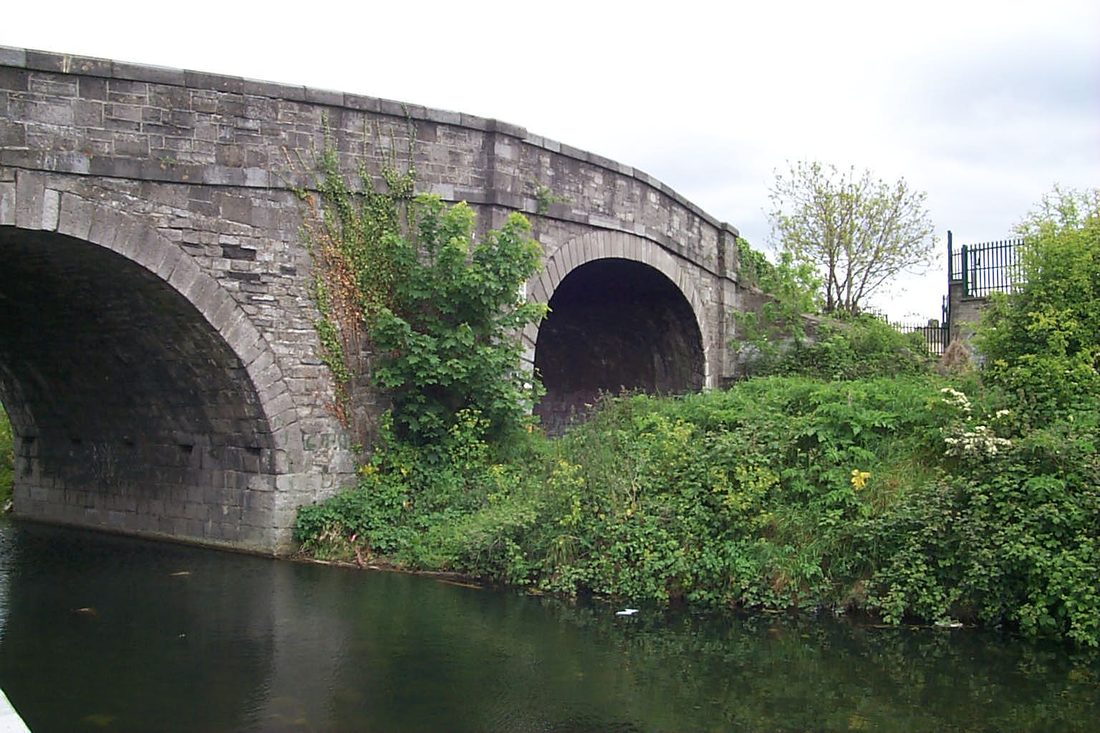
On 16 October 1843, beside the Royal Canal, Hamilton found how to multiply triplets. Next day he wrote to his friend John Graves that "we must admit, in some sense, a fourth dimension of space for the purpose of calculating with triplets", and that the order of multiplication "is not indifferent." With fewer than three directions a round trip can only say how many times round; with three it can say what came before what. A floor lap then a wall lap takes the same steps as wall then floor. A tally that adds can't tell them apart; the record, which writes each trip in order, can. Floor, wall, floor backwards, wall backwards: the tally reads 0 everywhere, yet the trip isn't nothing. It takes 14 steps. A computer checked all 196,592 shorter walks that don't double back: none does this. Its order reading is −2, and +2 backwards.
LIVETHE CUBE OF THREE YES/NO'S
Walk floor then wall, then wall then floor. The tally matches; the record doesn't.
Corners are three digits, 0 for no, 1 for yes. Click a neighbour, or press 1, 2 or 3 to flip.
STEPS0
CORNERS VISITED1/8
HOME✓
THE TALLY
Adds, so it forgets order.
THE RECORD
Lists the cyan roads crossed, in order.
ORDER READING
–Roads 1 and 2: twice the area the dot circles. Clockwise counts minus.
Each step flips one yes/no.
- road {n} back
- road {n} forward
- road {n}
- ✓
- ✗
- road 1
- road 2
- Each step flips one yes/no.
- Each step flips one yes/no.
- Each step flips one yes/no.
- Each step flips one yes/no.
- The 8-step cycle: every corner, then home.
- Floor, then wall. Tally: −1, +1, −1, 0, 0. Record: road 1 back, road 2 forward, road 3 back.
- Wall, then floor: same steps, same tally. The record reads road 2 forward, road 3 back, road 1 back.
- The 14-step trip: every number on the tally is 0, and the record still lists six lines. Order reading −2; backwards, +2.
1969 – 2013 · KNOTS COME BACK
Knots came back, and hooked loops still part only by a cut
The atoms failed and the knots stayed. In 1969 Keith Moffatt proved that in a frictionless fluid the linkage of vortex lines is conserved as they move with the fluid. In 1980 Liu, Liu and Alberts showed how enzymes unknot DNA: they break a double strand, pass a second strand through the break and seal it, the cut that parts hooked loops in three dimensions. Vaughan Jones found a new knot polynomial in 1985, and in 1989 Edward Witten explained it in three-dimensional terms, with quantum fields; both won Fields Medals in 1990. In 2013 Dustin Kleckner and William Irvine tied vortex knots in water and watched them untie by reconnection: a cut again.
SOURCES
- J. W. Alexander, "A proof and extension of the Jordan–Brouwer separation theorem," Trans. Amer. Math. Soc. 23 (1922) 333–349. doi 10.1090/S0002-9947-1922-1501206-6
- L. E. J. Brouwer, "Beweis der Invarianz der Dimensionenzahl," Math. Ann. 70 (1911) 161–165. doi 10.1007/BF01461154
- U. Stammbach, "Zur Entstehung der Mengenlehre II: Aus Briefen zwischen Richard Dedekind und Georg Cantor," Elem. Math. 73 (2018) 122–129. doi 10.4171/EM/361
- P. Ehrenfest, "Welche Rolle spielt die Dreidimensionalität des Raumes in den Grundgesetzen der Physik?" Ann. Phys. 61 (1920) 440–446. doi 10.1002/andp.19203660503
- B. Riemann, "On the hypotheses which lie at the bases of geometry," trans. W. K. Clifford, Nature 8 (1873) 14–17, 36–37. doi 10.1038/008014a0 and 10.1038/008036a0
- W. Thomson, "On vortex atoms," Phil. Mag. 34 (1867) 15–24. doi 10.1080/14786446708639836
- P. G. Tait, "On knots," Trans. Roy. Soc. Edinburgh 28 (1877) 145–190. doi 10.1017/S0080456800090633
- W. R. Hamilton, "On quaternions; or on a new system of imaginaries in Algebra" (letter to J. T. Graves, 17 October 1843), Phil. Mag. 25 (1844) 489–495. doi 10.1080/14786444408645047
- E. C. Zeeman, "Unknotting spheres," Ann. of Math. 72 (1960) 350–361. doi 10.2307/1970138
- H. Seifert, "Über das Geschlecht von Knoten," Math. Ann. 110 (1935) 571–592. doi 10.1007/BF01448044
- H. K. Moffatt, "The degree of knottedness of tangled vortex lines," J. Fluid Mech. 35 (1969) 117–129. doi 10.1017/S0022112069000991
- L. F. Liu, C. C. Liu and B. M. Alberts, "Type II DNA topoisomerases: enzymes that can unknot a topologically knotted DNA molecule via a reversible double-strand break," Cell 19 (1980) 697–707. doi 10.1016/S0092-8674(80)80046-8
- V. F. R. Jones, "A polynomial invariant for knots via von Neumann algebras," Bull. Amer. Math. Soc. 12 (1985) 103–111. doi 10.1090/S0273-0979-1985-15304-2
- E. Witten, "Quantum field theory and the Jones polynomial," Commun. Math. Phys. 121 (1989) 351–399. doi 10.1007/BF01217730
- D. Kleckner and W. T. M. Irvine, "Creation and dynamics of knotted vortices," Nature Phys. 9 (2013) 253–258. doi 10.1038/nphys2560
- S. Pardo-Guerra and J. Washburn, "Three Dimensions from a Recognition Requirement," Preprints.org (2026). Preprint; not peer reviewed.
Aristotle, On the Heavens I.1 · Kant, Gedanken von der wahren Schätzung der lebendigen Kräfte (1747) and Prolegomena (1783) · Gauss, Werke V · Poincaré, Rev. de métaphysique et de morale 20 (1912) · Zöllner, Transcendental Physics · Seybert Commission, Preliminary Report (1887) · Abbott, Flatland · Hinton, A New Era of Thought
Three directions: the one size of space where a loop can hold a loop, and the first size of cube with room for order.